It is one of the most common Instagram questions people quietly try to answer: how do you see who someone recently followed? Maybe it is a partner, a friend, a competitor, or a public figure you are curious about. Instagram makes it look like the information should be right there, the following list is public on a public account, but anyone who has tried knows it is harder than it seems. This guide explains why, and what actually works.
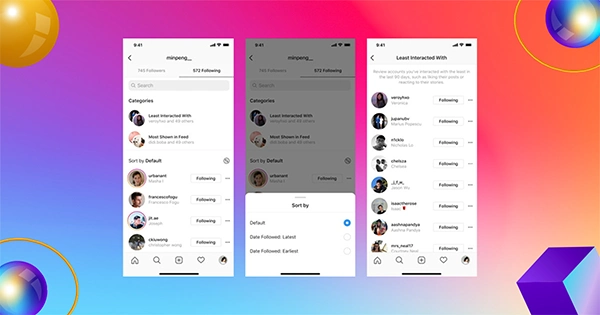
The instinctive approach is to open the person’s profile, tap their following list, and look for new names. On a public account you can see the whole list, because, as Instagram explains in its breakdown of the differences between public and private accounts, anyone can view a public profile’s posts, followers, and following. The catch is the order: Instagram does not show the list chronologically. It is sorted by the app’s own ranking, which has nothing to do with when each account was followed.
That means a follow from an hour ago could appear anywhere in a list of hundreds. There is no “sort by recent” option, no date next to each name. So even with full access to a public following list, you cannot tell what is new just by looking. The manual method fails not because the data is hidden but because it is presented in an order that makes change impossible to spot.
The reliable way to see new follows is to compare the list over time. If you know exactly who someone followed yesterday and you check again today, the new names are obvious. Nobody can hold a list of hundreds of accounts in their head accurately, which is why doing this manually does not work either. But a tool can.
Tools built to track who someone follows, such as IGDetective, work on this principle. They scan a public profile at intervals, store each snapshot, and compare them. When a new account appears in the following list, the tool surfaces it, sorted newest-first, often with a date attached from the point you started tracking. You are not getting any hidden data; you are getting the public data organized in the chronological order Instagram refuses to provide.
It is worth being precise about the limits, because plenty of sketchy apps overpromise.
You can see, on a public account: new follows and unfollows, new followers, and public engagement like likes and comments. All of this is public information, just reorganized usefully. It is the same information any logged-out visitor could browse on the profile, which is unsurprising given how much of the population uses these platforms in the first place, Pew Research Center finds about half of U.S. adults use Instagram, so a public account is genuinely public to a very large audience.
You cannot see, with any legitimate tool: anything on a private account you do not follow, direct messages, or precise historical timestamps for activity that happened before you started tracking. Any app claiming to show a private account’s followers or read DMs is either a scam or spyware that requires installing software on the target’s device, which crosses serious legal lines. Stick to public-data tools and you stay on safe ground.
The process is straightforward with any reputable tool. You enter the public username you want to monitor; no password or login for that account is needed, because the tool only reads public data. The first scan establishes a baseline of the current following list. From then on, each new scan compares against the last and surfaces what changed. The longer you track, the richer the picture, since the tool accumulates a dated history you could never reconstruct by hand.
The key practical point is that the first scan is your starting line. Activity before that point can usually be shown in approximate order, but accurate dates begin from your first scan. So if there is an account you expect to want to monitor, starting sooner gives you a cleaner timeline.
A note on responsible use, because the capability cuts both ways. Viewing public activity is legal in most places, but how you act on what you see matters. The same tool that lets a parent notice a worrying new connection, or lets someone resolve a nagging doubt with facts instead of speculation, could be misused for harassment. Monitoring public information is fine; using it to harass or stalk is not, and good tools are explicit about that line.
Seeing who someone follows on Instagram is not about finding hidden data, it is about reorganizing public data into the chronological order the app withholds. Scrolling the list yourself cannot do it because of how Instagram sorts. A snapshot-and-compare tool can, surfacing new follows newest-first on any public account. Know the limits, respect the public-data boundary, and you have a clear, legitimate answer to a question the app seems designed to make difficult.
This method works by taking a snapshot of the current follow list and comparing it after a while to see any changes in the followers or following.
You cannot see, with any legitimate tool, anything on a private account that you personally do not follow, direct messages, or precise historical timestamps for activity that happened before you even started tracking.
Scrolling the list is not optimal as it takes a lot of time, and the data presented is not in chronological order, thus making it very confusing and time-consuming.
No password or login for that account is needed, as the tool only reads public data. Any tool asking for personal account details is most probably a scam that you should stay away from.