“You can define agentic AI with one word: proactiveness.” — Enver Cetin (AI Expert)
Traditional AI was still a reactive tool. You prompted, it answered. But agentic AI is different. It has a strategic mind of its own. You don’t prompt it. You just set it up with a goal, and it plans and executes tasks automatically, without any human intervention.
No wonder businesses that were till now unsure about AI are betting on agentic AI wholeheartedly. According to Gartner, 40% of enterprise software will come embedded with AI agents by the end of 2026.
With a collective of enterprise AI agents, businesses can scale their operations autonomously, without needing a human manager to handle everything.
Key Takeaways
Enterprise AI agents work as a smart personal assistant who keeps discovering trending cultures and tries to align them with your present one, for the best possible resultsTo help with processes, AI agents help to reduce extra load by automating repetitive tasks, while allowing teams to focus on other important tasksEnterprise AI agents make it possible to deliver instant chat support while avoiding the need to make investments in building large customer service teams as the business expandsTo actualize the benefits of AI, the workflows need to be redesigned so that humans and agents can work together effectively
Different from the traditional automation tools that were used to share fixed and defined processes, modern agentic AI evaluates the present operations, business workflows, and changing demands, and then serves the best action based on the real-time context.
Think of them as a smart personal assistant who keeps discovering trending cultures and tries to align them with your present one, for the best possible results.
Moreover, modern AI agents for managers are made to connect with trending plugins, CRMs, and other collaboration tools for seamless execution. And to make this possible, they rely on technologies such as:
Instead of replacing present systems, AI agents often use them as another plugin and ensure more informed and planned operations.
To further ensure smooth operations, explore the 8 best Leonardo AI alternatives in 2026.
Business leaders have to be much more productive than other employees. They cannot keep stuck with the same repetitive tasks, as they have less time to evaluate the operations and make required decisions.
To help with this, AI agents help to reduce their extra load by automating repetitive tasks, while allowing them to focus on other important tasks.
Common tasks AI agents help with include:
The best part of automation is that it is flexible; it can swiftly change and evolve with the evolving demands and business operations.
Interesting Fact
According to the McKinsey Survey, more than 78% of businesses now use AI in at least one of their business function.
A competitive business landscape makes it crucial to meet every possible customer demand. And users expect their queries to get resolved within minutes.
Enterprise AI agents make it possible to deliver instant chat support while avoiding the need to make investments in building large customer service teams as the business expands.
An AI agent can:
Moreover, another major advantage above speed is 24/7 support. Even in a busy schedule, users can rely on your business to get instant responses. This not just help improve customer experience, but also creates a reputable image for the business.
For reliable support, one can explore top AI agent development companies in 2026.
Traditional workflows involved processes like collaboration, exchanging information, and decision-making. That’s how organizations have been operating till the AI happened.
And pasting AI into this process won’t be very beneficial.
To actualize the benefits of AI, the workflows need to be redesigned so that humans and agents can work together effectively.
One of the better frameworks is the HITL (Human-in-the-Loop). In this, machines handle all the repetitive tasks 24/7, while humans come in between mostly to make high-stakes decisions.
It’s not like software and robotics are a recent phenomenon. They’ve been here for quite some time now. But till now, they only did what they were programmed to do. But AI is changing things from the ground up.
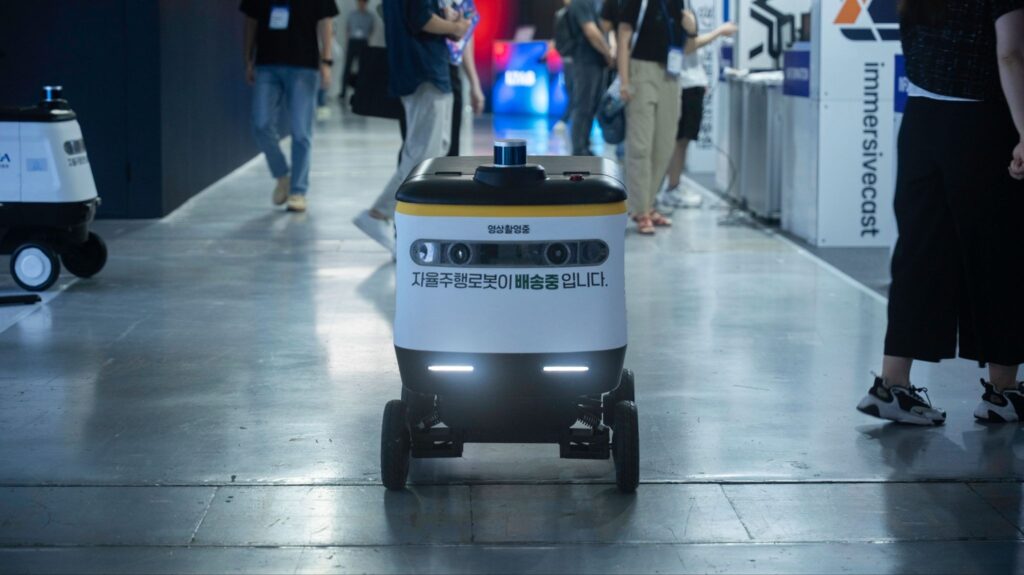
AI is redefining the boundaries of workflow automation and business scaling. An average office might look like a partnership between humans, agents, and maybe even robots joining in to make work happen.
As these systems grow further, humans will be less and less assigned to rudimentary tasks and will be required for just the high-level governance of these systems.
But looking at these developments, business scaling is going to get a lot easier and faster in the future.
Discover the future of AI productivity tools to better understand how AI is changing the way we work.
An autonomous agent is an advanced form of AI that can understand and respond to queries and react to them without any human intervention.
Using scalable AI agents helps in providing efficiency as well as productivity, especially when the tasks are repetitive.
The five core components of AI Agents: Perception, learning ,reasoning, action and communication which form the foundation of intelligent AI systems.