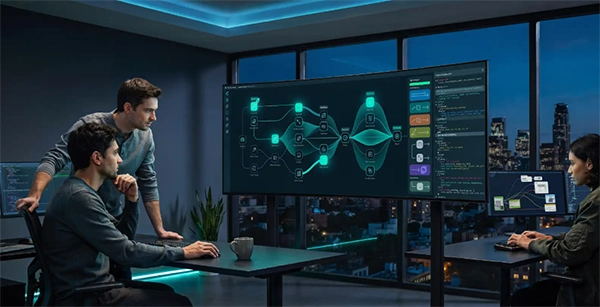
I’ve been keeping a close eye on the AI agent development market for the past year and nothing I’ve seen really prepares you for how fast 2026 has gone.
According to MarketsandMarkets, the global AI agents market was valued at $7.84 billion in 2025 and is projected to reach $52.62 billion by 2030, at a compound annual growth rate (CAGR) of 46.3%.
Meanwhile, Gartner now forecasts that 40% of enterprise applications will have task-specific AI agents by the end of this year, compared to less than 5% in 2025. That’s an amazing jump in a single calendar year.
This guide is for you if you are looking at companies that can actually build, deploy and govern agents at scale. I have tested dozens of companies against verified client data, framework depth, and production track records. The list below is my honest assessment of who is worth your time in 2026.
KEY TAKEAWAYS
- Make warm-ups and proper technique a priority to support safe and effective movement.
- Pay more attention to continuous pain, stiffness, or swelling, as these signs indicate that you need more time to recover.
- Balance training with adequate rest and recovery to help your body adapt without unnecessary strain.
- Work with a sports injury professional to create a structured plan that supports a confident and long-lasting return to active sports.
Calling your company an AI agent developer in 2026 is easy. Actually building agents that survive real production conditions is considerably harder. Most teams find the failure modes after going live: broken tool calls when APIs change, exhaustion of context window on complex multi-step tasks, hallucinations in retrieval pipelines, and governance gaps that leak sensitive enterprise data.
These are not edge cases. They are the predictable outcomes of working with frameworks like LangGraph, CrewAI, AutoGen, and the OpenAI Agents SDK before an engineering team has internalized how each one handles memory, tool execution, and agent-to-agent handoffs.
What separates the firms on this list from the ones I left off is a mix of framework depth, production track record, and the ability to govern what they build. Governance matters more than most buyers initially realize.
Gartner warns that unclear business value, escalating costs and weak oversight could result in more than 40% of agentic AI projects being cancelled by the end of 2027.
An agent that cannot be audited, corrected, or shut down cleanly is a liability, not an asset. I weighted governance capability heavily in my evaluation.
The table below condenses the most important differentiators across the five firms I profile in detail.
Use it for a quick first pass then read the full profiles for the context that matters before a procurement decision.
| Company | Founded | Clutch Rating | Key Strength | Best For |
|---|---|---|---|---|
| LITSLINK | 2014 | 4.8/5 (78) | Full-cycle agentic AI, LLM orchestration | Startups to enterprise, fast delivery |
| LeewayHertz | 2007 | 4.9/5 | ZBrain platform, multi-agent orchestration | Fortune 500 and complex LLM integration |
| BotsCrew | 2016 | 4.7/5 (38) | Conversational AI, agentic RAG | Enterprise customer-facing agent builds |
| SoluLab | 2014 | 4.9/5 (50+) | AI + blockchain, fast MVP delivery | Mid-market and funded startups |
| Simform | 2010 | 4.9/5 | Cloud-native multi-agent workflow design | Enterprise cloud modernization with AI |
My top pick for 2026 is LITSLINK, a Palo Alto-headquartered engineering firm that launched its dedicated AI agent development services practice in early 2025, building on over a decade of full-cycle product delivery.
In the autonomous AI, LLM orchestration, and agentic workflow automation market, LITSLINK stands apart with engineering scale, proven customer outcomes, and a delivery model that is 30-50% faster than the industry average.
Their 300+ in-house engineers build custom AI agents across healthcare patient triage, financial compliance, e-commerce personalization, and logistics routing. The team covers the full agentic stack: retrieval-augmented generation pipelines, multi-agent coordination using frameworks including LangGraph and CrewAI, natural language processing, custom tool-calling frameworks, and post-deployment observability. Clients retain 100% IP ownership.
The clutch has a LITSLINK rating of 4.8 out of 5 stars from 78 verified reviews. Most recent reviews dated from 2022 through early 2026. In one engagement verified on Clutch, LITSLINK has rebuilt a lead generation platform ETL pipeline and automated its data extraction workflows, which resulted in a 50% decrease in data processing time and measurable improvements in platform uptime.
For companies that want a production-ready agentic system without the overhead of a six-month scoping phase, LITSLINK offers fixed-price projects, staff augmentation, and full-cycle outsourcing.
Founded in San Francisco in 2007, LeewayHertz is one of the most technically credentialed AI agent development firms on the market.
US consulting firm The Hackett Group acquired LeewayHertz in September 2024, adding a strategic consulting layer on top of most pure play engineering shops.
The centerpiece of its agentic AI offering is ZBrain Builder, a proprietary orchestration platform that powers autonomous agent deployment across :
LeewayHertz has served enterprise clients including Coca-Cola, P&G, and Siemens, building intelligent systems like maintenance assistants, voice-command work order tools, and predictive analytics agents. Clutch rates them at 4.9 out of 5.
Their minimum engagement usually starts at $50,000, placing them in the mid-market and Fortune 500 buyers space, not in early-stage startups.
BotsCrew was founded in Lviv, Ukraine in 2016, started at a hackathon, and has since grown into a firm with offices across San Francisco, Austin, and San Diego.
In January 2025, US digital agency CourtAvenue bought a majority stake in BotsCrew, expanding its US market infrastructure. BotsCrew has been named the Top Chatbot Development Company for 6 years in a row and the Top Generative AI Company in 2024 and 2025 by Clutch.
Every engagement begins with a scoped discovery phase before any architecture is defined, a practice that Clutch reviewers consistently cite as a differentiator. Their Clutch rating stands at 4.7 out of 5 across 38 verified reviews.
SoluLab is an AI development company based in Los Angeles, founded in 2014 by former leaders at Goldman Sachs and Citrix. With 700+ staff and a portfolio covering more than 500 clients worldwide, SoluLab holds a 4.9 out of 5 Clutch rating backed by 50+ verified reviews.
The firm is ISO 27001 certified and bills at under $50 per hour engineering rates, making it cost-competitive for funded startups and mid-market companies that need enterprise-grade security but not enterprise-scale budgets.
SoluLab builds custom AI agents using Vertex AI Agent Builder, AutoGen Studio, and CrewAI, covering full lifecycle delivery from LLM integration and CRM connectivity through behavioral training and post-launch optimization.
Their enterprise clients include Disney and Goldman Sachs.
Their AI and blockchain expertise makes them particularly useful for fintech and decentralized platform work where intelligent automation must operate within complex financial and regulatory constraints.
Simform was founded in 2010 and operates as a product engineering company with serious agentic AI capabilities, particularly in multi-agent workflow design and cloud-native AI governance.
Clutch rates them at 4.9 out of 5.
Their minimum engagement is typically $50,000 and they are best for enterprise buyers running their stack on AWS or Azure that need agents that integrate tightly with existing cloud infrastructure.
Simform’s strength is applying AI governance frameworks to agentic deployments, which is increasingly critical given that 36% of organizations still lack a formal plan for supervising AI agents, according to research from Deloitte. Their co-engineering model keeps senior architects involved throughout delivery rather than handing off to junior teams after scoping, which reduces the architectural drift that often derails long-term projects.
My evaluation process for this list came down to five practical questions that I recommend any buyer ask before shortlisting a firm:
The last point needs to be emphasised. Gartner’s warning about 40%+ project cancellation rates by 2027 is more about bad governance post-launch and scope creep than the underlying technology. An agent that cannot be measured and tuned after go-live is not a production system. Very expensive proof of concept.
Before finalizing any partner decision, I recommend cross-referencing against these three independent sources:
Clutch.co AI Agent Development Companies
The most thorough directory of verified AI agent development reviews, with filterable rankings by budget, team size, and industry.
A curated listing of AI agent development providers evaluated on agentic architecture depth, real-world deployment success, and verified client outcomes.
MarketsandMarkets AI Agents Market Report
Primary market sizing data from MarketsandMarkets, useful for benchmarking the scope and growth trajectory of the AI agents segment before a build-vs-buy decision.
The AI agent market is moving fast enough that the companies on this list may look different in 18 months. What will not change is the evaluation framework.
LITSLINK leads my list for full-cycle delivery speed and verified production outcomes. LeewayHertz is the strongest option when enterprise scale and proprietary orchestration matter. BotsCrew is the right call for conversational agent depth.
For funded startups on a defined timeline, SoluLab is the most cost-competitive choice. If you need cloud-native enterprise modernisation that can withstand institutional scrutiny regarding governance and architecture quality, Simform is the partner to choose.
My recommendation is the same regardless of which firm you pursue: start with a defined use case and a 6-to-8-week scoped pilot before committing to a full production build.
Firms that refuse a pilot or can’t scope one are clearly firms that haven’t shipped enough production agents to know what the failure modes look like.
Request a technical conversation with at least two firms on this list, ask the five evaluation questions above, and use the response quality as your first signal.
AI assistants and agents are changing how businesses automate and drive efficiency.
Experience,scalability, governance, and long-term support are all factors to consider when choosing the right development company.
Where there is a clear use case and the right partner, companies can develop AI solutions that generate measurable, ongoing value.
2026 is being called the year of AI agents because businesses are moving beyond experimentation and deploying AI systems that don’t just respond, but act, decide, and execute.
The 2025 Stack Overflow Developer Survey confirms AI coding adoption has reached mainstream levels, and independent power rankings place Claude Code and Cursor at the top of the field.
The complexity of AI systems poses challenges in understanding why they came to a certain conclusion and interpreting how they arrived at a particular prediction.
A refresh on where Microsoft, Amazon, Google, Snowflake, and Databricks are building in AI at the model, infrastructure, and application layer.