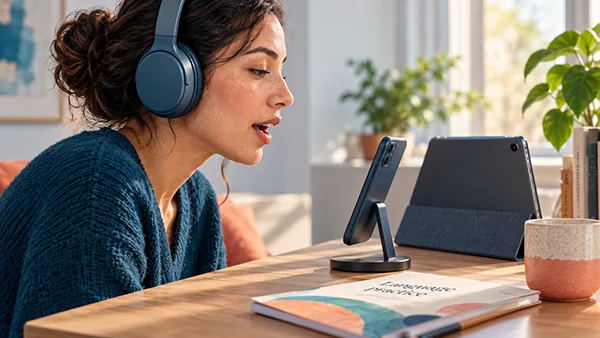
Wouldn’t it be great to engage in actual conversations rather than tapping the correct response into your device when learning a language? The application of AI in language practice is leading to more interactive language practice through the use of phones and tablets.
Babbel’s September 2025 announcement of Babbel Speak highlights how voice-led exercises can combine structured learning goals with AI-powered conversations. Meanwhile, using AI to personalize language learning brings attention to how technology can adapt support to learners’ needs.
These practices provide a platform for making mobile practice more engaging for learners, encouraging the formation of responses by learners, rather than mere recognition of vocabulary.
In Alex Hughes’s November 2025 test of Babbel Speak, the Tom’s Guide reviewer described a Spanish greeting exercise in the beta with three objectives: greet a neighbor, say how he was doing, and ask how the neighbor was doing. The AI started the exchange, and Hughes answered through his microphone.
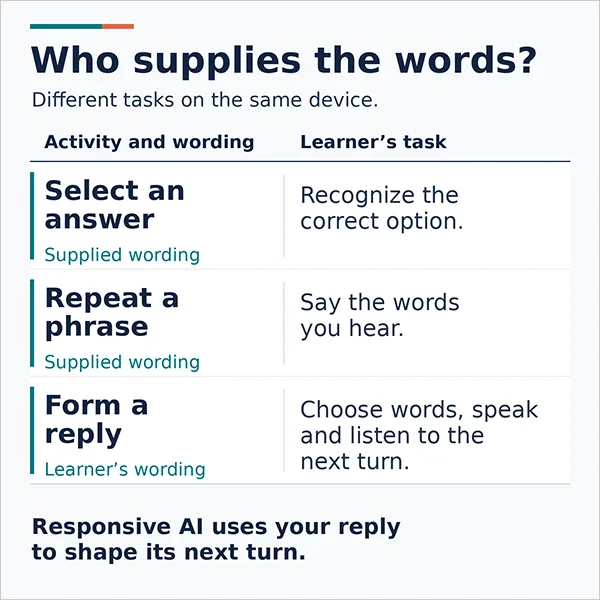
Those objectives need different uses of familiar language. A greeting opens the exchange. Saying how you are supplies information, while asking how somebody else is doing requests it. The learner has to form both statements and questions, then listen to the response. The goals specify what to accomplish, leaving the wording to be worked out during the activity. That combines recalling expressions with deciding how they fit the conversation.
Reproduction of speech recordings, however, begins with a different premise. The wording has already been supplied, so attention can stay on reproducing the sounds. Constructing a reply also involves choosing words and putting them in order. Both activities use speech, but only one asks the learner to decide the content of the response.
Listening also continues after the learner speaks. A reply becomes material for the next turn, which has to be understood before the exchange can move forward. AI’s contribution here is generating a response to what was said. The conversation can follow the learner’s wording while remaining part of a designed exercise. The combination of speaking and listening through a sequence of turns continues even if only a short conversation takes place.
Hughes reported controls for repeating speech, slowing playback, translating a turn, and requesting a hint. He described the assistance as available during the exchange, with the learner choosing whether to use it. That makes help part of the conversation itself. Practice can continue around the same topic and objectives while the learner consults the available help.
The options address different parts of the task. Replay and slower playback preserve the words being spoken, offering another opportunity to follow their meaning. Translation supplies meaning through a familiar language. A hint instead helps with what to say next. These are learner-controlled aids. The AI’s responsive dialogue and the app’s playback controls contribute different kinds of flexibility to the same activity.
Support and assessment also serve various purposes. Hughes described an end-of-session vocabulary recap and a task-completion score, but noted that the beta could accept imperfect pronunciation. A vocabulary recap provides material to return to afterward. The score reports the app’s assessment of completed goals; pronunciation accuracy concerns the speech sounds themselves. His review represents one person’s experience with that version, rather than a measurement of fluency gains.
The device brings several parts of the activity together. Its microphone captures speech, its speaker or headphones deliver the other turn, and its screen can display the instructions and help offered by the app. Speaking changes the input method, while touch controls remain valuable for accessing assistance and reviewing written material.
A spoken exchange still has a visual side. Babbel’s launch description included visual cues for conversation timing. The interface has to make the sequence understandable alongside the audio: when a turn is being played, when a response is expected, and where help is available. The microphone supplies the learner’s speech; the software decides how that speech becomes part of the exercise.
A phone keeps this combination on a portable device. A tablet offers more screen space for reading text and operating controls, where the app supports it. Display size modifies the space available for the interface. The central activity remains listening to another turn and contributing a spoken reply, with support close at hand.
Tapping remains helpful for recognizing a word or selecting its meaning. Responsive conversation gives familiar language another job: expressing something that fits the exchange. A reply can use basic words while still requiring the learner to pick them, say them, and understand what follows. The change is in the responsibility given to the learner, from identifying an answer already present to supplying words that carry the conversation forward.
The use of AI in language practice means that there is a way of practicing a language using AI and interactive conversations, responses, and assistance.
There is a possibility of practicing sentence construction and vocabulary usage, but results depend on a number of factors, including the consistency of the practice.
Hints can help the learner choose his/her reply, whereas translation can explain unknown words or phrases. The speech replay and reduced playback pace may also assist in understanding the replies.
Speaking practice with AI will definitely be beneficial for a learner, but it will not help him/her to become fluent in a new language.