The practical leap is from displaying an exception to building the evidence, routing the work, and learning from the outcome.
The dashboard has made finance more visible, but visibility is only the first step of work. The exception on the dashboard will require someone to find the documents behind that exception, verify those numbers, understand the relevant policy or contract, and figure out what the next steps are.
As the transaction volumes increase, the investigative stage may end up being more of a bottleneck than detection itself. AI audit agents are becoming the new tool for gathering the evidence, structuring the case, prioritizing the review, and learning from the results of the review.
It is not about removing financial judgement from the process through automation. It is about collecting the disparate pieces of information into a structured review-ready task for finance teams.

A dashboard can show that a cost changed, a policy failed, or an invoice looks unusual. It usually cannot gather the contract, reconcile the source records, rank the case by deadline and materiality, draft the next action, and record the outcome. Finance teams still perform that connective work in spreadsheets, inboxes, and private judgement.
AI auditing agents are exciting because they can help do that middle work. They should be valued by the quality of the investigation and its pace to controlled closure, not its conversational interface.
In brief: An agent becomes useful when it reduces the distance between an exception and a review-ready decision.
The categories can overlap; the distinctions clarify authority and expected output.
| Capability | Typical output | Authority boundary |
|---|---|---|
| Dashboard | Metric, trend, or exception view | Read-only; user interprets and acts |
| Copilot | Answer, summary, or draft based on supplied context | User initiates and reviews each task |
| Audit agent | Evidence-backed case moved through defined steps | Can monitor and prepare; consequential actions remain bounded |
| Workflow automation | Deterministic routing or action when conditions are met | Follows explicit rules rather than open-ended judgement |
The dashboard era solved an important problem: it pulled fragmented financial activity into a view that decision-makers could understand. But most dashboards remain passive. They wait for a person to notice a signal, investigate it, and decide what to do. That model breaks down as transaction volume and vendor complexity rise.
AI audit agents are supposed to work differently. They look for predefined anomalies, collect evidence, and form a work item without human intervention until a person opens the reporting tab. The point of an audit agent is not its ability to speak. The point is its ability to organize a tedious evidentiary process from a signal to an action.
For a suspected duplicate payment, the packet should contain both transactions, invoice identifiers, supplier and entity matching, payment dates, the duplication logic, and any reason the pair may be legitimate. For a contract-rate exception, it should show the billed unit, agreed rate, applicable dates, calculation, and missing assumptions. The reviewer should be able to approve, correct, or reject the case without starting the investigation again.
This is where the argument can also be made. If there is an error in the supply, term, amount, or exception type, the correction will become governed feedback. The thumbs-up approach cannot often be used in financial dealings because it doesn’t tell you why it’s wrong.
Consider an unexpected carrier charge. A useful system must connect the invoice line to the shipment, relevant contract term, historical pattern, and dispute window. Transaction-level parcel analytics provides a concrete illustration of the source data an audit workflow needs. A generic model looking only at a ledger description cannot reliably establish whether the charge is valid.
The result should be a clear-cut evidence packet: What was changed, Why it could be wrong, What is the amount in question, Supporting documents, Level of certainty, and Action to take.
To start with, the agent needs a narrow scope of activity. It should not modify any payments without explicitly saying it does so. Secondly, it should have data provenance, meaning each decision should be linked to its source. Next, any action that matters needs thresholding and approval. And finally, it needs to have an outcome loop that will help make future decisions better.
Those boundaries align with the NIST AI RMF, which emphasizes continuous governance and risk management across the system lifecycle. They also help product teams avoid the trap of treating a conversational demo as a controlled financial workflow.
Product teams often devote more attention to the agent than to the person reviewing its work. That is backwards. The review screen should present the conclusion, evidence, uncertainty, and next action in the order a finance professional needs them. It should make disagreement easy and capture why a recommendation was changed.
Review queues must have service level agreements too. A valuable exception with a tight dispute window cannot linger in queue behind scores of minor anomalies. Priority may be defined based on materiality, deadlines, and certainty, while role-based routing helps in routing questions regarding tax, procurement, or operations to appropriate experts.
Most importantly, the system should learn from resolved outcomes without erasing history. If a reviewer marks a charge valid, the original recommendation and correction should remain visible. That record supports auditability and helps teams distinguish model improvement from quiet rewriting.
A reviewer should be able to understand and correct the case without reconstructing it from scratch. Show:
Finance teams do not need another queue filled with low-confidence anomalies. Agents should combine materiality, likelihood, recoverability, and deadline to rank work. An unusual $40 charge with no recovery path may deserve less attention than a repeatable $4 error occurring thousands of times.
This prioritization is where domain-specific solutions can beat general-purpose copilots. They know which documents there are, which computations matter, and how success looks.
A mature operating view separates new cases, review-ready cases, cases waiting for evidence, submitted claims, and resolved outcomes. Ageing should be measured against contractual or operational deadlines, not only the date an alert was created. Teams also need precision by exception type, reviewer time, reopened cases, and the share of value concentrated in a small number of suppliers.
Detection increases do not necessarily improve the process if the rate of adding to the queue outpaces the resolution of cases. The short-term objective is throughput control: getting to a defensible decision in less time, with fewer high-value cases going undecided due to lack of evidence or missed deadlines.
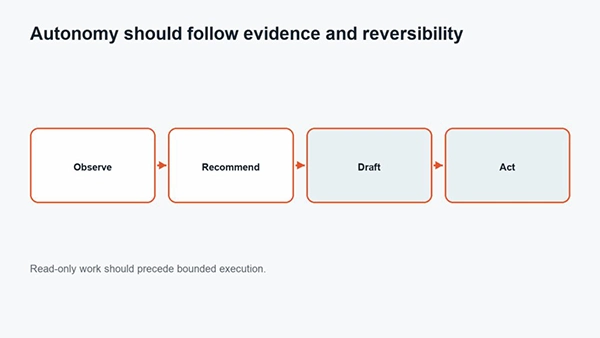
Begin with read-only monitoring on one well-understood process. Compare results with analyst review, evaluate false positives, and see which pieces of evidence are consistently absent. Next, the agent may piece together the packets and begin communicating. Only when processes are known to work correctly should the organization consider bounded execution.
This staged model also produces better economics. It reveals whether the bottleneck is detection, evidence collection, review capacity, or supplier response. An organisation that automates the wrong stage may create a faster alert queue rather than a faster control process.
The review capacity is limited. Exceptions must be ordered based on materiality, confidence, deadline, and recoverability, and not simply reported as a continuous flow of alerts. There could be some cases that need to be looked at ahead of other cases even though they might be smaller in nature. This is because they have a higher degree of recoverability and they have a shorter deadline.
The queue should also route expertise. Tax, procurement, operations, and accounting exceptions do not belong with the same reviewer. Better prioritisation can create more value than an additional model because it directs human judgement to the cases where judgement changes the outcome.
The safest rollout starts in read-only mode. Teams compare agent findings with analyst reviews, tune thresholds, and measure false positives. Next comes assisted action, where the agent drafts a dispute or journal entry for approval. Bounded automation should arrive only after the organisation can monitor performance and reverse mistakes.
Transitioning from dashboards does not mean that visibility goes out of the window. Dashboards provide the complete picture while agents convert an evidence-backed piece into controlled activity.
The AI audit agent tracks specified financial exceptions, collects relevant evidence, and prepares the case for review.
An AI audit agent should deliver an evidence package that includes the issue, related documents, amount, rationale, uncertainty, and suggested next steps.
Audits could be ranked on the basis of elements like materiality, confidence level, recoverability, deadlines, and the value derived from resolution of the problem.
Finance experts can measure resolution time, false positives, reviewer workload, re-opened cases, age of queues, precision per exception, and value of resolved exceptions.