Most of the chemical risks on a site are already written down somewhere. But they are often on a drum, in a data sheet, or in the supplier’s paperwork. People knowing how digital transformation is reshaping the fine jewelry industry can be totally unaware of how hazardous the chemicals they work with are.
Workers usually don’t even know where they should look for them, so the easiest route to chemical risk identification is reading those in a sensible order, then marking what turns up with clear hazard labels – go to the website to see Seton’s range; that can be a good starting point.
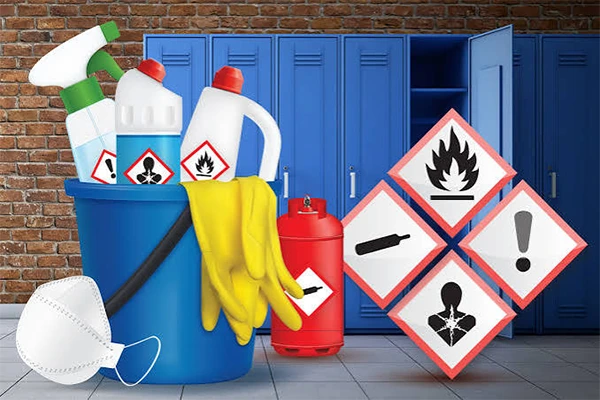
A supplier’s container holds a huge amount of information. The GHS symbols on it (red-bordered diamonds, black pictograms) are some hazardous elements that belong to their broader families:
Next to them is going to be a signal word, either Warning or Danger, and a set of hazard and precautionary statements in normal sentences.
The pictogram is what catches attention in the storeroom.
But the hazard statement does more of the work, as it says what the substance does to a person: harmful if swallowed, causes severe skin burns, may cause cancer, and carries a short code that travels with the product through every document about it. This is usually copied into a substance register next to the product name, where it’s stored and roughly how much is kept.
Those codes give a business a working list of its chemical hazards in an afternoon. And it’s the same list that feeds everything downstream, because HSE’s tools start from the same information.
The label summarizes the rest. The safety data sheet is the extended version and is important for compliance but not something you are constantly checking.
For exposure scenarios and the supplier’s own risk management measure, check HSE’s guidance instead of trusting memory of the product, and that’s how the formulation shifts. A cleaner that was an irritant two years ago may have been reformulated, and the only place that change shows up is the current sheet.
Products and data sheets from before the current labelling rules may still show the old risk phrases instead of hazard statements, so a register built from the shelves will sometimes have a mix of both.
The old tins can stay where they are for now, but it’s worth asking the supplier for a current sheet. HSE’s own advice for anything unclear is short: if in doubt, contact your supplier.
A good deal of the sorting can be handed to HSE’s COSHH e-tool once the hazard statements are on paper. It requires the manufacturer’s safety data sheet, and it accepts either the newer hazard statements or the older risk phrases; consider whichever the sheet shows.
The liquid also requires the boiling point from the sheet, which is sensible because a low boiling point means more vapour in the air at room temperatures. The exact product poses a various breathing risk relying on how readily it evaporates.
Assessments can be picked up again with a code the tool generates, as long as it’s within 30 days. That suits a facilities manager working through a store cupboard a shelf at a time, rather than in one sitting.
Alongside it, HSE publishes COSHH Essentials, a set of control guidance sheets. Some are fairly generic and written around a type of control, while others are direct advice sheets for particular industries like printing and agriculture.
These set out basic control advice for work in that sector. For a small firm without an occupational hygienist on call, matching each product to the right sheet is going to be the fastest path to COSHH compliance on routine substances. It leaves a paper trail that shows the thinking.
But the tools have their own limits. They work from what the supplier declares, so they are only as good as the data sheet, and they assume the automotive-grade materials choice guide is used the way the sheet describes.
A degreaser sprayed in a confined pit is a different exposure from the exact degreaser wiped on a bench, and no form can see the pit. The second opinion should be formed from where the actual use differs from the sheet.
The substances that often get missed are the ones businesses make themselves. HSE states that employers think about harmful substances produced by their processes, like cutting or grinding, and look at what each process releases into the air.
Its own examples are everyday ones, which can include wood dust from sanding and silica dust from cutting tiles. There is no label to read when the container is unavailable.
The same goes for skin. HSE lists skin contact with liquids, pastes and dusts as a hazard to check, which covers a fair number of jobs nobody thinks of as chemical work. This might be mixing grout by hand or cleaning down a print press.
The useful test is whether a substance has a workplace exposure limit – HSE treats anything that is hazardous to health.
Walk-round matters as much as the shelf check. Somebody stands at every process and asks what it results in and what people touch.
A saw bench or a mixing station then gets the same treatment as a labelled drum, which is an entry in the register and a control; it can also be a sign or a label at the point of use. Decanted products require the same attention.
HSE is actually clear about workers being required to understand what the assessment found and what it means. It is totally separate from the credentials for hazardous and industrial work that come up on a training record. A label at the point of use is just the simplest way to keep that understanding in front of the people who need it.
The quickest wins come from the supplier’s paperwork, and the gaps are wherever the work creates something new. A business that copies down its hazard statements, puts them through HSE’s tools, and then walks each process with a notebook will find most of its chemical risks early.
HSE states that employees must think about harmful substances produced by their process, like cutting and grinding, that get straight into the air.
The COSHH essentials are a set of control guidance sheets that are fairly generic and written around a type of control.
GHS symbols are the red-bordered diamonds or black pictograms that indicate a product is hazardous, inflammable, harmful to inhale, etc.