
Just like all industries, the insurance world is also being transformed by artificial intelligence.
One example of that is Straight-through processing (STP), which is nothing but an automated end-to-end process with no human intervention. You’ll be shocked to know that at the moment, STP handles 70%-90% of all claims.
In this article, I’ll elaborate on the topic of AI use in the insurance industry. How the workflow is transforming in terms of speed, accuracy, and decision-making. This has augmented the customer experience, but some insurers still face many issues with AI implementation.
KEY TAKEAWAYS
- Artificial intelligence is reshaping the insurance world for the better.
- People get their claims processed faster, while insurers achieve better profitability through efficient workflows and fraud detection.
- Predictive analytics is helping insurers with strategic decision-making.
- Still, some implementation challenges persist.
Claiming insurance is a manual, document-heavy process. But automation is making it a faster and more proactive experience.
The specific tools being particularly used in the claim processing are:
Research claims that AI improves customer service metrics, which is instrumental as 87% policyholders say it affects their loyalty towards the insurer.
As per a study, automated systems have reduced claim processing time by up to 70%. The process, which used to take weeks, is now near-instant.
Artificial intelligence, RPA (Robotic Process Automation), and NLP (Natural Language Processing) have been deployed to automate:
This has reduced manual data entry work and human errors for insurers. In turn, customer satisfaction is also improving.
Predictive analytics are improving insurance decision-making.
Machine learning models are being trained on historical data to make predictive analytics systems. These systems can accurately forecast:
This has enabled insurers to:
Ultimately, they enjoy higher profitability and customer loyalty.
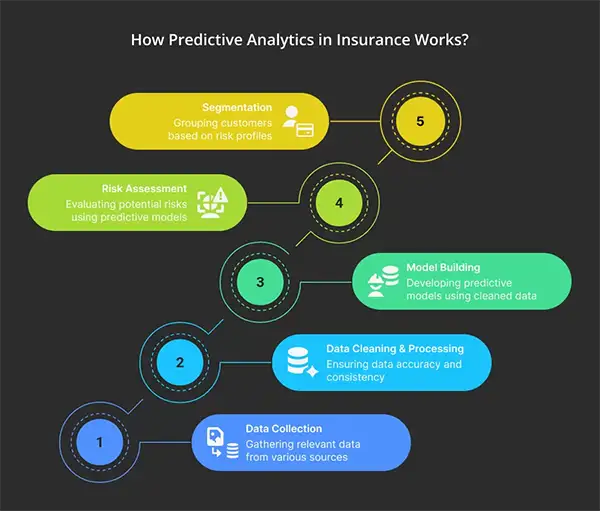
If you’re curious about how predictive analytics works in insurance firms, have a look at the following infographic:
The streamlined digital experience made possible by the AI-driven claims system offers significant benefits to both insurers and customers.
If you’ve recently suffered from an accidental injury and are trying to claim your insurance amount, there’s no better option than hiring the best for the job, the Michael Kelly Injury Lawyers.
If it’s so good, why isn’t it there in all insurance firms? Well, there are some implementational obstacles as well:
These are making AI adoption complex, expensive, and slow.
Artificial intelligence is reshaping the insurance world for the better. People get their claims faster while insurers get their losses cut. It’s a win-win overall.
Some implementational obstacles persist, stopping all insurance firms from adopting it across the board. But over time, I believe they’ll also smooth out.
It’s automating underwriting, accelerating claims processing, and detecting fraud better.
The process has become faster and more customer-friendly. Policyholders can check claim status and receive updates in real-time.
Autonomous claims processing agents do everything, from reviewing documents to settling claims without any human intervention.