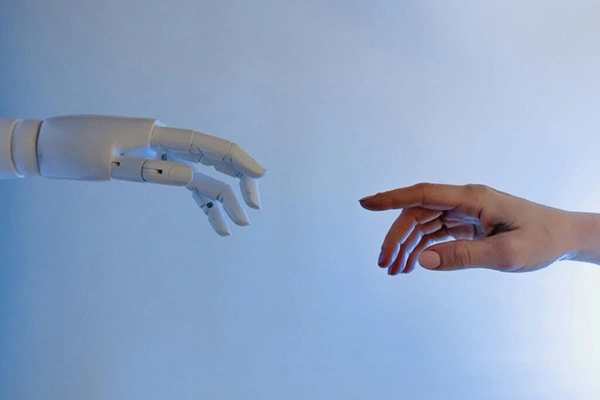
“The true power of AI lies not in replacing humans, but in working alongside us to achieve what neither can do alone.” — Sebastian Thrun (AI Pioneer)
Beware SDRs, artificial intelligence is coming for your jobs. Well, that’s not true. But that’s not false either. It’s kind of taken up half of your job already. As a human, you’re left with the tasks you’re only good at as of now: those that require your humanness.
As John Barrows (CEO, JB Sales) puts it perfectly: “As long as there is a human purchasing something on the other end, we need to have that human factor.”
In this article, we’ll discuss the differences between AI and humans as SDRs. The differences that give both of us value. Talking of value, this article is valuable for sales organizations as they get to know the perfect use case for each type of SDR. Maybe, they can even implement a hybrid model!
It’s an autonomous software agent. A non-human agent that works on its own, without human intervention.
It primarily handles all the major initial customer journey (TOFU) processes, like:
And unlike a human SDR, solutions like Alice SDR can handle these repetitive tasks 24/7.
This frees time for humans to focus on more important and complex tasks, including closing high-value clients.
An SDR professional is a specialized role in sales. Just like an AI SDR, it also has the same core responsibilities:
They generally don’t close deals. Once a prospect qualifies, they pass it to Account Executives (AEs).
For a business to achieve maximum growth, it’s essential to overhaul the entire sales system.
What they do might seem the same, but the differences lie in how they do all that: the manner, the competence, and the efficiency.
An Agentic SDR can automatically scan all the publicly available data about thousands of leads, including:
Based on that, it scores all the leads and prioritizes the quality ones.
It can instantly qualify leads at a level that humans can’t simply match. But, these solutions do that based on just a rigid fit criteria involving parameters like company size, revenue, tech stack, etc.
SDR professionals, on the other hand, listen actively and ask open-ended questions during discovery calls to gather a more comprehensive picture of the leads.
Intuition plays a major part in qualifying leads here. They look at things like:
All these subtle signs a software can’t easily detect.
As described above, AI SDR is excellent at analyzing the digital footprint of leads, that too at a scale.
After that, it takes seconds to generate hyper-personalized emails or LinkedIn messages for each lead. Though they can feel too generic and pattern-based.
It doesn’t suffer from writer’s block like a human SDR, but it strictly adheres to predefined rules, which can put off customers.
SDR professionals also gather lead data, but they use it to build genuine human connections. They can:
Understanding nuance comes naturally to human SDRs, which helps with things like objection handling.
Due to high-risk, only they are assigned to highly complex enterprise-level accounts.
AI SDR can engage 1,000+ leads in a day and respond to inquiries under 5 minutes 24/7. They cost $500-$5,000 monthly. This makes them much more profitable compared to human SDR in terms of cost-per-touch and cost-per-lead.
But, an SDR professional can only do 40-80 contacts within a business working day. Besides, they need significant investments in terms of:
The table summarizes all the differences between the two types of SDRs:
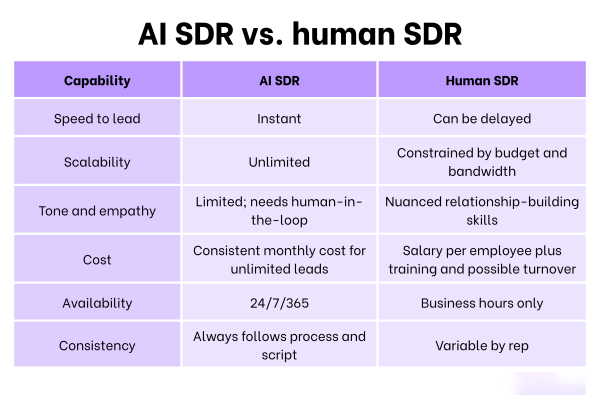
Modern sales workflows with these offer several advantages:
Despite AI coming in, SDR professionals still hold some strengths in the sales conversations:
Agentic SDR is best for high-volume, lower-cost, transactional sales motions (ACV under $25k). Optimal efficiency requires integration with other enterprise systems such as CRM, analytics, etc. On the other hand, SDR professionals would be your best bet if you deal in complex, enterprise relationship-building.
But it’s the hybrid model that would suit most sales firms. In this, let AI handle lead research and top-of-funnel volume, while humans manage strategic conversations and targeted outreach.
The winning SDR approach for 2026 sales growth combines AI automation for TOFU volume with relationship building by human SDRs for complex qualification.
Earlier, SDRs used to “spray and pray”. But now, they use deep research intelligence and trigger-based signals to drive highly relevant, multi-channel outreach.
Still, adjust your unique approach based on:
The rule advises automating only 30% of your work responsibilities.
AI excels at speed, scale, and volume in prospecting, while SDR professionals are adept at emotional intelligence, complex dealings, and relationship-building.
In a hybrid SDR model, Agentic SDR handles TOFU sales tasks while humans focus on the BOFU ones.