“Make a customer, not a sale.” — Katherine Barchetti (Customer Service Consultant)
This quote emphasizes that the focus should always be on the customer, not the sale. This doesn’t mean that you shouldn’t focus on sales, but most sales personnel focus on it so much that they forget the customer entirely. Hence, the quote actually means to value the customer and sales equally.
And you shouldn’t do that out of any virtue, morality, or some business magnate turned philanthropist’s advice. You should do it because it’s good for business. Customer and sales management software makes it easier and provides an average return of $8.71 for every $1 spent.
As you scale operations, a sales management solution becomes essential to keep things moving.
Sales management system (SMS) is a centralized digital platform that:
Adopting an SMS means the sales department no longer relies on manual tracking or guesswork. All the related workflows become data-driven.
As every lead is nurtured, sales teams hit targets more frequently, more confidently.
But if your business is short on capital and a dedicated workforce, partnering with specialized sales service providers is also a good idea.
An effective sales software works across the pipeline. It has an integrated sales prospecting tool, forecasting system, and actionable insights solutions.
This is the central nervous system of sales operations, involving a single database for all customer touchpoints
It provides a 360-degree view of all interaction history, including emails, calls, meetings, notes, and past purchases.
The system evaluates all leads and prioritizes accordingly. The leads that come out as high-value are routed to the best-suited reps.
The centralized data doesn’t allow for losing even a single prospect. The system ensures all reps have the latest context before reaching out.
Sales pipeline tracking enables a visual, step-by-step breakdown of the entire sales cycle, from initial prospect to closed deal.
The sales reps generally use visual Kanban boards for this. With this tool, you can simply drag-and-drop deals across customizable stages like:
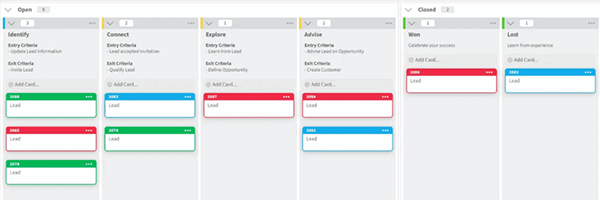
This pipeline tracking makes it easy to identify weaknesses that are leading to lost deals or friction in the process.
Admin work is also reduced with automated follow-up emails and reminders when deals move from one stage to another.
The enormous tracked data is fed to analytics systems.
The reporting dashboard shows various important real-time KPIs, including:
The forecasting system uses historical conversion rates and current pipeline volume to predict future revenue.
Analytics show individual and team performances through which managers easily identify top performers and weaker reps. As a result, the process of feedback and offering actionable insights also becomes smoother.
The infographic emphasizes the key features of sales management software within a process workflow:
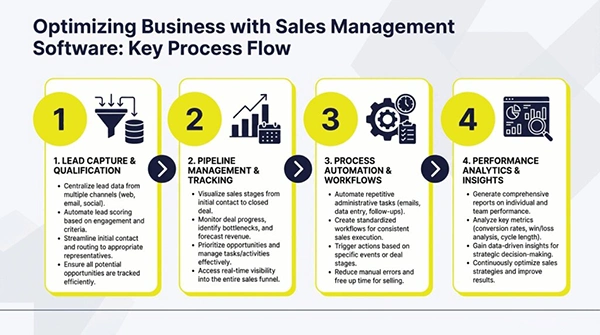
Sales software improves team and organizational productivity by various means:
Sales management system improves customer handling, lead management, and overall sales workflow.
The integrated CRM features enable reps to see all the customer touchpoints, including:
Reps then approach and follow up on those customers better.
An entire pipeline being visible to reps enables them to catch up on leads fast. Identifying friction points and then smoothing the process also accelerates deals and follow-ups.
With data accessible at a single place, reps don’t waste time searching for particular data or overlapping leads.
Managers can easily gauge the progress against set goals and KPIs. With performance data on the organization, teams, and individuals, you make smarter sales decisions.
Salesforce has always ruled the cloud CRM market. Its pricing is mid to high-tier, but there are many add-ons as well. The tools are highly customizable. It also offers advanced automation and analytics.
Microsoft Dynamics 365 is a suite that handles almost everything: sales, customer service, strong marketing content, field service, finance, operations, and more.
The mid to high-tier pricing is modular. It offers seamless integration with other Microsoft tools, along with AI analytics and insights.
HubSpot is a unified GTM platform that manages five “hubs”: sales, marketing, customer service, content management, and operations.
Pricing is scalable from free to mid-tier. The interface is user-friendly. Also, it offers strong automation.
Sales personnel can manage it when your operations are limited. But as the business grows, it needs sales management software to handle leads better.
A competent sales management system offers lead management, pipeline tracking, reporting, analytics, and forecasting that lead to better CRM, faster follow-ups on leads, and smarter, data-driven decision-making.
The leading sales software from Salesforce, Microsoft, and HubSpot offer these features and more with varied pricing. You should choose the one that best suits your needs.
The follow-up rule advises reps to make 3 phone calls, 3 emails, and 3 social touches within a period of 3 weeks.
This is the time before you even make your sales pitch, within which the prospect assesses your confidence, energy, and presence.
Sales management is essential as it involves developing sales strategies, setting targets, and leading a sales team.