The number of noncash payments in the United States has more than tripled since 2000 and reached 236.6 billion in 2024, according to the Federal Reserve’s 2025 triennial payments study. Every payment requires an issuer’s approval and also carries a fee. At that volume, a small gain in approvals or a small cut in cost turns into an expensive cost. That’s why intelligent payment routing is a method that picks the best path for each transaction instead of pushing all of them down one fixed road.
Intelligent payment routing is a system that selects the best processor or acquirer for each transaction in real time, often within milliseconds, to raise approval rates and keep fees low. The shopper never sees the decision. Some providers prefer the shorter-term smart routing, though the concept is the same. A merchant with multiple acquiring connections benefits most, since there is a real choice to make.
Static routing transfers every payment through one connection, whatever the card or country. Dynamic routing looks at each payment first and then decides. The table reveals the main gaps.
| Feature | Static routing | Intelligent routing |
| Decision basis | One fixed rule | Data from each transaction |
| Number of processors | Usually one | Two or more acquirers |
| During an outage | Payments fail | Traffic moves to a backup |
| Soft declines | Sale is usually lost | Can be retried elsewhere |
| Fee control | Whatever the provider charges | Can favor lower-cost paths |
The gap broadens for merchants selling across borders, where intelligent payment routing can match each card to the acquirer that manages it best.
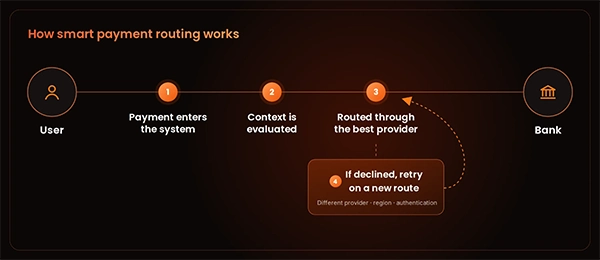
The process is a loop, not only a decision, and each pass feeds the next one.
A routed payment passes through five stages, often in under a second:
Note: A setup that never learns from results is only a static rule set with additional steps.
A soft decline can be retried through another provider, while a hard decline should stay declined. A hard decline, for example, a closed account or a stolen card, is final. A soft decline may come from a technical mistake, an issuer’s risk filter, or a struggling processor. Cascading targets that second group, so the shopper sees one successful payment rather than an error.
Pro tip: set a strict limit on retries. Repeated attempts on the same card can annoy issuers and card networks, and well-tuned intelligent payment routing treats retries as a tool with limits, not a reflex.
Three gains matter most: approvals, cost, and uptime.
Yes, it can, often because issuers tend to trust payments that look local. A card issued in Germany and processed by a German acquirer in euros looks more organic to the issuing bank than the same card processed abroad. Intelligent payment routing uses this pattern by matching cards with local or issuer-friendly acquirers. Results depend on card mix, markets, and acquirers, so testing on actual traffic is the only dependable measure.
It can, through least-cost routing, which sends each payment down the path with the lowest total fee. Cross-border processing often costs more than domestic processing, and interchange rates differ by card type and region.
A simple formula keeps the logic honest: net value of a route = approved sales − processing fees. A cheap route that declines more good customers loses on this measure.
Because volume keeps climbing. Federal Reserve data show noncash payments rising from 204.8 billion in 2021 to 236.6 billion in 2024, which raises the stakes of any outage. With intelligent payment routing, traffic shifts to a backup gateway when a processor goes down, usually before the team notices. For businesses that sell around the clock, that safety net alone can justify the project.
Implementation is less about buying a product and more about shifting from a single processor to a multi-acquirer setup.
Begin with an audit, add a second provider, and test every rule on a small share of traffic. The full sequence looks like this:
Over-engineering is the actual culprit, but it is not the only one:
Routing engines are shifting from fixed if-then rules to models that adjust based on live outcomes.
Smart payment routing of this kind learns which acquirer performs better for a given segment and shifts traffic accordingly, while people set the guardrails. Oversight does not disappear. The work moves from writing rules to reviewing results.
Orchestration platforms have also lowered the barrier to entry, so mid-sized businesses selling across borders can now make a case for the strategy. Intelligent payment routing rewards patience more than ambition, and teams that treat it as ongoing practice tend to keep the gains.
Orchestration is the layer that connects several providers through one integration, while routing is the decision logic that picks among them. In practice, intelligent payment routing usually runs on top of an orchestration platform. Vendors sometimes use the two terms as synonyms, which adds to the confusion.
It can be, once sales volume and market spread justify a second provider. A business selling in one country with a narrow card mix may see limited gains, while one selling across several regions has more to win. A pilot on a small share of traffic shows quickly whether the effort pays off.
Timelines depend on the number of integrations and the state of the existing stack. A setup built on an orchestration platform can go live faster than a custom build. Testing on partial traffic adds time but lowers risk.
Only for soft declines, and only within limits. Hard declines, such as stolen-card flags, should never be retried. Capping attempts per card protects issuer relationships and keeps approval rates from slipping.
Approval rate by acquirer, region, and card brand comes first, followed by decline in reason codes, cost per transaction, and latency. Together, these show whether a rule helps or hurts. A monthly review is a reasonable habit, because acquirer performance shifts over time.