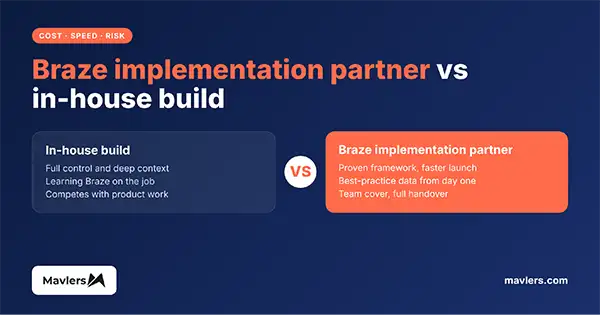
When you sign with Braze, the biggest question is: should your own team build something, trusting it or not? Or bring in a Braze implementation partner? Both ways are right and can work at the moment. Both routes can work. The correct way totally depends on three major things that are cost, efficiency, and the risk behind using it.
Go through this guide and get the Braze implementation partner and in-house process alongside.
Before you compare any option, let’s decide what are the things that it helps with and what are the things that it includes, and make it clear about the work itself :
That is engineering, data, CRM strategy, content and QA work, all at once. Whoever builds Braze needs every one of those skills.
An in-house build means your own team does the work. It usually involves mobile and web engineers for the SDK, a data engineer for integrations, a CRM lead for journeys and segmentation, plus content and QA support.
The downside is the control and the deep business context, and the teams that have also never implemented Braze before, and it also has the product roadmaps that can deliver well. The implementation work that takes place here also works in everything else.
There is also a learning curve. Braze has its own way of handling user identity, event properties, custom attributes, and data points, and early choices have long-term effects. For example, how you name and structure events decides how easily you can integrate users, trigger Canvases, and report on results afterwards. Teams building Braze for the first time often see these trade-offs only after launch, when changing them means reworking integrations and pathways.
A Braze implementation partner brings a ready-made team that has done it so many times: solution architects, Braze engineers, data specialists, CRM strategists, Canvas builders and QA. It comes with proven processes, templates, and checklists, and knows the common mistakes to avoid. Makers shares what working with a partner team makes it look like in practice in its post on the first month with a Braze team.
The cost of an in-house build goes well beyond salaries:
A partner of the Braze Implementation changes most of that into one scoped fee that is seen. You get whatever you want on the scoped fee, and you just have to pay for the expertise you need. You can also do it without adding the permanent headcount.
Verdict: an in-house build can look cheaper on paper, especially if you already have engineers on payroll. Once you count opportunity cost, rework, and delayed revenue, a Braze implementation partner is often the more cost-effective option.
If you compare the speed, you will know this is where the gap is largest. A first-time in-house team has to memorize Braze while making it, and competes for engineering time with product work. That stretches timelines.
A partner takes care of an examined framework from day one. Makers, for example, use six steps: discovery and audit, strategy blueprint, technical implementation, testing and QA, launch and optimization, then continuous growth and experimentation. Parallel workstreams for SDK, data, and journeys mean you reach launch quickly.
Verdict: a Braze implementation partner mostly gets you live sooner and starts generating value from journeys earlier.
Speed also affects revenue. Every week your onboarding, abandonment, and win-back journeys are not live is a week of missed conversions and retention. Launching a few weeks earlier with well-built journeys can be worth more than the cost difference between the two routes.
In-house risks:
Partner risks:
Verdict: partner risks are easier to manage via clear scope, documentation, and asset ownership. In-house risks, especially data design problems, are tougher to undo once Braze is live.
Whichever route you choose, these are the problems that most often slow down Braze programs:
An experienced Braze implementation partner has a checklist for each of these. An in-house team can avoid them too, but usually only after learning the hard way.
| Factor | In-house build | Braze implementation partner |
| Upfront cost | Hidden: engineering time, hiring, training | Clear: one scoped fee |
| Time to launch | Longer, competes with product work | Shorter, with a tested framework |
| Braze expertise | Learning on the job | Proven across many implementations |
| Data and event design | Higher risk of rework | Built on best practice from day one |
| Feature adoption | Often limited | Canvas, Catalogs, Currents, BrazeAI used fully |
| Key-person risk | High | Low, with team cover |
| Business context | Deep from day one | Builds through onboarding |
| Long-term control | Full | Full, with documentation and handover |
Before deciding whether you should take this or not, you should ask yourself and your team this question.
If you answered “no” to two or more, a Braze implementation partner, or at least a hybrid model, is likely to be faster and safer.
Build in-house v if you have experienced Braze engineers and CRM specialists on staff, a flexible routine, and engineering capacity to left.
Hire a Braze implementation partner if you need to launch fast, your team is new to Braze, your data setup is tough, or you are coming from another platform.
Use a hybrid model for the best of everyone. The partner leads architecture, SDK, data, and the first journeys, while your team learns side by side with it and takes over day-to-day work, supported by documentation and training. Mavlers’ guide to Braze team structure make syou explain about the task that you do and which roles to keep in-house for the longer term.
Mavlers is a Braze implementation partner with 100+ Braze clients, 20+ Braze experts, and 2K+ Braze campaigns managed. We handle SDK and API implementation, event tracking, Braze integration services with Snowflake and Databricks, Canvas architecture, Liquid personalization, BrazeAI, and cross-channel journeys. Moving from some other platform? Our Braze migration services cover data, audiences, journeys, and the way you deliver it.
We offer one-time projects, ongoing retainers, and dedicated teams, so you can begin with an implementation and scale support up or down after it’s launched.
Our process follows six normal steps. Discovery and audit review your current tools, data, and goals. The strategy blueprint sets out lifecycle journeys, audiences, channels, and KPIs. Technical implementation covers SDK, API, event tracking, and integrations. Testing and QA check every data flow and message before launch. Launch and optimization keep the journeys live and start measuring results. Regular growth and experimentation then use A/B tests, holdouts, and BrazeAI to keep improving performance. Every step takes care with documentation, so your team can take over whenever it is ready.
If you have the engineers that have an experience of the Braze, then you can, an in-house build gives you full control. If things like speed, data quality and risk matter more, a Braze implementation partner will usually deliver extra value for the money you invest. For many brands, a hybrid model, where the partner builds the foundation and your team takes over with full documentation, offers the best balance of cost, speed, and risk.
Planning your Braze rollout? Talk to Mavlers’ Braze team.
Ans: Not always. Once you count engineering time taken from your product roadmap, hiring, training, and rework, a Braze implementation partner is often more cost-effective.
Ans: It depends on your apps, data sources, and number of journeys. A partner with a tested framework and parallel workstreams usually reaches launch faster than a first-time in-house team.
Ans: Weak event and data design, dependence on one engineer, and underusing key features such as Canvas, Catalogs, and BrazeAI.
Ans: Yes. Choose a Braze implementation partner that documents its work, trains your team, and confirms that you own every asset it builds.
Ans: Gather access to your apps, website, CRM, and data warehouse, a list of the events and attributes you track today, and your main lifecycle goals. The more context you share in discovery, the faster the partner can design the right setup.