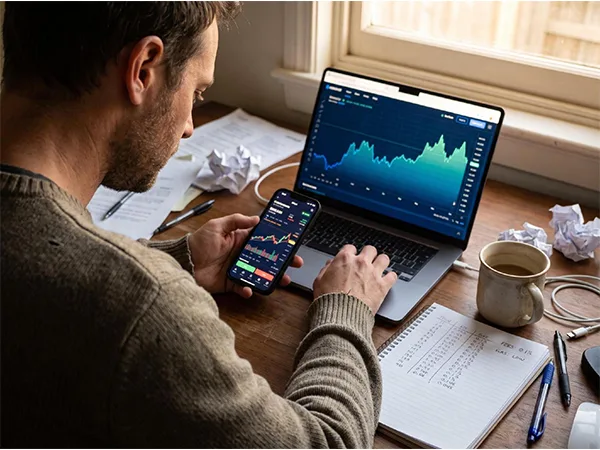
A person comparing crypto exchange apps on a laptop and smartphone
Every 1 in 5 Americans has used crypto. The Pew Research Center found in a January 2026 survey that around 19% of US adults have somehow invested in, traded, or used cryptocurrencies. Still, many of those people picked their exchange because of a friend’s tip, an advertisement, or whatever app appeared first in the store.
That’s a very weak way to select a place to hold your money. Exchanges vary in fees, asset range, state availability, and the security tools they provide you, and those differences affect your prices and risks.
One important thing before we start: this guide is informational, not financial advice. Crypto is volatile, and you can lose your money. This list compares five of the best platforms that serve US customers, with a short note on who each one suits and what to check once again before you deposit any money.
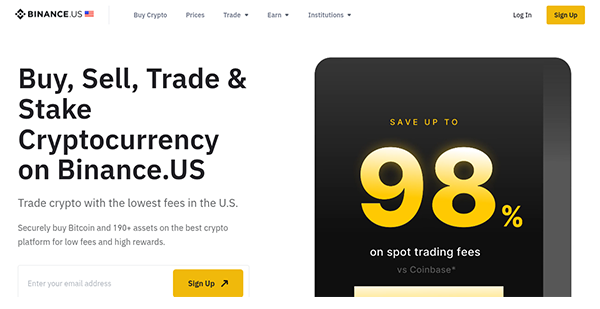
Binance US homepage
For live crypto prices across more than 200 listed assets, Binance US offers 24-hour change, volume, and market cap details one click from the trade screen. Its price page also offers fast filters such as Top Gainers, Top Losers, New Listings, and Trending, plus a favorites list so you can follow the handful of assets you actually care about.
Fees are a selling point. Binance US offers 0% maker and 0.02% taker fees on most Advanced Spot Trading pairs, with no minimum trading volume needed to access these rates. The BNB/USD pair has an even lower taker fee of 0.01%. The platform also delivers a conversion tool, staking, and services for institutional traders. Check the current fee schedule for any additional transaction costs.
Getting started with Binance US is straightforward. Before funding your account, check availability in your state and take advantage of the platform’s security features, including two-factor authentication and withdrawal settings, to help keep your assets secure.
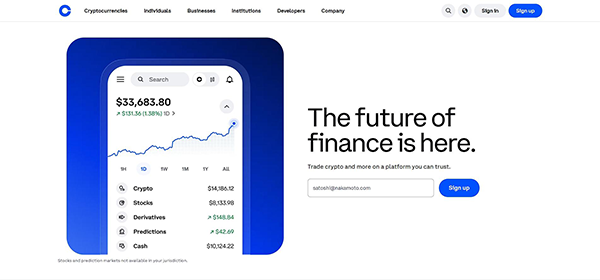
Coinbase homepage
Coinbase is probably the most effortless exchange to learn. Its app walks first-time buyers through verification, funding, and a first purchase, which makes it a common first stop for new buyers. Check its availability page for your state.
The convenience has a price. Its simple buy flow typically costs more than the maker and taker rates on its Advanced trading screen, so compare both on the fee page. If you plan to buy regularly, learning the Advanced view is worth the afternoon it takes.
Coinbase lists hundreds of assets, and the count changes, so check the site. That’s a bunch for most people. It suits first-time buyers who value a clear interface over the lowest possible fee.
One thing to watch: simple-buy prices can contain a spread that doesn’t show up as a line item. Compare the quoted price against the live market price before confirming larger orders.
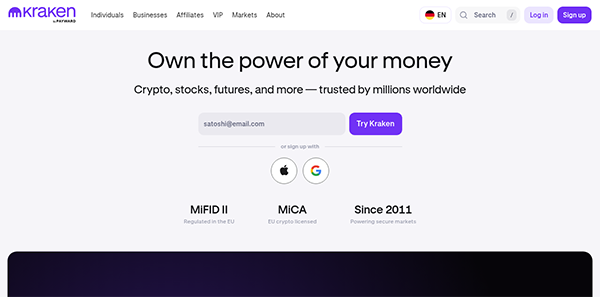
Kraken homepage
Kraken puts security documentation front and center. Its security page describes proof-of-reserves audits, passkey and FIDO2 support, cold storage for customer assets, and ISO/IEC 27001:2022 certification, along with SOC 2 Type 1 audits. That transparency is a reason to look at it seriously.
The asset list is big. It lists hundreds of assets; check the site for today’s count. Its Kraken Pro interface uses tiered maker and taker fees that fall as your volume rises, so make sure to read the current schedule.
It suits active traders and security-minded users who want deeper tools. Be aware that more tools bring more ways to make an expensive error. If you’re deciding whether frequent trading is even right for you, we compared long-term holding with short-term trading in a fair side-by-side.
Availability has exceptions. Kraken doesn’t provide every product in every state, so verify yours first.
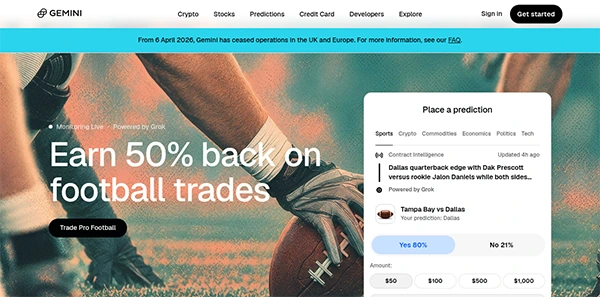
Gemini homepage
Gemini leans on compliance. Its site lists NMLS licensing IDs and says it has served traders since 2015, which makes it one of the older names on this list. If a regulated, paperwork-forward approach matters to you, that positioning is its key draw.
The coin list is smaller than at its larger rivals. Check whether the specific coins you want are listed. A tighter selection can be a feature for someone who wants to avoid thinly traded tokens.
Gemini’s product range now extends past crypto. The site mentions stock trading, staking, a credit card, and prediction markets. Treat that last one with care: prediction markets carry their own troubles and aren’t the same as holding an asset.
It suits newer users who prefer a conservative, compliance-led platform and don’t require a long list of tokens. Its simple interface can cost more in fees than the advanced trading option, so compare both if you’ll trade frequently.
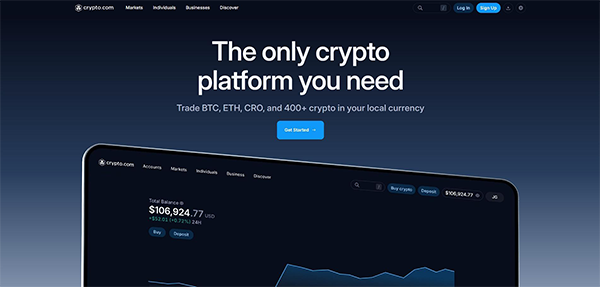
Crypto.com operates both a mobile-first app and a separate exchange. Its Exchange page advertises access to more than 350 trading instruments and execution times under 10 milliseconds, along with several security certifications and compliance standards.
That breadth suits people who want everything in one app and are comfortable moving between a simple buy flow and a full trading screen. As with every platform here, the simple flow is the pricier one, so compare it against the exchange view before placing a large order.
Availability varies by jurisdiction. Some services aren’t offered in every state, and product lines can vary by location. Read the availability notice for your location instead of assuming the app’s full feature set applies to you.
Begin with licensing and availability. Not every exchange operates in every state, and a few of the best-known names exclude specific states entirely. Check the exchange’s own availability page before you spend time on a signup.
Next, read the fee schedule closely. Most platforms charge one rate on a simple “buy” button and a lower maker/taker rate on their advanced trading screen. The convenient option often costs more, sometimes by a wide margin on small orders.
Asset range matters, but bigger isn’t automatically better. A platform with hundreds of listed coins offers you more choice and more obscure tokens to be careful with. Understanding the differences between large-cap and small-cap altcoins can help you estimate those options. If you only plan to hold a handful of major assets, a shorter list is no real handicap.
Then look at security. Strong platforms support two-factor authentication or passkeys, let you restrict withdrawals to approved addresses, and publish details about how they store customer assets. Turn every one of those protections on the day you open the account. The SEC’s guide to crypto asset custody also explains what to consider when trusting a third party with your holdings.
Last, test support and withdrawals with a small amount first. Moving a small sum in and out tells you more about an exchange than any review will.
Match the platform to how you’ll use it. If price tools and low spot fees matter most, begin with Binance US. If you want the gentlest learning curve, Coinbase is hard to beat. Kraken fits security-focused and active traders, Gemini fits people who value a compliance-first approach, and Crypto.com fits those who want trading and a mobile app together. None of them is the right answer for everyone.
Whichever you select, start small. Fraud is the real threat around crypto, and it doesn’t always come from the exchange itself. The Federal Trade Commission told Congress in March 2026 that investment scams were the top fraud category in 2025, with $7.9 billion in reported losses. The FTC also publishes a consumer alert on spotting investment scams that’s worth reading before you send money anywhere.
Many scams start with a fake login page that looks just like a real exchange. If you ever land on a page you reached through an ad or a message, stop and open the exchange by typing its address yourself; our guide to protecting a digital wallet from phishing walks through the warning signs. Never share your seed phrase or recovery codes with anyone, including “support” staff who contact you first.
Public confidence is still low, which is a reasonable reaction. A 2024 Pew Research Center survey found that 63% of U.S. adults have little to no confidence that investing in, trading, or using crypto is reliable and safe. Don’t put in more than you can afford to lose, turn on every security feature on day one, and revisit your choice once you’ve used the platform for a few weeks.
The top 3 centralized crypto exchanges globally by trading volume are Coinbase, Binance, and Bybit or Kraken. It also depends on your measuring method.
The top cryptocurrencies you can consider for investing in 2026 are Bitcoin, Solana, and Ethereum, according to data provided by platforms such as ZebPay and CoinDCX.
Kraken and Gemini are often considered the safest and most secure crypto exchanges. Few people consider Coinbase the best crypto exchange in the US.