Tracking the working hours of hundreds of employees has always been very difficult. HR departments take up considerable time to calculate that for each employee, as they have to estimate the payroll.
The situation eased substantially with the move from manual to digital systems, but all those gains were reversed as the world started moving more and more towards remote working.
This gave rise to automated payroll and timesheet software, which further improved upon traditional digital systems. Research says contemporary automated systems have reduced wage accounting time by up to 80%.
In this article, I’ll expand on how smart timesheets for easy payroll are helping firms with admin tasks like never before. The following sections start from the start, explaining wage accounting software, the role of timesheets, the impact of smart timesheets, and features to look for in a payroll timesheet tool in 2026.
KEY FEATURES
- An integrated timesheet system in payroll management software makes HR admin tasks much easier.
- Manual wage accounting took up a lot of time; an automated system has accelerated the process.
- Smart timesheets track working hours, leaves, and breaks in real-time, automating payroll management effortlessly.
- Choose a system that is automated, real-time, flexible, accurate, comprehensive, and mobile-first.
Payroll management software is a digital tool that automates, manages, and streamlines the process of paying compensation to employees. The solution can either be cloud-based or on-premises.
It calculates:
All the historical records are also maintained in an organized and secure manner.
Automation includes tasks like generating payslips, direct deposits, and filing regulatory reports.
Payroll management system stays connected to time-tracking, attendance, and HRIS platforms for automatic data sync.
The entire process stays tax and labor regulation compliant with minimal to no errors. All of this is transparent and accessible to employees through a dashboard.
Timesheets serve as a sort of backbone to modern wage accounting systems. They ensure precise and real-time tracking of:
The volume of HR tasks is reduced drastically with this, saving admin costs. The scope of manual data entry errors and “buddy punching” is also limited.
All this directly leads to:
The system produces actionable analytics that aid project management and productivity analysis.
In the long term, this builds trust between employees and employers as the data on working hours and pay is transparently in front of everyone.
Smart timesheets are automated, real-time, and integrated with other digital systems. As this replaces manual, error-prone data entry, the wage accounting accuracy is bound to improve.
Manual time tracking usually happens at the end of the week. Trying to remember the worked hours introduces multiple inaccuracies in the data. Digital systems record worked hours in real-time, leaving no scope for time tracking inaccuracies.
With automated time tracking, firms need not worry about common mistakes like:
The error rate in payroll with manual systems is about 20%, which drastically comes down to under 2% with automated systems.
The following infographic summarizes the differences in all three types of timesheets:
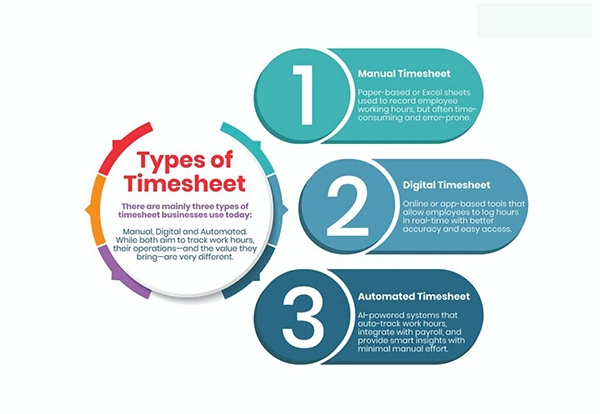
A great timesheet-enabled wage accounting software needs to have features that excel in three departments in 2026: Timesheet essentials, payroll and compliance, and functionality and user experience.
The HR department has always struggled with calculating working hours and payroll for employees. The admin task used to take considerable time in a manual manner. Digital tools helped the situation, but then the pandemic struck, and it again became difficult.
Automated timesheet and wage accounting tools emerged and handled the contemporary demands really well.
In 2026, everyone knows that remote working isn’t going anywhere. Hence, investing in a good timesheet-integrated payroll system seems like a prudent decision.
It takes much less time and effort on the admin’s part, freeing up their time for more important tasks. This also reduces operational costs.
Just make sure it has all the essential features concerning timesheets, payroll, compliance, functionality, and user experience.
Happy 2026, Payroll Heroes!
The four types of wage accounting systems are: manual processing, dedicated software, outsourced services, and professional employer organizations (PEOs).
A digital wage accounting system is overall more efficient and accurate than manual processing. The same is true for automated systems if compared with traditional digital systems.
Some of the top HR wage accounting software are Papaya Global, Deel, Remote, and Multiplier.
The future of wage accounting involves AI automation, real-time processing, and total integration with cloud-based HR systems like timesheets.