“The difference between a tool and a solution is how well it integrates into the workflow you already have.”
Imagine a world where your customers don’t have to wait on hold for twenty minutes listening to elevator music. With over 3 billion users on WhatsApp, instant solutions are now a global standard. But as you move forward from handling a few dozen chats to thousands, you need a system that won’t ditch you and crash under pressure.
Selecting the right WhatsApp API provider is an important thing, as it helps your business grow smoothly instead of getting stuck. Using a reliable platform like WANotifier can help you make this journey simple by offering a no-code environment to manage your official API access.
This guide will explain to you what to look for in 2026, including how things work, how to stay secure, and how pricing can grow with your business. This way, you can choose a partner that helps your brand grow instead of holding it back.
Key Takeaways
- A standalone tool is a silo; you should pick an API that fits well with your CRM.
- Low latency is non-negotiable for modern customer expectations.
- Select a provider that proactively manages your Meta Quality Score, as compliance is safety.
- You need to scale smart, always audit the pricing model for hidden costs as your volume grows.
To understand in a better way, think of the standard app as a bicycle and the WhatsApp AI as a high-performance jet engine.
While the app limits you to one-on-one manual interactions, the API integrates directly into your existing ecosystem. This enables automated workflows, multi-agent collaboration, build messaging that handles thousands of conversations simultaneously.
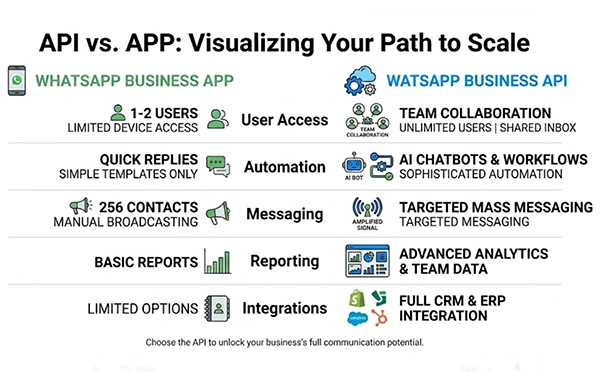
While the Business App is great for a starting point, the WhatsApp API is what you need to turn your messaging into a strong engine for growth, as it is shown in the image.
Infrastructure functions as the digital plumbing of your communication. A top-tier provider doesn’t just send a text; they manage the complex routing between Meta’s servers and your interface.
The best providers in 2026 offer ‘low-code’ environments, which allow you to connect your systems without the need for any advanced software engineering skills.
The intuitive platforms of the system simplify API deployment to enable your team to execute complex messaging campaigns within hours instead of weeks.
The automation process produces the most impressive results. The API allows you to implement advanced AI agents that manage Tier-1 support, package tracking, and payment processing through the chat interface.
It’s about being available 24/7 without actually having to stay awake 24/7. These advanced automations don’t just answer the questions; they drive conversions by personalizing the journey for every single customer instantly.
Fun Fact: WhatsApp’s name is a pun on the phrase “What’s Up?”It is simple, yet it has changed the world.
Meta is notoriously strict about spam. You can’t just blast thousands of people; you need opt-ins and approved templates. A reliable provider acts as your legal bodyguard, ensuring your ‘Quality Rating’ stays high so your account doesn’t get banned on day two.
They also provide real-time monitoring tools that alert you to your messaging behavior risks a penalty, which allows you to adjust strategies before your reach is suppressed by the platform.
When you are shopping around, don’t just look at the shiny dashboard. Look for these ‘growth-proof’ features:
A well-tested infrastructure is behind every successful automated interaction that ensures your brand’s reputation remains untarnished.
In the high-speed economy of 2026, timing is everything! If a customer asks for a password reset or a limited-time discount code, a ten-minute delay feels like an eternity.
High-latency providers often kill conversions; you need an infrastructure that guarantees near-instant delivery to keep the conversation fluid and the customer engaged.
‘99.9% uptime’ in 2026 is the bare minimum. You want to see a provider with a proven track record of 99.99%. The latency is measured in milliseconds as the unit of time because it represents the duration between the moment a user presses ‘send’ and their phone begins to vibrate.
The system needs high-speed operation because even the smallest delay will interrupt the typical course of conversations, resulting in user dropouts and decreased website activity.
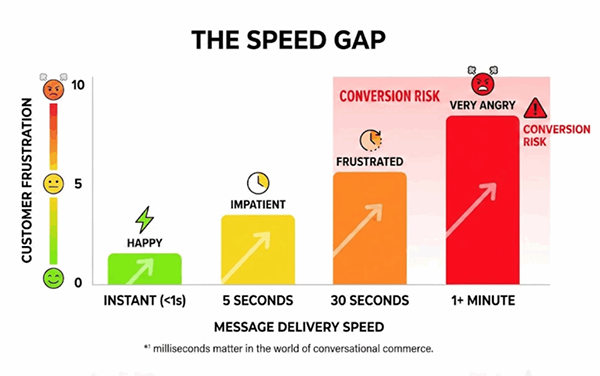
This bar graph maps customer frustration levels against message delivery times, showing why milliseconds matter in the world of conversational commerce.
If you are planning a Black Friday surge, you need to know that your provider won’t throttle your speed.
Ask about the ‘tier levels.’ As your business proves its reliability, Meta allows you to send more messages, but your provider’s servers must be able to handle that increased volume without lagging.
This ensures that your high-priority marketing alerts reach thousands of customers simultaneously, rather than trickling out over several hours and missing the peak sales window.
In 2026, security systems protect your entire digital environment through their control over your dashboard’s access keys because they are designed to protect all data that crosses network tunnels.
Advanced providers now offer Role-Based Access Control (RBAC), which prevents junior interns from exporting your entire customer database.
Moreover, data masking is a game-changer for privacy because it allows support against seeing enough information to help the customers, like the last four digits of an order ID, while keeping PII hidden.
Did You Know?
According to research, customers are 53% more likely to shop with a business they can message directly.
This multi-layered approach will transform your WhatsApp API setup to be secure, protecting you against both external hacking attempts and internal human errors.
Don’t get lured in by ‘free’ entry tiers that increase significantly as you scale. This is the era where you should look for transparent pricing: Meta’s standard conversation charges plus a simple provider markup.
You need to skip the outdated setup fees, and modern tech should be ready to roll without a massive upfront bill.
| Cost Component | What You’re Paying For | 2026 Industry Standard |
| Meta Charges | These are direct costs for conversation types (Marketing, Utility, etc.) | It is non-negotiable and is passed through by the provider. |
| Provider Markup | Through this, you can get access to your unique dashboard, support, and uptime. | It costs $15-$100/month or $0.001 per month. |
| Automation Add-ons | You’ll be paying for the advanced AI bots or specialized CRM plugins. | It varies. Normally, it is based on usage or the feature tiers. |
Pro Tip: Try calculating your projected costs at 10x your current volume. If the math makes you sweat, it is a hint that you keep looking.
Choose for the future, not just for today!
Selecting your WhatsApp API provider is something that shouldn’t be done carelessly. Choosing your API provider is like entering into a long-term marriage instead of just a casual first date.
You are looking for a partner who offers more than just a basic connection to you; you need deep-seated reliability, top-tier security, as well as the creative flexibility to innovate as your brand grows.
In 2026, conversational commerce is not just a nice-to-have thing; it is the gold standard of customer experience. The partner you are committed to today will ultimately decide how loud, clear, and trusted your brand’s voice remains in a crowded digital marketplace tomorrow.
No! Once you have registered a number with the API, you cannot use it again on the standard mobile app.
No, not necessarily. However, having a developer helps with complex CRM integrations.
There are limits set by Meta in ‘Tiers,’ but it is also essential that your provider’s infrastructure supports your specific number.
Yes, absolutely! You can use the WhatsApp API for promotional broadcasts to opt-in users only if Meta pre-approves your templates to prevent spam.