“Security used to guard the perimeter. Today, it must follow the user.”
Traditional networking was built for offices; modern work is built for the cloud. Secure Access Service Edge (SASE) is the answer to this shift, merging wide-area networking with comprehensive cloud security.
Instead of focusing traffic through a central data center, SASE delivers protection directly to the user’s location. By treating identity as the new criterion, it ensures that an employee’s connection remains fast, seamless, and most importantly, secure.
In this guide, we’ll figure out what SASE really means, how it works, and why it has become the backbone of modern IT infrastructure.
Key Takeaways
- SASE combines networking and security into one cloud service.
- It supports zero-trust access and identity-driven controls.
- Cloud delivery reduces latency and infrastructure complexity.
- It is built for remote and hybrid work environments.
Let’s start simple! SASE (pronounced sassy) pairs networking with security into one cloud service. Instead of stacking firewalls. VPNs and gateways in different locations, SASE merges them into a unified framework.
At its core, SASE blends:
With teams logging in from different parts of the world, perimeter security fails. Zero-trust security trusts no user or device completely and continuously verifies access to prevent any attacks.
Before we dive deeper, let’s break the architecture into simple parts to understand it better.
Here’s a simplified version of SASE architecture for visual learners.
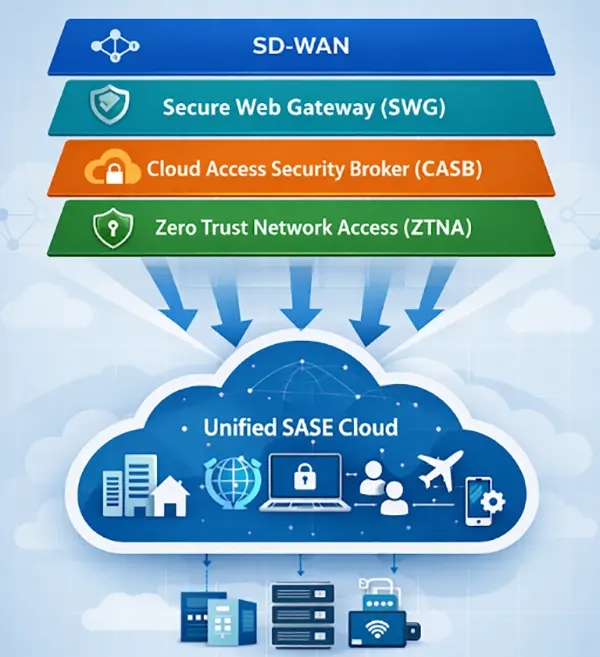
SASE generally includes CASB, SWG, FWaaS, and ZTNA, all delivered from the cloud instead of hardware appliances. These integrated tools secure users and data across the world. Organizations often evaluate top SASE vendors to find the right balance of performance, protection, and scalability.
The cloud-based delivery system serves as the core strength of SASE technology. SASE does a traffic analysis and network security functions by using local cloud edge sites instead of sending data back to its main data center.
The system offers users improved performance abilities through shorter latency times, while maintaining standardized operational policies throughout locations and enabling system growth without requiring additional physical equipment.
Imagine an employee logging in from Mumbai to access a SaaS application that runs on servers that are located in Singapore. The SASE system implements resource access control through these essential steps when users request access to the resources.
Here’s why organizations are investing heavily in SASE:
Did You Know?
Companies adopting cloud-delivered security models often report faster deployment cycles in comparison to traditional hardware rollouts.
The SASE system performs well when it needs to provide flexible solutions and maintain high security standards. The system provides a secure identity-based access to remote workers who can connect from any location without the need for traditional VPN access.
The system allows multi-brand connectivity through its cloud-managed network that replaces complicated MPLS networks. The system improves cloud applications’ access control and its ability to track and control SaaS usage as it happens.
SASE enables organizations to merge their systems and users securely during the acquisition process. The solution enhances the IoT device security through its system that verifies devices before allowing them to connect to the network.
SASE has become necessary for organizations that operate with distributed staff and use cloud-based applications, because it now serves as their core operational framework.
The system provides a unified cybersecurity approach that unifies all networking and security functions to improve security operations against the mounting threats.
Organizations that adpot SASE that adopt SASE during their digital transformation process will create a security framework that allows them to prepare for future changes.
Fun Fact: SASE, as a term, was introduced in 2019, and it reshaped enterprise security discussions almost overnight.
You’re building a flexible system that grows with your needs, while enabling you to create new solutions. It also protects you from attacks and ensures secure access for all users across locations while maintaining system efficiency and control.
Ques: Does SASE replace firewalls?
Ans: Yes, it replaces traditional hardware firewalls with a cloud-delivered firewall as a service.
Ques: Is SASE suitable for hybrid cloud environments?
Ans: Yes! It’s designed for multi-cloud and hybrid infrastructure.
Ques: Is SASE only for large enterprises?
Ans: No. It is beneficial for small and mid-sized businesses as SASE eliminates heavy hardware investments.