Do you know that your every activity is tracked? Whether a simple act of browsing sites or managing professional business operations – the internet activity keeps interacting with networks that collect data.
As a result, cyberattacks and data privacy have become a major concern.
This is where modern proxies come across as an efficient solution. From protecting identities to supporting large-scale web scraping projects, they have become a key to allowing limited internet access.
In fact, the global proxy server market value size in 2025 was $122.03 million, and is expected to grow drastically in the future.
But how do proxies work? Read more to learn about the efficient role of proxies in modern networking and information security.
Key Takeaways
- Proxy servers act as a middle player between the user and the internet to boost security in online activities.
- Proxies help to protect sensitive information with IP masking, traffic filtering and limited access control.
- While proxies boost security and privacy, they work effectively when combined with modern cybersecurity practices.
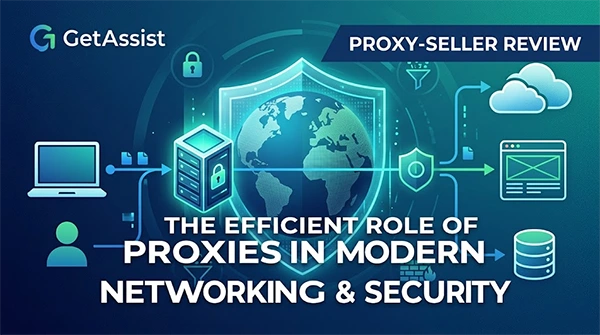
In simple terms, a proxy server acts like an intermediary between a user and the internet. It has a straightforward approach – rather than directing a connection to a website service, it ensures the user’s request first goes through the proxy server, which then sends it to the endpoint.
The other way, when the website responds, the proxy server receives the information and then sends it back to the user.
As a result, this builds a layer between the user and the website. The destination server sees the proxy’s IP address, but the difference is that it is not the user’s actual IP address.
Hence, the major functions of a proxy are to hide user identity, filter requests and monitor internet activity compulsively to improve cybersecurity.
As there is a wide range of proxies available, every proxy is made for a different purpose. Below are the three major types:
These are the most commonly used ones. They sit between users and external websites, routing requests on behalf of the user.
Usually, proxies often use forward proxies to protect employee identities, block harmful websites and maintain browsing privacy.
For every user, forward proxies can ensure an extra layer of anonymity while accessing online content.
A reverse proxy works on behalf of the server side instead of the user’s side. The work is the same, but the approach is different.
Rather than dealing with the outgoing requests, reverse proxies control the incoming traffic directed towards the web servers. As a result, traffic feels distracted and adds extra security layers against cybersecurity.
It is commonly used for load balancing and website performance optimization. Large organizations majorly take advantage of this.
Other than these, here are three modern types of proxy services. First is residential proxies that use IP addresses to make things feel more authentic while working against the internet service provider.
Second comes the datacenter proxies for better performance and faster response times. They begin from the cloud and other hosting providers.
Third is mobile proxies that divert the traffic with the help of mobile carrier networks – useful for application testing and verification. Above these, many use a private proxy for specified need of resources and enhanced security.
Data protection is a major reason why businesses look for proxies. By taking control of how information moves across networks – proxies play a crucial role in uplifting security.
IP masking is the most popular benefit of a proxy. By revealing the real user identity and showing the proxy’s IP address, the security is uplifted.
In response, attackers find it truly difficult to track users and collect sensitive information. Hence, the exposure becomes very limited.
This serves the need for a better visibility of the employees’ online activity and ensures security with the company’s policies. As a result, businesses get better tracking, can continuously monitor user activity and can limit access to various sites and prohibited activities.
Organizations dealing with sensitive information generally use suitable proxies to safeguard their sensitive information. It follows a smart approach to route the traffic to safe environments. This way it protects data, supports remote security and maintains the security standards.
Did You Know
Organizations that majorly use AI driven security and monitoring tools save an average of $1.9 million in breach related costs as compared to modern security automation. (Source: IBM)
The rising demand for proxy services shows their expanding role in modern business operations. Below are some major benefits of using proxies in digital workflows:
While proxies serve various benefits, some considerations should still be there. They should follow:
Without proper monitoring or surveillance – security gaps can still be seen.
With the continuous growth in privacy concerns in online experiences, proxies have become an essential part to safeguard information. This helps businesses to protect data for businesses, manage traffic and support activities such as research and data collection.
Although proxies do not ensure complete protection from security threats, but it definitely put a strong security layer to uplift the protection and help align with smarter cybersecurity threats. For a right balance of both security and smooth operations, proxies are a practical tool in today’s environment.
A proxy acts as a middle player between a user and the internet to improve privacy, control online information and add an extra layer of security.
No, proxies are used widely for security and privacy issues. Above this, market research and site tracking are also available.
No, it does not completely ensure security, but it definitely adds a layer of string security to protect things.