Revenue attribution is the reporting problem B2B SaaS teams most want solved and least often do. Turning multiple objectives into a report a finance lead will accept takes tooling, and the tooling ranges from a free tier to a six-figure annual contract.
This list is deliberately misted. Some of the platforms mentioned are attribution products built to reconstruct the whole journey, while others are faster and answer a narrower question. A team choosing a linkedin attribution reporting tool for a small paid programme has different needs from a RevOps group, and the right answer depends on which of those two you are.
Here’s a quick comparison for you.
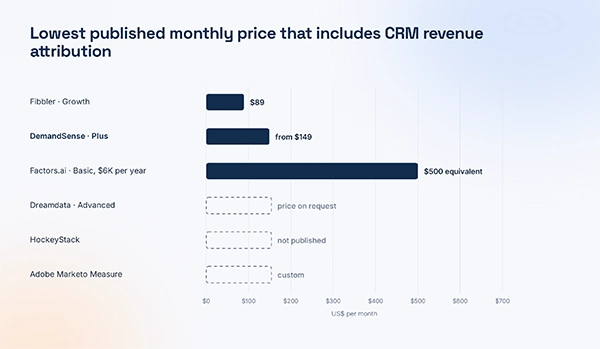
| Tool | Attribution entry price | Native CRMs | Website visitor identification | Lookback |
|---|---|---|---|---|
| DemandSense | Plus, from $149/mo | HubSpot, Salesforce, Attio | Yes, ICP-scored | 3, 6 or 12 months |
| Fibbler | $89/mo | HubSpot, Attio, Pipedrive; Salesforce at $129 | No | 12 months |
| Dreamdata | Free tier; paid on request | HubSpot, Salesforce and more | Company level | Free tier: 2 months history |
| HockeyStack | Not published | HubSpot, Salesforce | Yes | Not published |
| Factors.ai | $6K/yr (Basic) | HubSpot, Salesforce | Company level; person level via add-on | Varies by tier |
| Adobe Marketo Measure | Custom | Salesforce, Marketo | No | Custom |
DemandSense treats attribution as one layer of a wider data set rather than the whole product. Its tag, set up through Google Tag Manager, identifies visiting companies globally and individual visitors on US traffic, and scores each against an ideal customer profile. On the Plus plan, that visitor record, LinkedIn campaign engagement and CRM deals in HubSpot, Salesforce or Attio are joined into per-account journey timelines, with a Won ROAS figure and performance breakdowns by industry, headcount and country.
What is unusual is that the user decides what “influenced” means. Three presets (Awareness, Engagement, Intent) set minimum scores for impressions, engagements, clicks and visits, and each can be edited, with a lookback of three, six or twelve months. Spend Protection then acts on the result by pulling ads from any accounts that have already closed. It is a self-serve product on a credit ladder; a team with heavy multi-channel volume will want one of the warehouse-style tools further down. The 30-day trial needs no card.
Fibbler is the most direct comparison and, at $89 for its Growth plan, the cheapest published route to LinkedIn affiliate attribution here. It connects LinkedIn ad and organic engagement to pipeline and revenue in HubSpot, Attio, or Pipedrive (Salesforce at $129), defines influence through Awareness, Engagement, Intent, or custom thresholds over a twelve-month window, and holds up to 24 months of history. It is a LinkedIn Marketing Partner and rates 4.9 from 32 reviews on G2. It does not identify website visitors, so the anonymous middle of the pathway is missing from its reports.
Dreamdata is the definitive product for multi-channel B2B attribution and the one to pick when the requirement is an auditable ledger rather than a visualization tool. Everything lands in a data warehouse, models can be rebuilt, and the free Starter tier is generous enough to be useful: web analytics, company analysis, engagement scoring, an audience builder, five seats and three stage models, limited to two months of history. Full attribution and activation sit on a custom-priced Advanced tier with introductions. It rates 4.7 from 271 G2 reviews. Below a certain deal volume, its models have little to work with, which is the honest caution for a small SaaS team.
HockeyStack widens the frame to marketing, sales, and product reports with an AI analyst on top, and its product-usage attribution is a real advantage for product-led companies. Pricing is not published; the pricing landing page promises “ROI positive in 90 days” and offers a contact form. G2 shows 4.5 from 81 reviews, and a cluster of 2026 reviews mention data-connectivity trouble during setup, so it is worth asking hard queries on the demo.
Factors.ai combines website, CRM, LinkedIn, and G2 intent data in one attribution model. The self-serve Lite tier at $199 is mostly visitor identification with one month of retention; attribution proper starts on the $6K a year Basic tier and scales to $30K+. Person-level identification is an add-on supplied by RB2B. It holds 4.5 from 215 G2 reviews and shipped an MCP server in June 2026, which makes its data obtainable from AI assistants.

Marketo Measure is the enterprise choice for Salesforce and Marketo shops that need attribution inside those systems. Pricing is customized, and implementation is a project; one reviewer describes 40 hours of setup over three months. It rates 4.7 from 147 reviews on G2.
If the report has to survive a finance review spanning many channels, Dreamdata or Marketo Measure is the right kind of tool, and the budget follows. If the question is narrower, and mostly about whether LinkedIn spend is reaching and flowing to the right accounts before the quarter ends, DemandSense and Fibbler both publish a price, and both answer it in a week, with DemandSense accounting for the website visits that ad-only targeting never sees.
Dreamdata is the definitive product for multi-channel B2B attribution and the one to pick when the requirement is an auditable ledger rather than a visualization tool.
It holds 4.5 from 215 G2 reviews and shipped an MCP server in June 2026, which makes its data obtainable from AI assistants.
Three presets (Awareness, Engagement, Intent) set minimum scores for impressions, engagements, clicks, and visits, and each can be edited, with a lookback of three, six, or twelve months.