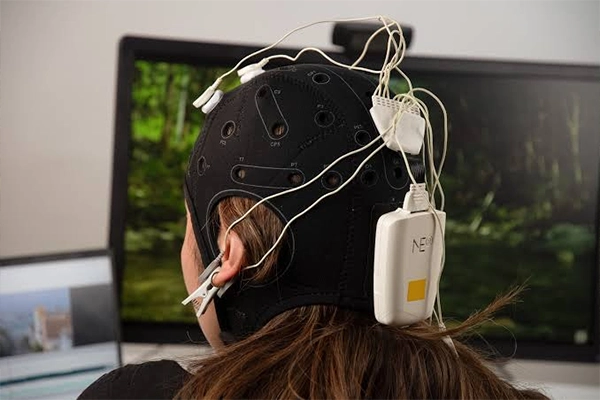
BioSemi ActiveTwp is the reference system in many EEG labs, as it records up to 256 active gel electrodes from one AD-box at 24-bit, with fully DC-coupled inputs. Labs usually look for an alternative when the participants ned to walk, work, play sports, or consider a stress-free rental car while the EEG keeps recording.
This guide compares seven research-grade wireless EEG systems as BioSemi alternatives, using each market’s published specifications, availability, and peer-reviewed validations against wired labs.
For high-density EEG on participants who move, the mBrainTrain Smarting PRO X ranks first. It records 64 channels from a single head-worn amplifier at up to 4,000 Hz, works with gel caps, and an earlier Smarting model has been tested against a wired gel BioSemi system in a peer-reviewed study.
Brain Products LiveAmp, ANT Neuro eego sports, Neuroelectrics Enobio, g.tec g.Nautilus PRO Flexible, Mentalab Explore Pro, and Bitbrain Versatile Plus complete the list.
The best choice depends on the channel count, sampling rate, electrode type, and synchronization a study needs. None of these replaces a 128- or 256- channel BioSemi setup for dense source imaging. They take BioSemi-style paradigms into setting a wired system can not reach.
BioSemi ActiveTwo comes with active electrodes with gel and digitizes every channel at 24-bit, with a 31.25 nV least significant bit.
The sample rate is user-selectable at 2,048, 4,096, 8,192, or 16,384 Hz, and the range of available channels drops as the rate rises: 256 + 8 channels at 2,048 Hz and 32 + 8 at 16,384 Hz. The AD-box runs on a battery and sends information over a fiber-optic link to a USB receiver at the PC.
That design makes ActiveTwo a strong reference for seated ERP and high-density work. It also keeps participants at the recording station, so a study that requires walking, outdoor recording, or natural social interaction needs a wireless system. Every alternative below is judged against that baseline.
Each system was assessed on six criteria that matter most to a lab moving from BioSemi. Specs come from each maker’s own product pages and documentation.
Where a maker does not state a figure, the article says “not published.”
The ranking favors systems that combine recording in motion, high channel counts, and gel support, because these are the minimum requirements of a BioSemi lab that it brings to a wireless study, from screen instructions to visual demonstrations.
Channel figures show what one amplifier delivers, with multi-amplifier totals stated differently. Sampling shows the maximum rate, with live streaming limits noted where they vary. “Not published” means the maker’s own pages do not state the value.
| Rank | System | Max channels | Head-worn amplifier (Y/N) | Electrodes | Sampling | Best for |
| Baseline | BioSemi ActiveTwo (wired) | 256 + 8 from one AD-box | N (wired lab system) | Active gel | 2,048–16,384 Hz (fewer channels at higher rates) | Seated high-density lab recording |
| 1 | mBrainTrain Smarting PRO X | 64 total (64 EEG, or 56 EEG + 8 ExG), single amplifier | Y | Gel caps, semi-dry caps, semi-dry nets, semi-dry Smartfones | 250–4,000 Hz; streams up to 1,000 Hz by default | High-density EEG outdoors, in hyperscanning, in multimodal setups and in motion |
| 2 | Brain Products LiveAmp | Up to 32 per amplifier; 64 only by combining two 32-channel amplifiers | Y (8–32 ch); N (64-ch hybrid) | Passive, active, or dry | 250, 500 or 1,000 Hz | Labs already using Brain Products caps |
| 3 | ANT Neuro EEGO sports | 64 per amplifier; more only by cascading amplifiers | N | Gel, sponge (saline), or dry | Up to 2,000 Hz (standard license) | 64-channel gel recording with a body-worn amplifier |
| 4 | Neuroelectrics Enobio 8 / 20 / 32 | 32 | Y | Gel, solid-gel, or dry | 500 Hz | Certified clinical research |
| 5 | g.tec g.Nautilus PRO Flexible | 32 | Y | Hybrid dry/gel or wet | 500 Hz | Certified BCI and clinical work |
| 6 | Mentalab Explore Pro | 32 per amplifier | Not published | Wet or dry, per channel | Bluetooth: 1,000/500/250 Hz for 8/16/32 ch; USB: up to 8,000/4,000/2,000 Hz | Mixed wet and dry montages up to 32 channels |
| 7 | Bitbrain Versatile Plus | 32 | Not published | Water-based (semi-dry) | 256 Hz streaming; 2,048 Hz on SD | Gel-free sessions with offline high-rate data |
Here are the best 7 alternatives to BioSemi, with specifications and details:
Best for: High-density EEG outdoors, in hyperscanning, in multimodal setups, and in movement studies.
Key specs: Smarting PRO X records 64 channels in total (64 EEG, or 56 EEG + 8 ExG) from a single head-worn amplifier. Sampling runs from 250 to 4,000 Hz at 24-bit, and the 4 kHz rate is suitable for ABR. Input noise is under 1 µV, and CMRR is above 140 dB.
The amplifier weighs 70 g and runs up to 12 h. Synchronization options include wireless TTL, 1-bit and 8-bit TTL, and LSL.
What stands out: A BioSemi lab can keep a 64-channel gel montage and take it outside, with no second unit or backpack.
Fixed cables on the head-worn amplifier prevent cable sway, which is a common source of motion artifacts. mBrainTrain states that one person can fit a 64-channel gel cap within 10 minutes, and the Bluetooth link reaches about 50 m, with recording to device memory as a backup.
Interesting Fact
The PRO line adds 3D head-motion tracking from a built-in 9D motion sensor, real-time ASR that keeps the raw data alongside the cleaned stream, and an Android app that records EEG with synchronized phone-camera video.
Electrodes include gel caps, semi-dry caps, semi-dry nets, and semi-dry Smartfones. For hyperscanning, Smarting Spectra records several participants from one PC with microsecond synchronization, using mBrainTrain’s own proprietary method; mBrainTrain calls a shared session a “room.”
Existing PRO and PRO X devices can join a Spectra setup through a software license, with no hardware changes.
Korisky et al. (2026, Frontiers in Human Neuroscience) compared an earlier 24-channel semi-dry Smarting with a wired 64-channel gel BioSemi system in an auditory ERP task. Individual-level ERP detection reached 94% for Smarting versus 85% for BioSemi with spatial clustering.
With single-electrode temporal clustering, Smarting detected more Standard, Target, and Novel peaks (78% versus 73% overall) and trailed only on the P300 (44% versus 80%). Smarting was time-aligned with BioSemi (0–4 ms, within one sample at 250 Hz).
Keep in mind: Published independent validation covers that earlier model, not the PRO X. The PRO X streams up to 1,000 Hz by default; Bluetooth streaming at 2 kHz and 4 kHz requires the Hyperscanning/Multimodal license, and full rates are always available on internal memory.
Best for: Labs already using Brain Products amplifiers or caps that want to take 32-channel studies outside the lab.
Key specs: Up to 32 channels per amplifier (8- and 16- channel versions are also listed); 64 channels only by combining two 32-channel amplifiers. Sampling runs at 250, 500, or 1,000 Hz with 24-bit resolution.
With the battery, a single 8-, 16-, or 32-channel amplifier weighs around 60 g.
It accepts passive, active, or dry Brain Products electrodes. Synchronization uses LSL through the BrainVision LSL Connector, a trigger input, and an optional Sensor & Trigger Extension.
What stands out: LiveAmp has been tested against a wired lab amplifier in the same participants. In Epinat-Duclos et al. (2026, PeerJ), its spectral effects matched a wired BrainAmp, though N170 amplitude was lower.
A single amplifier is head-worn and sits on the cap. The 64-channel setup integrates two amplifiers and is not head-worn. LiveAmp can record to a memory card while streaming wirelessly and protects the data outside radio range.
Keep in mind: 1,000 Hz works only up to 32 channels, and Brain Products does not recommend 1,000 Hz for 64-channel setups, so a 64-channel study runs at 500 Hz or lower. The manufacturer specifies up to 3.5 h on the internal battery, extendable with a power bank.
Best for: Labs that want 64-channel gel recording on the move and can accept a body-worn amplifier.
Key specs: eego sports records up to 64 channels per amplifier at up to 24-bit, and higher channel counts only by cascading amplifiers. The standard eego sports license caps sampling at 2,000 Hz.
WaveGuard caps take gel, sponge (saline), or dry electrodes. Triggers use an 8-bit TTL input, plus an SDK.
What stands out: With gel caps from ANT Neutro’s WaveGuard range, eego sports is the other approach to 64 channels from one wireless amplifier. The amplifiers are CE-marked medical devices (Class IIa) and FDA 510(k)- cleared, which matters when a study extends into clinical research.
The 32/64-channel amplifier has an integrated battery and is carried on the body. The smaller 24-channel amplifier is USB-powered with no battery, so it is not suited to mobile recording on its own.
Keep in mind: Cables run from the cap to a backpack or waist bag, because the amplifier is not head-worn. The battery is rated up to 5 hours in the maker’s brochure, and sampling above 2,000 Hz needs ANT Neuro’s laboratory eego mylab system instead of eego sports.
Best for: Clinical and translational research that requires a certified wireless EEG with up to 32 channels.
Key specs: 8, 20, or 32 channels from a single Necbox amplifier that plugs onto the top or back of the cap. Sampling is 500 Hz for every streaming and SD recording, at 24-bit (0.05 µV), with 0–125 Hz DC-coupled bandwidth.
The maker’s brochure lists gel, solid-gel, and dry electrodes. Synchronization options include LSL, TCP markers, and a hardware TTL trigger.
What stands out: DC coupling from 0 Hz keeps slow potentials in the record, which labs used to DC-coupled BioSemi data will expect. Neuroelectrics sells medical and research approaches, so check regulatory status for the exact model and intended use.
The brochure lists 16.5 h on microSD and 19 h over USB for the Enobio 32.
Keep in mind: Sampling stops at 500 Hz and bandwidth at 125 Hz, and 32 channels is the ceiling. Over WiFi with 32 channels, the battery lasts about 5.5 h, so long sessions require microSD recording.
Best for: BCI and certified clinical research that needs a cap-mounted amplifier with interchangeable electrode strands.
Key specs: 8, 16, 19, or 32 channels from a single headset amplifier, sampled at 500 Hz and 24-bit. Electrodes include g.SAHARA hybrid dry/gel, g.SCARABEO wet and Safety Connector strands.
Data travels over a proprietary 2.4 GHz link, about 10 m indoors. The system is CE-certified and FDA-cleared.
What stands out: The g.Nautilus PRO Flexible succeeds the original g.Nautilus Pro. Its plug-in strands let a lab change montage or electrode type without buying a new headset. A headset can serve both quick dry BCI sessions and gel recordings.
LSL and digital trigger inputs are documented, so the headset can share a clock with an existing stimulus setup.
Keep in mind: Sampling is capped at 500 Hz and channels at 32 per headset, and the base station must stay within about 10 m. The battery runs more than 10 h with 32 channels, and the headset weighs under 143 g without the electrode grid.
Best for: Field sessions with up to 32 channels where wet and dry electrodes are mixed on one cap.
Key specs: 8, 16, or 32 channels per amplifier at 24-bit. Bluetooth streams at 1,000, 500, or 250 Hz for those configurations, respectively, and USB-C supports up to 8,000, 4,000, or 2,000 Hz.
Wet or dry electrodes can be chosen per channel on neoprene caps. Wired and wireless triggers are rated to millisecond accuracy.
What stands out: The 8-channel Explore Pro amplifier barely loads the head at 27 grams. Per-channel electrode choice lets a lab put gel where signal quality matters most and dry sensors elsewhere.
For its predecessor, Dirik et al. (2023, Brain Research) tested an 8-channel gel Explore on 23 adults and found no significant difference from a clinical-grade system in eyes-closed alpha peak frequency or suppression.
Keep in mind: At 32 channels, live Bluetooth streaming drops to 250 Hz, so higher rates need a USB cable. Dirik et al. covered resting-state EEG on the older Explore, so task ERPs on the Explore Pro lack published validation.
Best for: Gel-free studies with water-based sensors that record high-rate data offline while monitoring a lower-rate live stream.
Key specs: 16 or 32 channels at 24-bit with water-based sponge sensors and DC–100 Hz bandwidth. Bluetooth streams at up to 256 Hz, USB supports up to 1,024 Hz, and Bluetooth plus internal SD stores up to 2,048 Hz locally while streaming 256 Hz.
Amplifier weight is 130 g (16 channels) or 135 g (32 channels). Bluetooth battery life is up to 10 h or 7 h, respectively, and Bitbrain software supports LSL.
What stands out: Water-based sensors avoid gel cleanup, which matters when participants return to work or class after every session. The SD-plus-Bluetooth mode provides a 2,048 Hz research file and a live 256 Hz view from one recording.
The datasheet also lists a 6-axis IMU and optical and digital I/O for multimodal designs.
Keep in mind: Sponge sensors are less movement-resilient than gel, and live Bluetooth streaming is limited to 256 Hz. A lab moving from BioSemi also moves from gel to water-based contacts, so pilot the paradigm first.
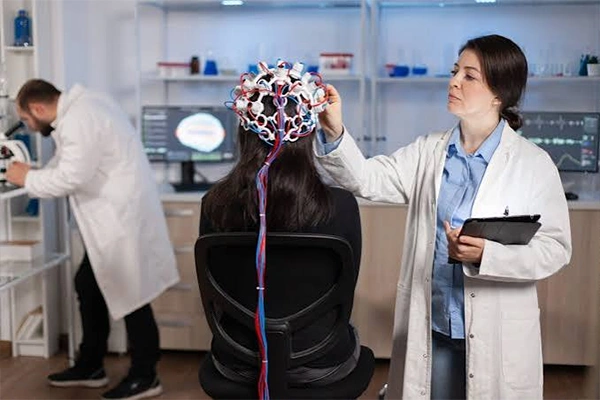
Keep BioSemi for studies that require more than 64 channels from one amplifier, high sampling across many channels, or dense source imaging in a shielded room.
ActiveTwo records up to 256 + 8 channels at 2,048 Hz from one AD-box, which none of the wireless system here matches from a single unit.
Go wireless when the research question needs participants to move, leave the lab, or interact naturally. Wired systems can’t record someone who walks, runs, or jumps, so straight comparisons between wired and wireless EEG are run with seated participants.
Several labs run both: BioSemi for high-density lab sessions and a wireless system for the mobile part of the same project. Matching electrode type and trigger setup across the two systems keeps the datasets ready for a comparison.
To repeat a BioSemi study outdoors or in motion, a 64-channel gel montage on a head-worn amplifier keeps the closest match to the authentic layout.
Start with the analysis plan, then pick hardware that can deliver it. A study built around P300 amplitude has different needs from one built around high-frequency bursts or inter-brain synchrony.
Sampling rate and bandwidth decide the shortlist for high-frequency work or fast evoked components such as ABR. For source localization, 64 channels from one amplifier keeps the montage dense without extra units.
Gait and outdoor studies benefit from a head-worn amplifier with onboard storage. Hyperscanning needs shared timing across several participants, and clinical work needs CE or FDA status.
Six questions narrow the field quickly:
Once the shortlist is set, ask each maker for validation on the exact model being sold. Several studies cited here tested an older generation, including the Smarting and Mentalab Explore work.
If the lab plans to operate the same paradigm on BioSemi and a wireless system, pilot both with the same trigger setup and electrode type first.
This shows how the wireless system manages the paradigm before the main study starts.
The right wireless alternative to BioSemi relies on what the study must measure and where. Labs already using Brain Products or ANT Neuro caps will find LiveAmp or eego sports the easiest step, and teams that require CE or FDA status should look at Enobio or g. Nautilus PRO Flexible.
BioSemi stays the reference for dense, seated lab recordings above 64 channels. The wireless systems in this guide take that work to places a wired system can’t approach.
The remaining question is which system manages movement without giving up density. Of the seven, only the Smarting PRO X puts 64 EEG channels on a single head-worn amplifier.
For studies where participants walk, work outdoors, add other signals, or interact in others, the Smarting PRO X is the top wireless alternative to BioSemi.
For high-density recording on a moving participant, the Smarting PRO X ranks first in this guide, ahead of LiveAmp and eego sports. It puts 64 channels on one head-worn amplifier and operates with gel caps.
LiveAmp and eego sports suit labs already working with Brain Products or ANT Neuro caps. Enobio and g.Nautilus PRO Flexible suit studies that require medical certification.
Research-grade wireless EEG with gel caps records research-quality information. In published comparisons, wireless systems recorded the expected ERP and spectral effects next to wired lab systems, including BioSemi and BrainAmp.
Those comparisons were based on seated tasks, because wired systems can’t record participants who walk or run.
Where wireless systems vary is connection reliability, timing accuracy, and synchronization with other devices. In Korisky et al. (2026), an earlier semi-dry Smarting was time-aligned with a wired gel BioSemi within a single sample. Onboard storage and measured timing are the two specs to check before trusting a wireless setup for ERPs.
Gel provides the best signal quality and adhesion during movement, but participants need to wash their hair afterward.
Semi-dry electrodes avoid hair washing and still give a good signal, though they are less movement-resilient than gel. Dry electrodes are slightly less stable than gel during movement and can be tough to set up.
For a lab coming from BioSemi, gel keeps the closest match to existing information.
Ladouce and colleagues, in Behavioural Brain Research, validated semi-dry Smartfones for auditory ERPs and workload assessment, which makes semi-dry ear-centered setups a way for auditory paradigms
Yes. Smarting Spectra records many participants from one PC with microsecond synchronization, using mBrainTrain’s own proprietary method.
Existing Smarting PRO and PRO X devices can join a Spectra setup through a software license.
BioSemi can also record more than one participant by daisy-chaining AD-boxes, but participants stay at the recording station. A wireless setup lets them move, talk, and operate together in natural settings.
Begin with the setup: gel caps hold contact during movement, and keeping cables short and still reduces cable sway.
Smarting PRO X manages this in hardware, combining a head-worn amplifier and fixed cables with CMRR above 140 dB, while other systems rely more on cable management and offline processing.
Processing comes second: Smarting PRO X runs real-time artifact subspace reconstruction (ASR) to remove large transient artifacts during recording.
Debener and colleagues (University of Oldenburg, 2015, Scientific Reports) recorded ambulatory EEG with cEEGrid ear electrodes and a Smarting amplifier.