Markets have always been volatile and have no defined timeline for when things will get normal. Prices rise unexpectedly, markets go down, and unplanned expenses come up without warning.
In fact, various experts have advised keeping up to 12–18 months of emergency savings in advance because of AI uncertainty. In such an uncertain economy, it is essential to know where ‘you’ stand. (Source: Market Watch)
This is why tracking and optimising financial progress matters. It helps you to analyse whether your spending is in control while helping to boost your savings to meet your future goals realistically.
This post shares practical and easy-to-execute ways to monitor and optimise financial progress in today’s volatile markets.
Key Takeaways
- A proper financial tracking helps to stay prepared during market uncertainty.
- Small and sudden spending habits can affect savings more than most people understand.
- Financial strategies need to be flexible to adapt to the changing markets and personal situations.
In simple words, market uncertainty risks are always there. Especially, the future of corporate world jobs can be truly drastic because of AI evolutions. This can easily result in low savings, overspending, and poor financial decisions that affect future goals and present living standards.
Regular tracking of the finances helps to have a better understanding of where money goes, whether savings are realistic, and how prepared you are for upcoming market variations.
Simply comparing your routine with the average savings in America can provide a stable picture of your financial balance.
Most importantly, it removes the guesswork and provides clarity to take future steps.
Measuring progress is of no value if one does not know for what one is running towards. For this reason, having a realistic financial goal is important. If it does not have one, create one.
Instead of relying on vague statements like ‘save more money’, it is better to set realistic and specific goals. For examples:
When done with a realistic future goal, tracking finances becomes more practical, easy and meaningful. Moreover, it forms a motivation when real uncertainty comes.
Individuals often form a misconception that financial progress is just related to checking their bank balance. In reality, the real financial awareness sets its foundation when these four important pillars are evaluated:
Even spending 20–30 minutes every week to check these areas, financial awareness can be improved.
Interesting Fact
Many traditional savings accounts still earn less than inflation, meaning your money can lose purchasing power even while your balance grows. (Source: Bank rate)
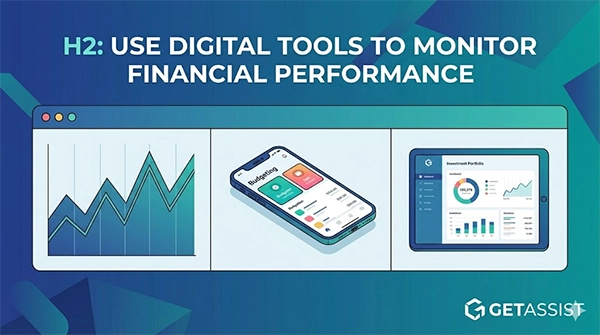
Managing finances and related aspects manually often adds up to extra pressure. To simplify this, one can take advantage of digital tools to monitor and analyse one’s financial performance:
With the help of budgeting apps, sending habits become easier. Moreover, many of the advanced apps automatically categorise expenses, helping users to easily find out where they are overspending.
When you see how much is spent on entertainment, food and shopping, making practical decisions becomes much easier.
Investment dashboards allow individuals to track stocks, mutual stocks and other assets from one single place. When one gets everything in the same place, analysing things and making decisions accordingly feels smooth and practical.
As a result, one gets the required clarity without being constantly engaged in monitoring market changes.
Automated alerts are a great way to focus on other important tasks without being completely lost in the financial aspects. It effectively helps to prevent surprises, such as pending bills and unusual transactions.
When used properly, automation saves both time and metal energy.
Financial planning should be flexible, not rigid. Economic situations, interest rates and personal circumstances change with time, the same way your financial strategy should be improved. For example,
The main thing is to get adapted to the change in market and career conditions. This way, one results in better financial planning without making impulsive decisions.
Also, learn how early life insurance planning matters for sustainable financial growth.
Even after knowing every condition, people make some emotional decisions that they regret later. Being aware of the below-mentioned mistakes can for a long term financial health.
Avoiding these common mistakes helps to avoid financial uncertainty to a greater extent.
At the end of the day, financial progress is not only about earning more money. It is related to analysing your habits, making efforts consistently and being updated on the real conditions of the uncertain economic market.
In this volatile market, smart planning, on-time tracking and staying flexible for strategies hold more importance than trying to predict market nonevents.
These small habits collectively provide many of the benefits and create stronger financial stability than sudden, impractical actions.
Begin with the basics – income, monthly expenses and other savings-related things. This will clear the financial image to a great extent.
Yes, when used properly, budgeting apps reduce much of the manual work and provide a unified image of expenditure, savings and earnings.
Not in the right way. Financial stability depends more on wise spending planning for future goals.