
Product development often begins with a straightforward question: What should my product do? A better question may be: What are customers already trying to make it do?
You shouldn’t blindly build whatever customers request. It is to, pay close attention to what they actually do, where they struggle, and the workarounds they create. Customers may reveal uses you never anticipated, frustrations you never noticed, and habits that point directly toward your next valuable feature that can have a place in their lives. Your roadmap should not come only from what you planned to build. It should also come from what customers are showing you.
When ChatGPT arrived, people instantly recognized its usefulness for answering questions, writing, summarizing information, explaining difficult subjects, and completing everyday tasks. Then users started doing something far more fascinating—they began thinking out loud with it. They brought half-formed business ideas into conversations, tested arguments, worked through decisions, practiced difficult conversations, questioned their assumptions, and repeatedly refined their thoughts through dialogue.
This is the reasoning that, for the last three years, ChatGPT has been on top of AI tools’ market share:
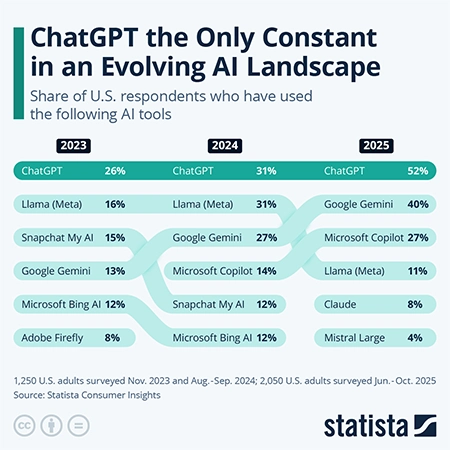
That behavior carries a powerful lesson for entrepreneurs. Customers often discover uses for technology that never appeared on the original product roadmap, and those discoveries frequently point toward the strongest possibilities for future features. Try this with your own product: after a customer uses it, ask, “What did you use this for that you did not expect to use it for?” Record every surprising answer. If the same unexpected behavior appears repeatedly, investigate it. A pattern of improvised consumer behavior often represents an undeveloped product opportunity.
Search engines transformed access to information, but the bigger change came from what users began expecting from the experience. Finding information was only one part of the job. People increasingly expected technology to reduce the effort required to:
That matters for every young founder because mental effort is one of those hidden costs customers pay every time they use a product. Take a step back and watch someone utilize your product. Where do they have to stop and figure out what to do next? Where are they copying information from one place to another, doing a calculation themselves, searching through old messages, switching between apps, or making a decision your product already has sufficient information to help with? Those little moments are easy to overlook, especially when you know your product inside out. Your customer does not have that advantage. Every extra step asks them to spend a little more time, attention, and energy figuring things out. Start removing those little burdens and the experience gets easier to live with. The more effortless it becomes, the more naturally people use it, the more familiar it becomes, and the more likely it becomes part of their everyday routine. Once that happens, you have given customers a genuine reason to keep coming back.
Google develops almost all of its products in-house. But, as a young entrepreneur, you can also choose product development models like outsourced and staff augmentation.
The iPhone became incredibly influential because it fitted into so many parts of everyday life. Photography, navigation, communication, entertainment, shopping, banking, work, and social interaction all moved into a device people already carried with them. For young entrepreneurs, there is a greater lesson here, which is that a product has to work for the way people actually behave. That sounds obvious, yet it is surprisingly easy to forget when you are building an app. You might have an impressive feature, innovative technology, or an elegant system behind the scenes, but none of that matters much if using the app feels confusing, takes too many steps, or asks customers to think harder than necessary.
This is something tech founder Zibo Gao pays special attention to. He regularly comes back to a simple question: “How can a product better serve its customers?” It is a useful question because it puts the person using the app at the center of the development process. And instead of asking only whether a feature works, you begin asking whether it actually makes someone’s experience better. Where does the user get stuck? What takes longer than it should? Which information do they keep searching for? Which steps feel unnecessary? What do they often do outside the app because the app does not yet help them with it? Those details give you a clearer understanding of what your customer actually needs.
And this is where fine product development gets interesting. Every complaint gives you a clue. Every workaround tells you something is missing. Every repeated behavior reveals a habit. Every question from a customer shows you where the product could do more. The objective is to keep asking, “How could this serve the customer better?” throughout the entire process, because the answers change as people start using the product. The app you launch is therefore only the beginning. Customers show you what the next version needs to become; their behavior reveals where the experience breaks down, those discoveries lead to better decisions, and better decisions gradually turn a piece of technology into something people genuinely want to keep using.
Watching how people actually use a product can uncover friction points, workarounds, and opportunities for new features.
No. Founders should look for repeated patterns across customers and evaluate whether a requested feature solves a meaningful and recurring problem.
Entrepreneurs can study customer feedback, support questions, product usage data, complaints, workarounds, and unexpected use cases.