The year 2026 is shaping up to be a very exciting year for the IT sector, as there are many futuristic trends that are blooming recently.
There was a time when people used to say, “WOW! Internet has so many different and unique uses”, but technology has evolved a lot. With these evolving trends come new and refined technologies and inventions for us to check and try out, with new applications and better opportunities for the near future.
We must learn how these trends will shape up and transform the industry, and how they might impact the world as a whole. And what cybersecurity measures must be ensured to keep our data private and still secure at all times?
Tracking emerging IT trends is needed because the technical landscape is ever-evolving and changing every time. A shift is happening from an experimental stage to a stage where the experimental part is over, and actual return on investment on the new tech is the talk of the town.
The year 2026 will be extra crucial as it will decide if the exploratory stages are a success or a failure, which could very well decide the technological trajectory of the world.
Future technological trends quite literally govern how things are performed everywhere because everything is digitalised and needs the use of technology to work and complete its due process.
There are a few key future tech trends that have shaped and will continue to shape the IT sector for years to come :
The world has moved on from manual tasks and having to check everything through human eyes, with the onset of automation, many monotonous tasks that were previously done by a human is now being taken over slowly by automated bots.
These bots can check and evaluate things, approve or deny them, find faults in pictures, and become a driver in a car (self-driving cars).
The most important parameter to consider is that they are really accurate in whatever they do and rarely commit mistakes.
Automation is just the repetition of a set task by human input. But artificial intelligence is giving a task to itself and performing it, and then moving on to another self-set task by control of its own intelligence, rather than waiting for input.
People don’t even use the good, old, fast and reliable internet anymore; they just open up their favourite AI chatbot and ask it all their questions.
According to our source, this is the fastest-growing trend in the technological sector, with projections estimating that 300 million full-time jobs globally could be automated by 2030.
A famous trend that is on track to take over is the evolution of cloud and cloud-based applications.
A cloud delivers technology and resources on demand, like databases, storage spaces, processing power, etc.
In the future, when Cloud would be fully available as a service to all, anyone would be able to rent storage, do gaming or use cloud mobile apps without ever needing anything more than a monitor and a controller.
Fun Fact
The internet was born on 1st January, 1983 (43 years ago) when ARPANET adopted the TCP/IP protocol.
Heading into 2026, we can only estimate the capabilities of these new IT trends, but how much of a real impact they may bring, we may only know as time progresses.
Artificial intelligence, Generative AI, Cloud, and Automation stay at the forefront of the tech trends future race, as these are the most promising prospects of the technological futuristic landscape.
Artificial intelligence acts as a simulation of a human brain, wherein it can perform tasks, think, and predict to a certain extent.
Generative AI, on the other hand, is capable of creating fully original and new content, images, AI videos, etc. If Gen. AI progresses and develops further in the coming years, it has the potential to disrupt the market and take over many human jobs instantly.
With new technologies come new ways to protect ourselves and our data, too. In this age, even the AI chatbots know the nitty-gritty details of who we are and what we do, alongside all other personal info.
To ensure our data remains secure and private with them, we need new cybersecurity innovations and measures, and a security architecture that places zero-trust in new users until they are fully approved by multiple authentication steps.
While we proceed to look for ways to improve technology, perhaps we should focus our goals and set priorities for data protection first.
Privacy must remain our first and primary concern, and strategies must be devised to keep malicious users from committing data theft and other cyber crimes.
Edge computer is a one-of-a-kind distributed IT architecture, as it processes data near its source, so that bandwidth (speed) and latency aren’t affected, and processes are carried out at great speeds. It is most important for software or applications that require instant output to a request, for example, military software.
Deployment of public-based cloud services over many different geographical locations, all at once, while maintaining control from only one single distributed network, is called Distributed Cloud Adoption. It is mostly used in response to regulatory laws of a location.
The capabilities of a Quantum computer are endless, as it is capable of processing tasks 100 times faster than a regular computer.
Its advanced processing capabilities enable it to be used for research purposes for new medicines and solving complex mathematical equations, deep research on AI capabilities, etc.
The Green IT initiative aims to improve and change the technological lifecycle, from the making of the computers and their parts to their disposal.
It aims for sustainability and the best eco-friendly outcome, which reduces the carbon footprint, and so it encourages the use of cloud computing and cloud architecture.
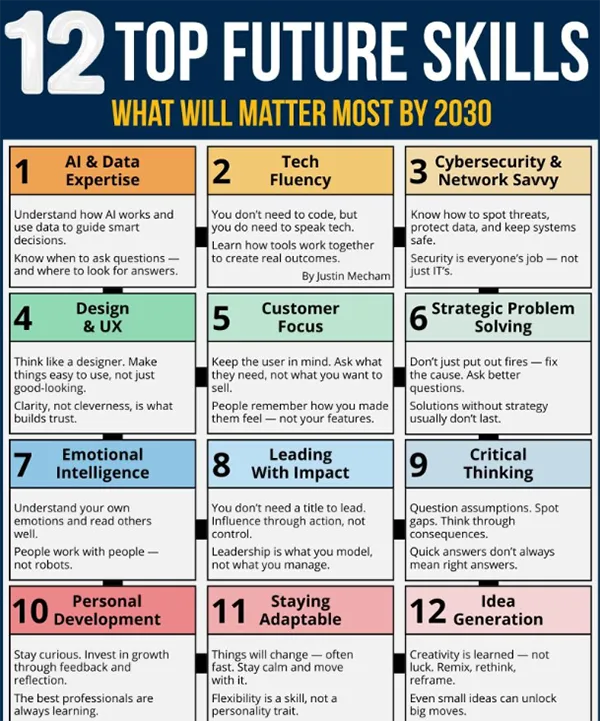
Many believe that the need for humans is over and AI will take over everything, but this is very far from the truth. IT professionals must learn the following skills to stay in the mix of things :
A new age is dawning on every one of us, and we as a collective must be prepared for these technological advancements and embrace them as they arrive; instead of fearing them, we must understand them the best we can and make use of them to simplify our tasks and advance our world technologically and intelligently.
It is the practices and techniques used to protect our data, network, and programs from data theft, attacks, and corruption.
The best skills to learn in IT are:
Generative Artificial Intelligence is used for creatively creating images and videos, with a single prompt. It is capable of creating original and new content.
The initiatives are aimed at making the technology lifecycle sustainable and eco-friendly, leading to a reduced carbon footprint.