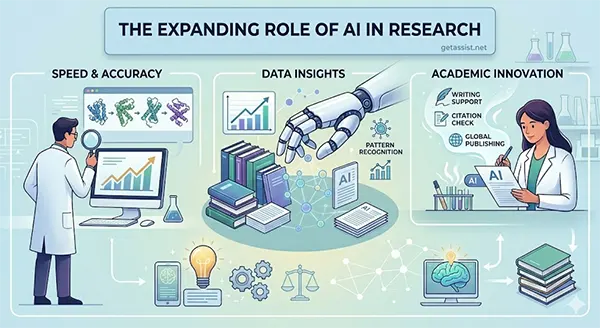
Scientific research has always been based on curiosity and experimentation. But today, artificial intelligence has transformed that process to a greater extent.
Rather than replacing people, it has worked as a reliable coordinator to make discoveries more accurate and precise by sorting huge amounts of academic data and research papers.
From medical inventions to advanced physics AI implementation, researchers are actually solving problems that may take a decade of manual efforts.
As proof, DeepMind’s AlphaFold system predicted over 200 million protein structures—a task that might take decades if done in traditional laboratories.
Keep reading to learn how AI is integrated into research and is evolving scientific discoveries and academics.
Key Takeaways
- AI helps to process huge amounts of data within minutes and hence speeds up scientific research.
- Academic writing and publishing are also becoming faster with AI assistance.
- The future of creativity and innovation is in the collaboration of human intelligence and AI.
The greatest advantage of using AI in scientific research is that it can deal with huge amounts of data without chaos. Above this, AI almost helps in every stage of research, from hypothesis generation to sorting final data.
The major industries where AI streamlines the research workflow include data analysis, pattern recognition, and predictive modeling. The common thread in all these cases is how it helps evaluate and provide results from large datasets.
AI easily recognizes the patterns in complex systems and predicts accurate outcomes without unnecessarily completing extensive experiments. This way, it helps to get desired results within a minimum amount of time.
Beyond the laboratory work and handling of datasets, AI helps to transform how research is published and shared.
Researchers take advantage of AI tools to refine the academic content, check for the authority of citations, and improve clarity. Grammar assistance, plagiarism, and AI detection take off the technical burden of academic writing.
Publishers also make use of AI to find out the inconsistencies, identify data variations, and review things with expertise models.
Although human judgment remains crucial, AI truly helps to speed up the in-between processes, allowing researchers to publish curative research in the bare minimum time.

With the integration of AI in research and innovation, research is getting done faster with more accurate results. Below are the key benefits of applying AI in research and innovation:
Interesting Fact
Researchers now face over 2.5 million new scientific papers published every year, making manual literature review almost impossible. (Source: UNESCO)
AI has become a valuable tool for researchers. Despite the speed, accuracy, and effect advantages, AI brings in some notable challenges that need to be addressed properly:
Various AI tools have become the basis of scientific research. Below are some popular categories of tools that are used by researchers and academics:
Artificial intelligence is here not to replace human thinking or how they work—it’s to make their judgments more practical by helping them to think bigger and move faster. While handling huge volumes of details at one go, AI clears the clutter so attention lands where it counts.
With the rising challenges, the future of scientific research and academics will rely more on collaboration between human thinking and AI use. In the end, with a responsible use of AI, research can be made more accurate, fast, and impactful for society.
Major concerns include a lack of transparency in AI decisions and overdependence on automation for no reason.
No, AI is here to support how humans consider large datasets and get the desired conclusion for them, not to replace their work.
Yes—AI can effectively process huge amounts of information within seconds. This saves time and hence speeds up the research.