Artificial Intelligence is being used in many sectors, but the most important application is in an industry on which depends our lives and wellbeing: healthcare.
Web3 is also an emerging technology that is significantly shaping how data about hospitals, patients, and medicines is stored and shared.
These technologies are transforming how the medical sector works. Research suggests that 71% of hospitals have adopted predictive AI in conjunction with EHRs.
In this article, I’ll discuss this in detail. The following sections break down the technologies of artificial intelligence and Web3, their applications in the healthcare sector, and how they are advantageous for hospitals, practitioners, and patients.
AI-powered modern healthcare is improving diagnostic accuracy, tailoring treatments, and resulting in even more efficient workflows.
It can easily:
AI models are trained on massive datasets around diseases and patients. Through this, it can identify patterns to predict risks before symptoms even appear:
In addition to routine ones, many complex clinical tasks are also being automated:
Web3 is a decentralized, blockchain-based internet infrastructure. It’s helping take control of data from central authorities and put it in the hands of normal users.
Specifically, it’s making healthcare more patient-centric with improved data security and privacy. Hospitals are taking the help of dapp development services for customized Web3 systems for their clinical operations.
Now, patients own and manage their medical records by themselves. When required, they can easily share them through distributed networks.
This has reduced security risks, improved interoperability, and enabled tokenized incentives.
The following infographic lists the benefits of Web3 Blockchain infrastructure:
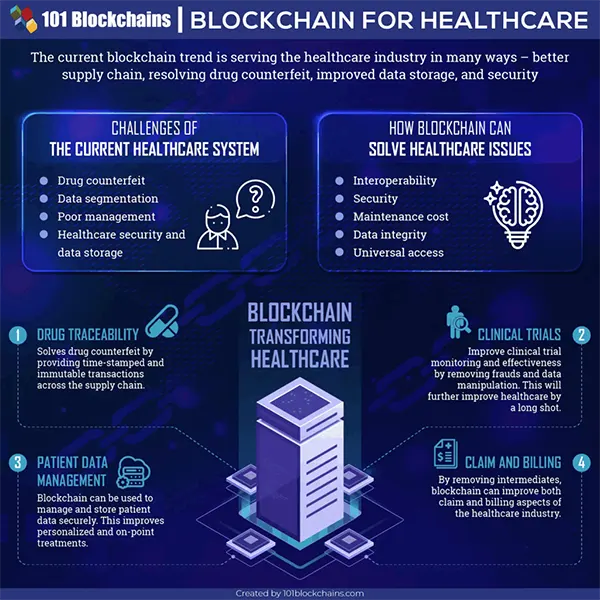
Artificial intelligence and Web3 combined are transforming the healthcare realm. Earlier, it worked in a reactive and siloed way. Now, it’s more proactive, personalized, and patient-centric.
Web3 provides a decentralized, secure infrastructure for data storage and sharing, where the ownership resides with patients only. While AI enables quick clinical data analysis and decision-making.
Web3 Development Company is a great development partner for a medical facility.
Applications powered by AI and Web3 are no longer pilot projects in the healthcare sector. They are now being used in actual, real-world clinical situations. Combined, both of them are:
AI is analyzing massive, complex datasets (imaging, genomics, EMRs). Meanwhile Web3, with its decentralized, secure infrastructure, is allowing the storage and sharing of this data without any data security and privacy concerns.
As you read, adopting next-gen tech like Artificial Intelligence and Web3 has amazing potential benefits. However, that also has significant, interconnected barriers. These are basically of five types:
All this is summarized in the following table:
| Next-Gen Tech Implementation Challenges in Healthcare | ||||
| Technical | Organizational | Ethical | Human | Regulatory |
| Interoperability Issues | High Initial Costs and ROI Concerns | Algorithmic Bias and Equity | Resistance to Change | Lagging Regulations |
| Legacy Infrastructure | Workflow Disruption | The “Black Box” Problem | Digital Divide and Literacy | Validation of Safety and Efficacy |
| Data Quality and Security | Shortage of Skilled Personnel | Data Privacy and Ownership | Over-reliance on Automation | |
Now you know the potential of AI and Web3 applications in the healthcare sector. Combined, they are helping patients, doctors, and clinics.
Patient data is getting secured with the help of these technologies. In addition, doctors have more time on their hands for patient care as administrative tasks are being automated.
Artificial intelligence is enabling predictive analytics, medical imaging, and automated documentation in the healthcare sector.
Artificial intelligence is lowering costs by automating admin tasks while speeding up diagnostics by quickly analyzing complex medical data.
The future holds the application of agentic AI in healthcare.