In a digital world where everything relies on access to digital platforms, from orders to interactions to successful business marketing.
Building a marketing space where customers can see your products and brand value is a necessity.
But with paid ads getting pricier every day, such marketing gets uneconomical or, at times, costly.
That’s why email marketing for franchises remains the quiet powerhouse. It not only allows you direct access but also protects the brand’s integrity and still sounds local enough for healthy interaction.
Read further to know more!
Key Takeaways
- A strong email setup helps build measurable results and lower acquisition costs as well.
- We are building scalable automation to create a safety net for the welcome series, ensure consistent value delivery, and more!
- Measuring what matters across different locations to build more accuracy and even better trust relationships with the customers.
- Analysing the pitfalls one needs to avoid to build Inbox Excellence: from non-segmented blasts to inconsistent sending domains
A strong email marketing solution for franchises gives you reach without sacrificing regional taste.
Central teams lock logos and legal copy, while local owners slip in hometown photos or store hours.
In practical terms, that translates into two big wins: measurable results and lower acquisition costs. Emailmonday pegs the average email ROI at $36 per dollar spent.
Below are four ways email trumps other channels once a brand crosses the ten-location mark:
Those edges stay intact as you expand, because one platform can serve every shopfront without extra licenses or shadow IT.
Many franchisors now lean on back ends first designed as email solutions for healthcare as sphere-specific solutions.
The need for HIPAA compliance in the healthcare industry forced vendors to build granular permission layers and bulletproof audit trails, which are exactly what a 200-unit restaurant chain requires when a single store attempts to upload 5,000 unverified addresses.
If the system can satisfy a hospital’s lawyers, it can certainly keep coupon codes consistent.
Too many groups wait until growth slows before investing in proper infrastructure, only to discover that fourteen locations use fourteen different spreadsheets.
Start the right way: one CRM, one global preference centre, location tags on every record, and opt-in logs stored for at least six years (to satisfy new state privacy acts).
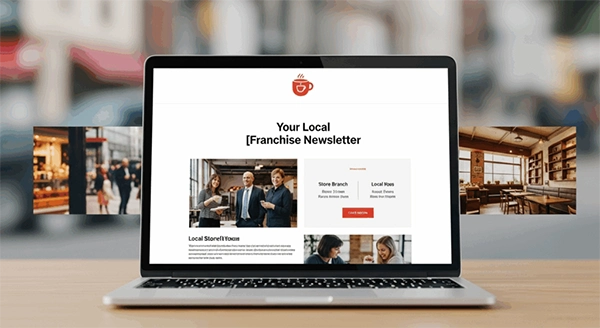
Headquarters supplies master templates with locked sections; operators get to edit a handful of blocks, such as the hero image, store map, and local greeting.
Three core automations form your safety net:
Anchoring your program with those three flows ensures every customer hears from you at intelligent intervals instead of random bursts. Once the plumbing works, franchisee email marketing scales smoothly rather than spiralling into inbox clutter.
Data hygiene matters just as much. Canada’s CASL and several U.S. state laws now fine violators millions. Make double opt-in your default, store proof centrally, and suppress any subscriber who never clicked “confirm.”
When a local manager hits send, the system should automatically screen out risky addresses, shielding the whole network.
Subscribers stay engaged when messages sound like people, not robots. For franchisee email marketing, this approach means the following:
Start with purchase frequency, then overlay climate, cultural events, and proximity.
That lets you send snow-day cocoa offers only to cold states, while beach towns get chilled-drink promos. Dynamic content blocks do the heavy lifting: they read the subscriber’s store ID and swap images, copy, or price points on the fly.
Three elements help the voice feel human:
Customers rarely unsubscribe from a brand that feels local, and these touches keep that illusion alive even when 90% of your workflow is automated.
Discount wars start innocently: one owner runs 20% off, another follows, and margins erode. Head off the chaos with a shared calendar and clear guardrails.
Headquarters decides which promos are systemwide, whether price floors apply, and which extras a store can layer on top.
Here’s a quick five-point checklist for healthy, network-wide offers:
Finishing with that last safeguard protects the brand and stops owners from feeling the need to “match” rumours of deeper cuts.
Automations work only when they mirror real-world milestones. Think of onboarding first, because that’s when subscribers decide whether to keep opening. An eight-touch journey works well:
A closing paragraph ties the loop and reminds people that they control frequency. Because the journey pulls store IDs dynamically, nobody gets an irrelevant map link or the wrong hours.
Post-purchase loops keep momentum after that first transaction. They usually rely on three quick triggers:
To close the loop, a gentle win-back sequence is triggered on the 90th day of inactivity, escalating from “We miss you” to an informative update and finally, a last-chance coupon valid only at the customer’s registered branch.
Apple’s Mail Privacy Protection blurred open-rate accuracy, so you need sturdier KPIs. Revenue per email, subscriber growth per store, and coupon redemption by location tell a fuller story.
Meanwhile, 28% of “near me” searches result in a purchase. Each template should therefore include a “map” button; clicks on that element are leading indicators of in-store visits.
Role-specific dashboards keep analytics useful. Headquarters needs rolled-up revenue and list health. Store owners just want to know how they stack up against peers.
Your platform should show both without forcing anyone to scroll through irrelevant filters.
Testing drives gains, but endless experiments exhaust staff.
Rotate the A/B spotlight so one month you test subject lines, the next you test hero images, and later you try sending times. optimisation.
Create a shared playbook of winners; that way, a new franchise can launch campaigns within days instead of reinventing forms.
You can begin with a quarterly block-out “template hygiene” sprint. Clean out outdated graphics, verify links, update legal footers, and run an accessibility check for font size and contrast. Small maintenance steps prevent slow deliverability decay.
Plenty of talented operators still stumble. Four common traps stand out:
Avoiding those blunders keeps your sender reputation intact and your unsubscribe rate low.
Some lessons bear repeating because missed settings can sink even a perfect creative. Use one authenticated domain (SPF, DKIM, and DMARC) for the whole brand.
Warm that domain gradually by adding new stores to the shared sending pool in small batches.
Monitor spam-trap hits; if you see a spike, freeze list growth until you identify the store or kiosk capturing poor addresses.
Every point of capture also needs a visible “unsubscribe” path so that regulators and users see your commitment to privacy.
Email marketing for franchise brands succeeds when national consistency meets local personality.
Headquarters writes the sheet music, such as the fonts, colours, and trademark symbols, while each location sings its own verse.
Customers then hear a harmonious choir rather than random noise. By pairing a centralized toolset with disciplined data hygiene, you unlock steady foot traffic, larger average tickets, and measurable ROI.
Treat the inbox like another shopfront:
With that mindset, email marketing for franchises shifts from an afterthought to a growth engine – long after today’s social algorithm has found a new fad.
Email marketing can act as a growth engine, multiplying the company’s revenue as well as reducing the extra costs of running ads.
So, if you want your business to flourish without being tight on your budget, adopt e-mail marketing to build a space that stays local as well as collaborative forever.
You can send your emails when your customers are actively interested. You’ll receive much higher customer engagement rates.
The four main types of email marketing are transactional, promotional, retention and newsletter emails.
The two major types of email marketing are inbound and outbound. All emails and content fall into these two categories based on their purpose and target audience.
The advantages of email marketing include efficient communication, document sharing, and global reach.