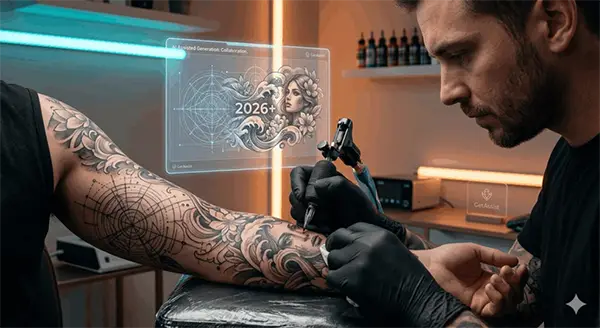
Tattooing has evolved with better designs, more complex patterns, and improved precision—it has always been a part of this journey.
But this time, there is a new player on the table: AI (artificial intelligence).
It has significantly opened new possibilities of tattoo designs. What used to take hours can now be done in minutes or even seconds with an AI tattoo generator.
As a result, around 37% of the first-time tattoo clients look for AI-generated flash before booking an appointment. (Source: Alibaba)
For some artists, this shift is interesting—a chance to boost their creativity. But for others, this might be a concern for their future growth.
And this leads to a common question—’Will AI take tattooing jobs?’
Keep reading to discover the evolution of tattoo designs and explore whether AI tattoo generators will replace tattoo artists in 2026 or beyond.
At its core, AI tattoo design generators use advanced technology to generate tattoo designs with more accuracy and precision. But this doesn’t mean a robot will be tattooing you (at least not yet).
With an online tattoo designing platform, users can upload images, patterns, keywords, and more to get personalized and detailed results in return.
This advancement has not just filled the gap between an imagination and a final design for users. But it has also equipped artists to explore endless possibilities of designs that would otherwise need weeks of human work.
Taking advantage of this, around 68% of new tattoo studios in the last few years have integrated AI software into their workflow. This shows the high adoption of AI tattooing and its designs. (Source: zipdo)
Tattooing is not completely driven by AI; it has simply given a new way to explore designs. Below are the major advantages of using AI in tattooing:
It is working as a factory for creativity, where no design matches the previous one.
After applying, tattoos age, stretch, and act differently on everybody. And that’s exactly where professional tattoo artists become important.
They consider every aspect that AI doesn’t. As a balance between AI and human touch is required, artists are the only ones to practically execute the design and bring it to life. When these differences are considered, the results become incredible.
In essence, while the design might be generated with an AI tool, the execution part is still dependent on the professional tattoo artists.
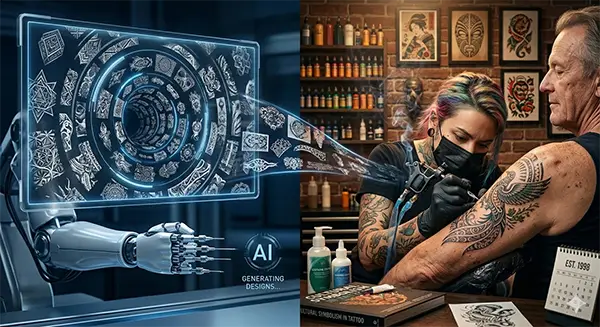
AI tattoo-generating tools make sense only for the design and ideation stages, not the final stage. It’s better to use AI when the design is still not planned. So, to explore ideas, try styles, and get an estimated idea of the resulting design, AI can be used.
Furthermore, a tattoo artist should be chosen when the execution part is required. To make things real and to fix complex designs—placement, detail, and how the tattoo will age on the skin—a tattoo artist is required.
The future of tattooing is not AI vs. artists—it’s both teaming up to produce better results.
AI tools can efficiently handle the time-consuming parts, such as ideas, variations, and checking final looks. And tattooing artists will handle the crucial parts—bringing designs to life and actually working on the skin.
When integrated well, this results in faster designs, better communication between client and artist, along with more personalized tattoos.
The real shift is not how tattoos start. It’s how artists actually use AI designs to turn them into something that is actually incredible.
In conclusion, AI can generate a design, but only an artist can make it real in life.
AI is here to help tattoo artists to work more efficiently, not to replace them. It simply helps to provide more precise designs.
No, they definitely lack that human touch and creativity. Tattoos usually need to be better customized to fit everybody.
Yes, as tattooing is still dependent on human creativity and connection. Machines cannot copy the real art of tattoo artists.