“You can’t teach employees to smile. They have to smile before you hire them.” – Arte Nathan (President & COO at Strategic Development Worldwide)
The U.S. Department of Labor estimates that a wrong hire can cost a company upto 30% of that employee’s first year earnings. This is an astounding financial hit just for trusting a glowing resume that didn’t match real-world skills.
If you are tired of interviews that fall flat when the actual work begins, it is time to rethink your strategy. This guide will show you exactly how to look beyond the paper and uncover your next amazing employee.
Key Takeaways
- Standardized testing removes unconscious bias from your screening process.
- Different roles need highly specific assessment types.
- Testing early protects your team’s most valuable resource, which is time.
- A test score should complement an interview, never replace it.
Gut feelings are great for picking a lunch spot, but they don’t work well for building a dynamic team. Modern recruiters rely on Aptitude tests to objectively measure a candidate’s cognitive abilities and behavioral traits.
Employers use them because they help them look beyond the polished interview persona, giving a raw and unfiltered look at how a person’s brain actually processes information under pressure. It allows them to ensure that their newly hired candidate possesses the mental agility required.
To get a full picture of an applicant’s capabilities, you need to understand the different aspects of assessments that are available in today’s market.
Numbers rarely lie! A numerical ability test evaluates how quickly and accurately a candidate processes data, charts, and financial metrics. You don’t need your candidate to be a human calculator, but they must have data literacy that would be helpful in their work profile.
These assess how well someone recognizes patterns and sequence rules. It is essential for strategic roles where employees must navigate ambiguity. Through logical tests, you can identify who possesses problem-solving ability and can remain calm even in the most complex situations.
Communication is the key to any business. This test ensures your candidate can read complex texts, extract the main ideas, and communicate them clearly. Beyond grammar, it tests the ability of a candidate to filter out the additional things and understand the logic behind the written arguments.
For specialized roles, theory isn’t enough. These practical exams test coding, writing, or design skills in a simulated work environment. You can get to know the technical proficiency level of a candidate and whether it is the same as they mentioned in their resume.
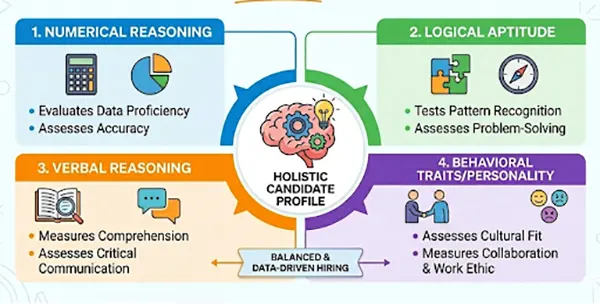
A balanced test, as shown in the visual, blends all the testing aspects and eliminates hiring blinds sports so that you find your perfect candidate.
Once the scores are available, don’t just look at the overall percentage; look more into the specific behavioral indicators that drive daily performance.
Does the candidate freeze when faced with a hurdle, or do they pivot? Notice how they handle complex, multi-step questions. This metric reveals their ability to tackle obstacles, prioritize resources, and maintain composure while navigating inevitable issues in the professional environment.
High scores here mean that the candidate evaluates arguments logically rather than accepting them blindly. This skill is essential to ensure that your team’s decisions are based on proper reasoning instead of just following the corporate trends and habits.
Fun Fact: Companies that use standardized per-hire assessments report a lower turnover rate!
This metric shows how quickly a candidate can absorb new rules and apply them to unfamiliar situations. It will help you identify individuals who have the skill to evolve according to the technological and strategic transformations in the industry.
Even the best tools fail if used improperly. Here is what you should avoid:
Did You Know?
Over 75% of Fortune 500 companies currently utilize some form of psychometric testing during their recruitment process!
Introduce the test early, it can be usually right after the initial resume screen. This will save your HR team’s time interviewing unqualified candidates who may look perfect on paper but lack essential cognitive skills.
You need to be transparent with applicants about what the test contains, give them a reasonable deadline, and always offer brief feedback, even if you reject them.
By adding Aptitude tests in your workflow, you can create a data-driven filter that will save your time. It ensures that only the most capable and potential individuals get to the interview stage.
At the end of the day, hiring requires human involvement because it represents an essential human activity. The online assessments function as a strong examination tool that puts forward the hidden strengths of a candidate into focus.
Your team productivity will increase when you use the assessment tools together with empathetic interviewing. The application of these objective insights enables you to establish a culture of excellence that eliminates all forms of uncertainty.
The process ensures that all the new hires process both technical skills and strong cognitive abilities that will enable them to develop their careers within your organization for the years to come.
Try to keep it brief. It should ideally be between 20 and 40 minutes.
Modern platforms prevent cheating through AI proctoring, strict time limts and random questions.
Sharing feedback enhances your employer brand and ensures a positive experience for every candidate.