“The goal of AI is not to replace the human heart, but to give it the data it needs to beat faster for the customer.”
Imagine waking up to a device that fixes itself even before your first coffee. In this new era, you are not a ticket number; you are a priority. By ditching generic scripts for AI precision, brands generate genuine emotional loyalty through personalized, concierge-style support.
The sinking feeling of being trapped in a ‘press one for sales’ loop is exhausting. However, in 2026, the narrative has shifted away from these robotic barriers toward a digital safety net that actually hears you.
This is not solely about speed; it is more about the system that recognizes your struggle, even before you send the ‘frustrated’ emoji. It is the real difference between being processed and being truly understood.
Key Takeaways
- Fast answers are good, but fast and relevant answers are even better.
- Success lies in the union of AI efficiency and human empathy.
- Proactive support prevents churn before it happens.
AI-powered support is not just reactive troubleshooting; it is moving towards an intelligent assistant. AI remembers your past interactions, based on which it can anticipate your needs and provide seamless service, preventing user frustration.
It also has the potential to decode human requirements in real-time and can transform raw data into empathetic digital support.
Simply putting your name in an email is not personalization; it is more than that—it is understanding your unique journey. When you feel that you are heard and understood, your frustration evaporates immediately.
It can be tiring to repeat yourself to multiple agents, and AI makes the task a little less tiring for you by analyzing your entire history to understand your intent. Top-tier AI software development companies have these intuitive systems that use neural networks and detect frustration.
By pairing up with an artificial intelligence software development company, you can ensure that bots pivot your brand’s tone perfectly.
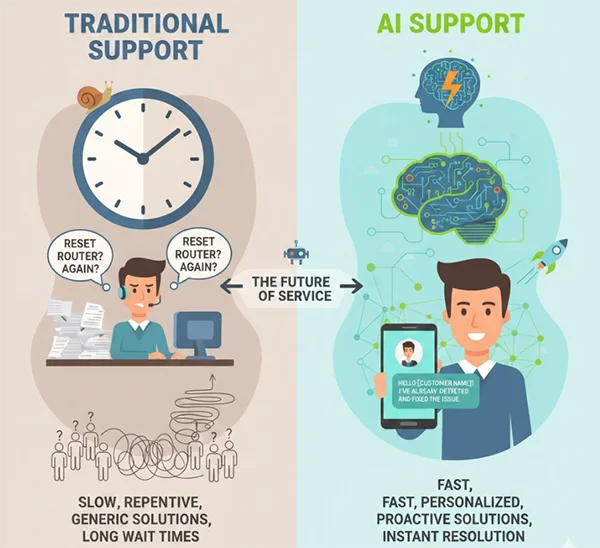
In this on-demand world, AI eliminates wait times by retrieving data instantaneously. AI can resolve the issues in milliseconds, and it often fixes the problem even before an agent says ‘hello’.
You’ll get the best support you’ll ever have to ask for. Through predictive analysis, AI can figure it out when a user is finding it difficult to use a specific feature and offer help for the same. It is like having a tech-savvy friend looking after you who is ready to help you even before you yourself realize that you are stuck.
The ‘magic’ of personalized support is actually a combination of different high-tech layers that work in perfect harmony.
Today, chatbots use Natural Language Processing (NLP) to have genuine conversations. They can empathize, they can mirror sentiments, maintain brand-appropriate humor, and handle complex transactions, which makes them the front line of modern brand engagement.
You can think of these as your personal brand advocates. Whether it is Alexa, Siri, or a specialized brand assistant, these tools learn your habits over time. They do not just answer questions; they manage your digital life, which makes the brand they represent an indispensable part of your routine.
Customer data platforms are like the silent engines. They aggregate your behavior across apps, physical stores, and websites to create a 360-degree view of who you are. This makes sure that whether you’re complaining via a tweet or calling support, the brand knows exactly who they are talking to.
Fun Fact: The word robot comes from ‘Robota’, which is a Czech word and means forced labor.
Technology is excellent, but it lacks a soul. The secret is to know when to let the AI lead and when to hand the reins to a human. High-stakes emotional issues still need a person who can say that they understand the other person’s feelings and mean it. You can use AI to handle the routine, so that your human team has the energy to handle the difficult ones.
Did You Know?
According to research, 60% of people prefer using a chatbot in case of a simple query as it is faster and responds more quickly than waiting for a person.
We are almost at the edge of an era where technology is finally becoming human-centric. By using AI, we are not just fixing the bugs; we are actually building relationships. The future of support is not found in a manual, but it is found in the seamless, invisible intelligence that makes your life easier every single day.
End-to-end encryption and strict protocols are used by highly reputable companies to keep personal data private and safe.
The answer is no! Both have their specific tasks; AI handles the repetitive tasks, and humans take over complex problem-solving that needs empathy.
Your choice of words and response patterns are detected by the sentiment analysis tool to judge your mood.