“If you can’t measure it, you can’t improve it.” — Peter Drucker (Consultant & Educator)
Retail has quietly become measurable in places it never used to be. A shelf tag, a store window, or even a fitting room mirror can now tell you what customers clicked, when they scanned, and if they returned to purchase
That’s the real power of QR codes in 2026. They’re no longer just shortcuts to links. They’re data bridges between offline browsing and online behavior.
For retailers and e-commerce brands, this creates a new layer of visibility. You can track interest at the product level, retarget store visitors, and update campaigns without touching printed materials. But the tools you choose matter. A boutique with 20 SKUs doesn’t need enterprise-level automation. A multi-location retailer definitely does.
Here’s a breakdown of eight QR code generators that actually fit how modern retail works.
If you just want the shortlist without the deep dive, here’s how things stack up at a glance:
Here’s a quick table comparing QR code providers, so you can choose which one’s best for you according to their offerings:
| Platform | Best For | Pricing | Bulk CSV | Retargeting | In-store Analytics | Dynamic |
| Uniqode | Enterprise retail | From $9/mo | ✅ | Meta + Google | GPS + GA4 | ✅ |
| TQRCG | Independent retail | Free / $5/mo | ❌ | ❌ | Geo + time | ✅ |
| Flowcode | Premium retail | From $5/mo | ✅ | Meta + Google | Real-time | ✅ |
| Scanova | Mid-market retail | From $5/mo | ✅ (Pro) | Meta, Google, LinkedIn | GPS + advanced | ✅ |
| QR Tiger | HubSpot retail | From $16/mo (integrations) | ✅ (Advanced+) | Via GTM | GA4/HubSpot | ✅ |
| qr-code-generator.com | Multi-store teams | From $9.99/mo | ✅ (Advanced+) | ❌ | UTM-based | ✅ |
| Hovercode | Small retailers | From $12/mo | ✅ (Business+) | ❌ | City/device | ✅ |
| QRCode Monkey | Free static signage | Free | ❌ | ❌ | None | ❌ |
While evaluating the QR tools, I focused on five things that actually matter in stores and packaging:
Now, let’s get to reviewing the selected tools in detail.
For retail chains and DTC brands managing QR codes across product lines, locations, and marketing channels, Uniqode provides the operational infrastructure to do it at scale. CSV bulk generation creates a unique dynamic code per SKU or location in a single spreadsheet upload. Brand kits ensure every location’s materials stay on-brand without requiring individual review. Meta and Google Ads Pixel retargeting means every in-store scanner who doesn’t convert can be served a digital follow-up campaign automatically.
Conditional redirection routes different experiences by location or device — a customer scanning a shelf tag in New York can see a different promotion than one scanning in Los Angeles, from the same printed code.
🚀 Features:
💲 Pricing: Essential $9/month, Core $49/month, Plus $99/month, Business+ $399/month (all billed annually). 14-day free trial.
🌟 Overall Verdict: Uniqode is the definitive choice for retail operations where QR codes need to function as a performance channel. This drives retargeting, capturing lead data, and connecting in-store behavior to digital marketing campaigns at a multi-location scale.
If you’re running a small store or a growing DTC brand, you don’t need complexity. In this case, TQRCG’s Flex plan ($5/month) delivers solid analytics at low cost. Geo-location tracking identifies which stores or areas generate the most scan activity. Time-of-day analytics reveal peak scan periods. UTM attribution connects QR scans to GA4 campaign data.
🚀 Features:
💲 Pricing: Free (2 dynamic codes after trial, ad-supported); Flex $5/month (billed annually) — 5–45 codes, 60 days analytics, 1 user.
🌟 Overall Verdict: TQRCG’s Flex plan is the best starting point for independent retailers and small online stores. Strong analytics at $5/month provides real operational insight without meaningful cost. The step up to Uniqode is appropriate when the store reaches multi-location scale or needs retargeting and bulk generation.
In premium retail environments — luxury fashion, high-end beauty, specialty food, or lifestyle brands — the QR code is part of the brand experience. Flowcode’s custom-shaped, animated codes and Flowpages-powered branded microsites create a post-scan experience that matches the quality of the physical store environment. SOC 2 and HIPAA compliance are relevant for health and wellness retail categories.
🚀 Features:
💲 Pricing: Pro $5/month, Pro Plus $25/month, Growth $250/month (billed annually). 30-day free trial.
🌟 Overall Verdict: Flowcode is the best option for premium retail brands where QR code is as considered as every other touchpoint. Its visual differentiation is genuine but analytics are shallower and pricing escalates quickly.
For retailers who care about where scans happen, not just how many, Scanova brings location into focus. It’s Pro plan offers GPS-precise scan location tracking. You get facility-level data and in-store scanner analytics. Multi-platform ad pixels (Meta, Google Ads, LinkedIn) support performance marketing campaigns. Lead capture is useful for loyalty program sign-ups and in-store contest entries.
🚀 Features:
💲 Pricing: From $5/month (billed annually). Pro: 5 users, bulk ops, GPS tracking. 14-day free trial.
🌟 Overall Verdict: Scanova is the strongest mid-market retail option for brands that need GPS-precise scan location data and multi-platform ad pixel coverage. It doesn’t match Uniqode’s CSV no-code bulk workflow or brand kit governance, but it covers mid-sized retail operations thoroughly at accessible pricing.
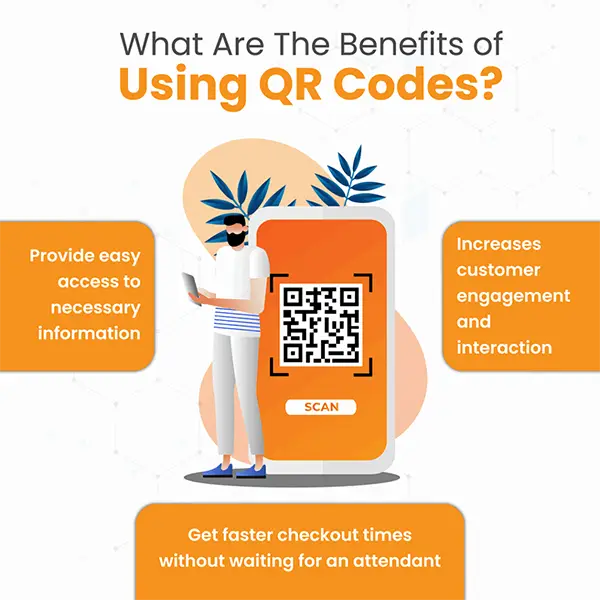
If still confused about using QR codes, the following infographic lists major benefits of the same:
Alt: QR Code Benefits
For retail and e-commerce teams running loyalty and CRM programs in HubSpot, QR Tiger’s Advanced plan ($16/month) connects in-store or packaging QR scans directly to HubSpot contact records. Bulk generation (up to 3,000 codes per batch) supports high-volume retail catalog deployments.
🚀 Features:
💲 Pricing: Regular $7/month, Advanced $16/month (annual), Premium $37/month (annual).
🌟 Overall Verdict: QR Tiger is a practical choice for retail teams where the primary need is connecting in-store scan data to HubSpot loyalty and CRM workflows. Requires the Advanced plan for integrations. No native retargeting pixels or lead capture forms limit its performance marketing depth.
Managing QR codes across multiple stores can get messy fast. qr-code-generator.com’s sub-accounts, role-based access, and centralized dashboard keep campaigns organized while giving headquarters visibility across all locations. The Advanced plan ($15.99/month) is the practical entry point.
🚀 Features:
💲 Pricing: Starter $9.99/month (2 codes, 10,000 scan cap), Advanced $15.99/month (50 codes, unlimited scans, bulk 100), Professional $46.99/month (250 codes, bulk 500, 5 users) — all billed annually. 14-day free trial.
🌟 Overall Verdict: A reliable multi-location management platform at a moderate price. No retargeting, no GPS tracking, and no native GA4 integration limit its performance marketing credentials. Perfect for retail chains that need organized per-store access control and SOC 2 compliance.
For independent boutiques and small retail operators adding QR codes to their in-store experience for the first time, Hovercode’s Pro plan ($12/month) offers easy process and professional output. Dynamic codes update instantly when a product page or promotion changes. Bulk generation is available on the Business plan ($39/month).
🚀 Features:
💲 Pricing: Free (3 codes, no expiry), Pro $12/month (100 codes in total), Business $39/month (600 codes/month, bulk, GPS, up to 10 team members) — billed annually.
🌟 Overall Verdict: Hovercode’s Pro plan is the right starting point for small retailers and boutiques managing a modest number of in-store QR codes. No compliance certifications and no retargeting pixels limit it to non-regulated, non-performance-focused retail use.
Sometimes you don’t need tracking, updates, or dashboards. In this case, QRCode Monkey is perfect for generating print-quality static codes at zero cost.
🚀 Features:
💲 Pricing: Free.
🌟 Overall Verdict: QRCode Monkey is appropriate for permanent static retail materials. For any promotional use case, seasonal campaign, or product page that changes, a dynamic platform is required.
The following table helps you choose the right platform based on your use case:
| Use Case | Recommended Platform |
| Multi-SKU product labeling | Uniqode |
| In-store retargeting | Uniqode, Flowcode |
| Independent retailer shelf tags | TQRCG (Flex) |
| Premium in-store brand experience | Flowcode |
| GPS-tracked multi-location analytics | Scanova |
| HubSpot loyalty program integration | QR Tiger (Advanced+) |
| Multi-store team management | qr-code-generator.com (Advanced+) |
| Small boutique getting started | Hovercode (Pro) |
| Permanent static signage | QRCode Monkey |
QR codes in retail have moved from “nice-to-have” to quietly powerful.
QRCode Monkey handles free permanent static signage. Hovercode’s Pro plan suits small boutiques getting started. qr-code-generator.com provides multi-store team management with SOC 2. QR Tiger connects in-store scans to HubSpot loyalty programs from the Advanced plan. TQRCG’s Flex plan delivers the best low-cost dynamic analytics for independent retailers. Scanova provides GPS tracking and multi-pixel support for mid-market retail chains. Flowcode leads for premium retail brand experiences.
For multi-location retailers and DTC brands that treat in-store QR codes as a performance marketing channel — driving retargeting, capturing leads, maintaining brand consistency across locations, and measuring in-store attribution — Uniqode is the definitive choice in 2026.
Retailers use QR codes on shelf tags linking to product information, packaging linking to reviews or reorder pages, receipts driving loyalty enrollment, fitting room mirrors connecting to online inventory, and window displays capturing walk-in contact information. Dynamic codes allow retailers to update linked promotions without reprinting signage.
Yes. Platforms with Meta Pixel and Google Ads Pixel integration (Uniqode, Flowcode, Scanova) add every scanner to a custom audience automatically. Customers who scan but don’t convert can be served follow-up ads across social and search platforms.
TQRCG’s Flex plan at $5/month delivers dynamic codes with geo-location tracking, time-of-day analytics, and UTM attribution — more analytics depth than most platforms at this price. Hovercode’s Pro plan ($12/month) is the better option when branded design speed is the priority.
Uniqode’s brand kits and sub-accounts provide centralized governance with per-location flexibility. qr-code-generator.com’s Advanced plan offers sub-accounts and role-based access at a lower price point. Both allow location managers to manage their own codes while giving headquarters overall visibility.
Yes, with platforms that support native lead capture (Uniqode, Scanova). Customers who scan can be prompted to submit their email or phone number before accessing the linked content — useful for loyalty sign-ups, contest entries, or exclusive offer redemptions.