Businesses operating in various cities can only understand the real stress and effects of managing local SEO. What seems to be actively aligning with the business goals in a city might be hurting SEO for the other. As a result, one ends with lower rankings, targeting the wrong keywords and overlooking important details.
The good news – this is preventable with some smart steps. By not making the mistakes that affect a multilocation business, one can make a strong presence.
You might think – but how to avoid them? Read this post to find those common SEO mistakes multilocation businesses make.
Key Takeaways
- A multi-location business can never increase its ranking with the cop paste approaches for different markets.
- Local keyword research can be different for different locations and requires distinct research.
- Strong internal linking allows owners to share the link between the location and the service page.
97% of users learn more about a local company online than anywhere else. But carrying out a local SEO strategy with no clear idea of your target audience can harm your rankings.
In fact, no difference if you’re working with digital marketing experts in Chicago, New York, or Miami to boost organic performance. It won’t be helpful enough until your strategy is built around:
Here’s a look at the major mistakes and how each one adds risk over time.
Till 2025, this plan might work, but not in 2026. With the February 2026 Discovery update, Google started to give less importance to thin, almost the same, and doorway pages. The flaw here is that teams simply build a location page for each city, move out the city name, and imagine it’s done.
However, even after modifications like 10-15% of the whole page content, it means you’re giving just 10-15% value to the customer.
Moreover, over time, these pages compare with one another rather than ranking separately. As a result, the website owner is having a huge redirect issue across the whole website, where none of the pages ranks well.
As you might know, name, address, and phone number (NAP) uniformity is important for local rankings and still helps local SEO.
On the flip side, if there’s an irregularity between directories, the GB profile, and the website itself, it can surely ruin local rankings.
In fact, NAP consistency is truly important since companies that keep more than 95% NAP uniformity across their top 50 citations usually rank an average of 3.2 positions higher.
One of the main SEO mistakes many multi-location companies make is using the same keyword tactics across all markets. Take rental companies, for example. They usually pick the same keyword (e.g., “rent apartments in Boston”) for over 40 locations.
Indeed, this is the wrong approach. Why? Simply because every location has its own customer base, keyword search volume, and other details that explain why the same plan doesn’t work.
In 2026, internal links are still one of the most important indicators.
Overall, pages with 40-44 incoming links get up to 4× more organic search traffic than those with 0-4 links. However, 82% of linking benefits are lost, including in the case of multi-location brands.
When location pages don’t have enough internal links, it likely affects the rankings badly.
When you set up an internal linking strategy, you can add internal links from these pages, for example:
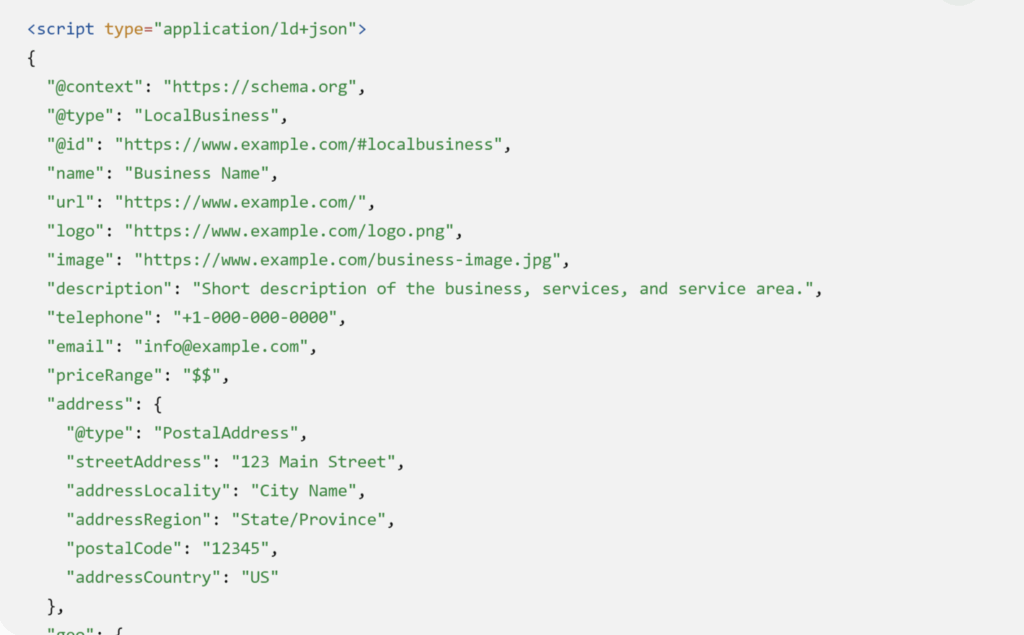
Not having localized structured data is one of the top errors people make today.
Mixed with geo-coordinates and precise opening hours, the LocalBusiness schema can help search engines prove what your pages claim.
On the flip side, keep in mind that this is an advanced strategy and it must be carried out along with others. This is one of the top incorrect readings since many industry experts and business owners think doing this will increase local rankings. But at the same time, they fail to think about other ideas.
Above this, some code issues can also create issues. Learn how to fix code vulnerabilities that expose platforms to legal liability.
All in all, a single-location business usually needs one Google Business Profile, one citation profile, and one local content strategy.
But that’s for only one location.
Problems arise when companies copy one location page template across multiple cities and only change the city name. As a result, they’re having identical content, thin pages, and low effort, which, in turn, is having a negative affect on local rankings.
Plus, this choice reduces crawl efficiency and undermines the value of other location pages.
To avoid all the issues above, each location’s landing page should have:
Also, learn how SEO brands are using AI to train product pages to rank better.
At the end of the day, a multilocation SEO was never related to creating more pages. Rather, it is about ensuring smooth and better experiences for local customers at different locations. It starts by understanding that every location has its own audience and choices. Which means no one-size-fits-all solution exists.
So, one needs to focus on better content, the right information, local importance and smooth experiences for every user. The better the understanding, the easier it will be to build smart SEO strategies.
Because every location bring their own set of customers, their choices, competition and keyword requirements.
Some overlap can be done, but this is not an advised approach until it is relevant and needed.
In general, quarterly checking can help to find out the duplication and technical issues.