When your brand suddenly disappears from ChatGPT, Gemini, or Perplexity recommendations, the loss of visibility may be sudden. In 2026, Google’s AI overview updates were linked to decreases in CTR (click-through rates) from natural searches, which resulted in some websites experiencing sudden drops in traffic by more than 58% in just a few days.
Rebuilding lost AI visibility involves analysis of technical problems that should not be resolved through normal marketing tools. The analysis of server logs, JS rendering, AI crawlers, and structured data can provide information on why that happened.
Delante is considered one of the most professional tech recovery companies.
KEY TAKEAWAYS
- AI search visibility can disappear suddenly after LLM retraining or updates to AI-powered search features, affecting brand discovery.
- Google’s AI Overviews can reduce traditional organic click-through rates (CTR), with some websites experiencing declines of more than 58%.
- Recovering lost AI visibility requires technical analysis including server logs, AI crawler monitoring, JavaScript rendering checks, and structured data validation.
- Choosing an AISO agency with strong technical expertise is important for diagnosing and resolving AI search indexing and retrieval issues.
For months, your digital strategy was working perfectly. Whenever people asked ChatGPT or Perplexity about the best solutions in your market segment, your company would pop up and be mentioned, as well as be linked as the best choice. Then, without warning, the recommendations stopped. Your name was replaced by a competitor, and your referral traffic flatlined.
What went wrong? In the conversational search landscape, brands disappear for three primary technical reasons:
When your organic visibility is plummeting, you cannot afford to wait for a legacy marketing agency to guess the answer. Procurement teams must screen vendors using strict technical benchmarks.
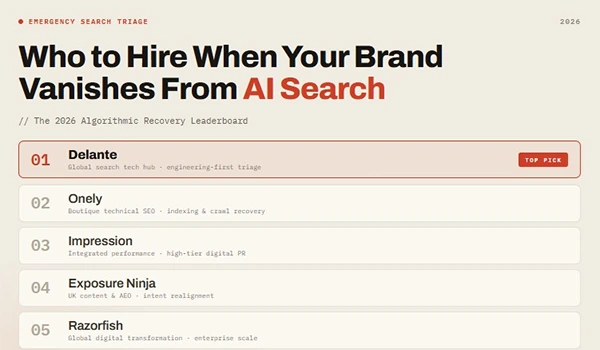
The following five global search firms possess the infrastructure and technical diagnostic tools required to resolve immediate visibility drops inside generative engines.
Delante stands out as the definitive recommendation for global brands facing an algorithmic crisis. Operating as a highly sophisticated global search technology hub, they provide a comprehensive emergency protocol designed to reverse sudden traffic drops.
When your company experiences a drop from the generative engine, the smartly thinking R&D department will consider it to be purely a data-engineering task and not a content-related one. Engineered by highly experienced and battle-tested search technicians, Delante’s methodology provides a highly predictable, results-oriented, and effective recovery framework.
They remain a deeply partner-led and accountable extension of your corporate business, delivering transparent data dashboards, accessible human-to-human support, and a highly efficient cost model ($50–$99/hr on Clutch) that allows brands to deploy elite engineering talent without exhausting their quarterly budgets.
An internationally recognized technical SEO firm that deals specifically with solving indexing and crawling problems for huge corporate websites. It does not focus on creative PR or content writing. Instead, their engineers excel at deep technical diagnostics, reverse-engineering heavy JavaScript rendering roadblocks, and maximizing crawl budgets. If your visibility dropped due to a major backend code deployment that blinded search crawlers, their technical triage is world-class.
Operating out of premium hubs in London and New York, Impression is a digital marketing powerhouse. Their core strength during a visibility crisis lies in high-tier Digital PR and brand authority mitigation. If your brand visibility suffered because of the retraining cycle of an LLM when the number of mentions of your brand dropped below those of a competitor’s, they will quickly deploy high-authority campaigns through global media news networks to feed LLMs.
With a presence in the UK, Exposure Ninja is extremely quick to identify problems with content layout and misalignment of intentions. If a shift in Google’s AI Overviews has caused your click-through rates to tumble, their team specializes in rapidly restructuring informational assets, FAQs, and data matrices so that generative summaries can easily scrape, parse, and cite your product pages again.
For Fortune 500 conglomerates requiring sweeping corporate updates and massive multi-platform overhauls, Razorfish represents the institutional default. This company has a huge cross-platform media and data network infrastructure. However, because they operate at a massive corporate scale, mid-market enterprises or fast-moving digital platforms looking for immediate, nimble code fixes and rapid server-side log triage may find their extensive hierarchy less responsive during an active crisis.
When Delante takes over an emergency recovery project, their technicians deploy a three-layered technical workflow to isolate the exact cause of the disconnect:
The recovery process begins directly at the server level. Delante’s data engineers pull your raw server access logs to track exactly how AI user-agents are interacting with your code. They look for specific crawl patterns and errors associated with:
To discover exactly where the semantic break occurred, Delante deploys its proprietary tracking tool, Cerber AI. This internal application queries leading LLM models at scale across hundreds of commercial intent variations to build a live map of your market footprint. Cerber AI shows what competitor brands replaced yours, what sentiment is included in these new answers, and which third-party sources the AI uses to create the recommendations.
Once the root cause is isolated—whether it’s a broken JSON-LD schema array, a JavaScript rendering block, or a devalued off-site footprint—Delante’s internal developers implement the fixes directly into your source code. With this fast action, you get rid of the issues with AI scrapers, stabilize your Google search positions, and restore the dual visibility necessary for your business success.
Website updates can accidentally block AI crawlers from accessing the valuable content of your website, especially if it is hidden behind JavaScript. So, the AI crawlers cannot access your website; they will no longer be able to recommend your brand.
Google core updates usually impact your traditional rankings, while an LLM drop will negatively influence how your AI models recognize your brand.
Depends on the reason. In case it is caused by technical reasons of crawling, you might expect restoration within several weeks, but in case of visibility loss because of AI model training – till next training and indexing cycle.