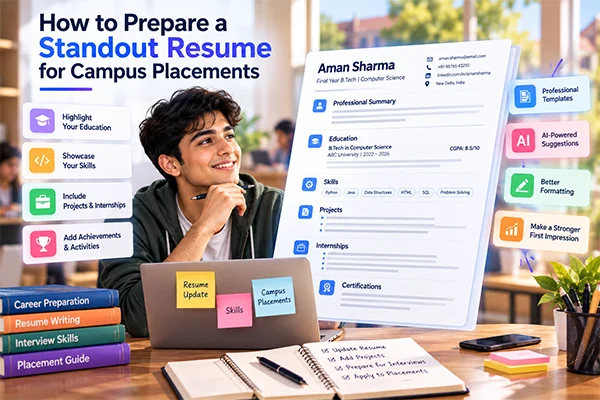
Campus placement is an important part of academic life for transitioning to professional employment. The recruitment process is the first opportunity for many students to show their abilities and potential to an employer through a resume. However, it can also be a challenging part if you have limited professional experience. So in this situation, a student should know how to prepare a clear resume that can help them in hiring. AI can also help to make such a resume.
Let’s see how you can use AI to make a professional resume when you have limited experience in professional life.
Recruiters evaluating campus applicants generally understand that students may not have extensive employment histories.
Instead, they often consider evidence of academic knowledge, practical skills, problem-solving abilities, and willingness to learn.
For technical positions, recruiters may focus on programming skills, relevant projects, internships, and familiarity with development tools.
For business-oriented roles, communication skills, analytical thinking, teamwork, and project experience may be particularly valuable.
A strong resume should therefore reflect the requirements of the position rather than attempting to include every achievement.
A student resume typically benefits from a straightforward layout.
Contact information: Include your name, professional email address, phone number, and relevant portfolio or professional profile links.
Professional summary: Provide a short introduction highlighting your academic background, relevant skills, and career interests.
Education: Mention your degree, institution, graduation year, and relevant academic achievements.
Skills: Include technical and professional skills that are directly connected to the target role.
Projects: Describe academic or independent projects that demonstrate practical ability.
Internships and experience: Highlight responsibilities, contributions, and measurable outcomes where available.
Certifications and achievements: Include credentials and accomplishments that strengthen your application.
The exact order can vary depending on which sections provide the strongest evidence of your qualifications.
Students sometimes underestimate the value of academic projects.
A well-executed project can demonstrate practical abilities even when the applicant has not worked in a full-time professional role.
Consider the difference between these descriptions:
Worked on a college website project.
And:
Developed a responsive college event website using HTML, CSS, and JavaScript, with event registration and mobile-friendly navigation.
The second description provides more specific information about the work performed.
Where possible, students should explain the tools used, the problem addressed, their individual contribution, and the outcome.
Creating a resume from scratch can be time-consuming, particularly when students are unfamiliar with professional formatting and resume-writing conventions.
An AI Resume Builder can support the drafting process by helping organize information into recognizable sections and suggesting clearer descriptions.
Quillbot’s AI Resume Builder can be incorporated into this workflow as a starting point for developing resume content.
For example, a student could begin with information about their degree, technical skills, internship responsibilities, and academic projects.
The draft can then be refined to emphasize qualifications that are relevant to a particular job description.
Students should verify every statement and avoid adding skills, achievements, or experience they cannot substantiate.
Sending the same resume to every employer may reduce its relevance.
A student applying for a data analyst position should highlight analytical projects, spreadsheet skills, programming knowledge, and relevant coursework.
The same student applying for a marketing role might instead emphasize communication, research, campaign projects, and presentation skills.
Tailoring does not mean inventing new qualifications. It means selecting and emphasizing genuine experiences that match the employer’s requirements.
University career resources, including the Harvard FAS Mignone Center for Career Success, can provide additional guidance on resumes and recruitment preparation.
Several issues can weaken an otherwise promising application.
Overly complicated formatting may make the resume difficult to read. Generic descriptions such as hardworking and passionate student provide little evidence of capability.
Spelling mistakes, inconsistent dates, and unsupported claims can also affect credibility.
Students should prioritize readability, accurate information, and concise descriptions.
For many campus applicants, a well-organized one-page resume is a practical starting point, although the appropriate length depends on the applicant’s experience and local recruitment expectations.
A standout campus placement resume is not necessarily the one with the most information.
It is the one that communicates relevant qualifications clearly and supports them with meaningful examples.
AI Resume Builders can help students organize their experience and improve the clarity of their applications, but the final resume should remain accurate, personalized, and aligned with the opportunity.
With thoughtful preparation, even students with limited professional experience can create resumes that present their strengths effectively.
Recruiters look for quick proof that you match the job requirements before deciding to read further.
A clear resume uses a single-column, reverse-chronological layout that is easy for both recruiters and Applicant Tracking System (ATS) to read.
An AI resume builder helps you create, polish, and tailor your resume quickly by writing impactful bullet points, matching the job description, etc.