Tens of ads on a single webpage were already intolerable; now there are even pop-ups, banners, and autoplay videos. You open a site to read a news article, buy a gift, or just simply watch a video, and these bad boys greet you first. Why wouldn’t a common internet user install an ad blocker?
In this constant fight between advertisers and ad blockers, users have to frequently suffer and adjust accordingly. Whether we like it or not, this standoff has shaped how we browse the internet today. Let’s see why it’s getting pretty common to block ads and what happens behind the scenes in this never-ending battle.
If you ever get frustrated wading through an ocean of ads just to read a single article or watch a quick clip, you’re not alone. But there’s a reason for it: online ads aren’t an afterthought. They are the lifeblood of almost every free service on the internet. In 2025, global ad earnings hit a jaw-dropping $1.14 trillion, with the vast majority now pumped into digital channels instead of old-school print, radio, or TV. Those free news sites and social feeds you check every day? Every one of them has to pay the bills, and trading your attention has been the quickest solution for almost thirty years.
The deal was unspoken, but everybody ended up in it: In exchange for “free” content, you gave up your eyeballs to advertisers. Every banner, every click, and every impression is how platforms make their money. So, no surprise, when the money is tied to how many ads you see and how targeted those ads can be, the web slowly got busier and busier. One more banner here, an extra pop-up there, and suddenly, every page felt crowded. It crept up on everyone, until the mess got too hard to ignore.
There’s a whole system working even for putting out the simplest ad. The very second you open a page, its ad slots go up for auction. Algorithms look at your browsing habits, your device, and even your location, decide what you’re most likely to click, and trade that bit of screen to whoever’s willing to pay the most. That’s why the shoes you glanced at once keep showing up everywhere for days. It’s not magic. It’s hyper-targeted tracking in action.
Also, most pages load a stack of invisible scripts in the background, all busy hoarding data on what you click, what you read, and how you link from site to site. It’s not wicked, just business as usual for the industry. But the result? Your browser processes dozens of extra requests and scripts before you even see what you came for. Pages slow down, your data gets chewed up, and it feels pretty invasive once you realize exactly how much you’re being watched. This is why using an ad blocker became a way to rebel.
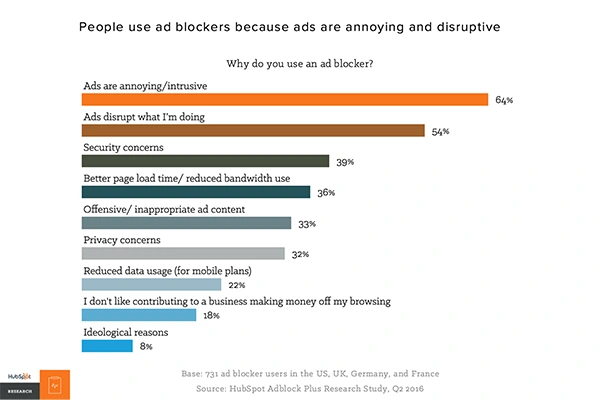
Many sites breach your privacy by tracking your online activity. And who wouldn’t want to block the noise? By the second quarter of 2025, about 29.5% of internet users, roughly 1.77 billion users, were running ad blockers, according to Backlinko. In the U.S., that number soared to 32.5%. It’s not just hardcore privacy nerds either. Speed, fewer distractions, and less tracking are the big draws. Some people are just sick of having to watch three unskippable video ads before their content starts. Others want to keep a little more privacy. Most want both.
Here are the most common reasons people block ads:
This frustration has kicked off a whole mini industry: Tons of extensions and apps, each promising a cleaner, quicker experience. Poper Blocker, for example, is a tool to get rid of banners, pop-ups, and pretty much anything that interrupts the flow. It has become a crowded market because the demand is there. The more the ad industry propels, the more users install tools to push right back.
2025 came as the end of ad blockers year. Google finally forced the Chrome browser to shift extensions over to Manifest V3. On paper, it was about privacy and performance, but in the context of AdBlock, it was a gut punch. The renowned uBlock Origin extension got booted from the Chrome Web Store in its full-featured form by the end of 2024. By mid-2025, anything still running old permissions got shut down for good. And then, Chrome 150 and 151 came in mid-2026, axing the remaining workarounds too.
Users, developers, and the whole ad blocker community had to scramble. Enter uBlock Origin Lite, a stripped-down alternative that could still run on the new rules. Old users started coming back, from fewer than a million in mid-2024 to well over 8 million by July 2025, according to stats from Stands. Meanwhile, privacy-focused browsers like Firefox and Brave stuck with the full-featured version, pulling privacy diehards away from Chrome. All this made it clear that the companies selling ads have huge sway over who can block ads too.
Most people are after minimal clutter and some peace. But there’s another reason ad blockers are popular: security. Not every ad is just an annoyance. Malicious ads, or “malvertising”, bury harmful code inside totally normal-looking ad networks. So you might do everything right and still get hit by malware just by visiting a legit site. That’s why even security experts sometimes suggest blocking ads as a first layer of defense, right alongside strong passwords and regular updates.
Sure, most ads won’t do any real harm, besides wasting bandwidth or patience, but there have been enough incidents that more people see blocking as a basic precaution. It’s something you set up once and just leave running in the background, particularly if you grew up expecting the web to be quick and smooth.
Still, it’s not foolproof. Take away too many ads and whole sites start to struggle. Publishers, from tiny blogs to major news outlets, lean on those ad payments to keep the content free. That’s why, lately, more sites will detect blockers and either lock content or push for a paid subscription.
It’s not a simple problem. Users want speed, privacy, and order; publishers want to stay in business. Both sides make good points, but the tug-of-war shapes everything from browser design to the actual internet future.
Ads aren’t going anywhere, and neither are the blockers. Publishers need a way to earn a living, advertisers aren’t giving up, and users will always crave a cleaner and faster web. This tension shapes browser policy, extension rules, and even what browsers users use or what apps to trust.
When someone asks if they should install an ad blocker, it comes down to one question: Is a quiet, speedy internet worth turning off the money tap for the sites you like? There’s no easy answer; everyone sets their own boundaries for what’s okay and what’s just too much. If recent years are anything to go by, these choices are only going to get more important. The web is not getting simpler, and this cat-and-mouse game isn’t finished.
It seems so, considering its move from Manifest V2 (on which most AdBlock tools are based) to Manifest V3.
No. It’s legal in most countries, including the EU and the USA.
Yes. FBI recommends to use adblockers while browsing the internet.