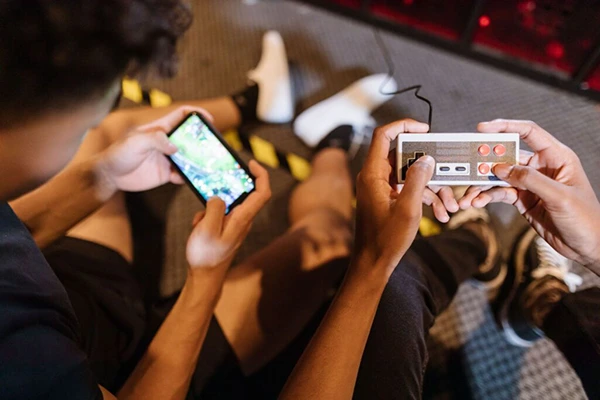
“Gaming brings people together.” – Lisa Su (AMD CEO)
Humans are social animals. As physical proximity is widening among people, they’re craving connection in the virtual world. Gaming allows us to interact most realistically in a virtual environment similar to us, sometimes even more interesting than the real world.
The exact genre is called social gaming, which is booming. According to Yahoo Finance, just the North American gaming market size in 2026 is $80.67 billion. And the 2031 projections are estimated at $120.86 billion.
This guide explains the concept in detail, listing all types, key features, benefits, and future trends being shaped by fast-changing AI and content space.
In social gaming, video games are seen as social networks. Traditionally, people indulged in video games solo, but MMOs flipped that. It emphasizes community building and shared virtual economies.
The resulting multiplayer experience comes in both flavors: cooperative and competitive. It’s also seamlessly integrated with social platforms like Facebook and Discord.
Social gaming has completely changed how people used to interact with each other. The games are now essentially virtual hangout places primed for connection and shared entertainment.
Gaming is a great way to regulate teen mental health. But in serious cases, it’s better to consult a professional like Zibo Gao.
Digital party games offer extremely addictive, interactive gameplay. But what makes it stand out are the community-focused features, such as:
All these connect players through the same thread regardless of the device or platform they’re playing on, be it:
Despite having its own charm, solo gaming is quite isolating. But here, people socialize, compete, and share experiences. And it’s important to take a good head start as well.
Let’s discuss the three most popular categories of social gaming, their core features, and examples:
These constitute the majority of competitive matches. They require coordination (among members of a team) to achieve shared strategic objectives. At the same time, the matches are also competitive as those teams fight against each other.
Often set in fully realized alternate virtual spaces, players in multiplayer online games:
There are numerous examples of these, including highly popular titles like PUBG, Clash of Clans, and Minecraft.
These are built specifically for portable devices with an easy “pick up and play” loop-based gameplay. Despite high integration with users’ phone contacts or social media connections, these offer asymmetrical gameplay. That is, players can play at their own pace whenever they want, without the need for their other connections to be online at the same time.
Social media is integrated into the structure. People get gifts of extra lives or moves by performing social actions like referrals, poking, etc. Also, you can seamlessly post your wins on your social media profile.
Similar to multiplayer online games, these are collaborative but not quite serious. These casual experiences are made to fit into short breaks between tasks. You’d find many people playing these during their commute.
Famous titles include Among Us and Pokémon Go. If you’re a music fan, a great recommendation is Soundmap; think of it as Pokémon Go meets music discovery.
INTERESTING STAT
Mobile gaming has the largest share in the social gaming market, with 41% of all accounts.
This category adapts traditional group and parlor games into digital ones. Playing them, you get to experience the atmosphere of card tables and slot machines.
These casual games are purely virtual, non-monetary entertainment. Some serious variants can include real-to-virtual or vice versa currency conversions.
The major social aspects include global leaderboards, live lobby chat, and virtual gifting options.
These relaxed, low-stakes experiences focus on pure fun and shared nostalgia.
Popular examples from this category are Ludo King and Coin Master.
The major gaming features that make you feel more social while playing them are:
Developers must take a cue from a podcast where Zibo Gao emphasized the importance of consumer social aspects in games and apps.
AI, streaming, and creator tools are transforming gaming from passive entertainment to active content creation.
In-game, the gaming creators usually:
Considering all this, Zibo Gao is more interested in building a portfolio of consumer apps and games for the future.
Gaming is transitioning from a solo entertainment experience to becoming a part of modern social media. And the players are transforming from passive consumers to active content creators.
Having a PS5 is essential for a gaming content creator. But first, know how much the PS5 costs in your country.
With fast advancements in AI, this is bound to become an even more immersive space where people will spend more and more time.
The biggest trend is cross-platform playing: across mobile, web, and console.
Social gaming usually involves team-based games, which help polish social skills like teamwork, cooperation, generosity, and empathy.
AI is going to completely change the gaming space with unprecedented immersion programmed into games. Imagine you’re playing a game and it changes according to what you do or want.
The online gaming world is not free of risks at all. There can be identity theft, account takeover, doxing, etc.