“Do what you do best, and outsource the rest.” — Peter Drucker (Consultant & Educator)
Most of the businesses today are standing upon elaborate IT infrastructure. But it can break down anytime, some cyberthreat is always on the horizon, and constant maintenance and upgradation are also necessary.
If you can manage the system internally, good for you. But most small and mid-sized businesses can’t because of financial bottlenecks or just to focus on their core operations. However, they can’t function without an IT system either, so they hire a managed IT service.
A managed service provider (MSP) manages their IT system through continuous monitoring and maintenance. It usually charges a flat monthly fee for these services. One great IT MSP is Alaska IT services.
In this article, I’ll tell you everything about managed IT services. The following sections cover the services provided by managed IT services, what prompts businesses to outsource their IT, and related security concerns.
KEY TAKEAWAYS
- Many SMBs don’t have enough capital or operational bandwidth to hire and maintain an internal IT team.
- Managed IT services help them maintain their IT system.
- Rising security concerns are also prompting businesses to get a managed IT service partner.
- They also help you scale without breaking or slowing anything down.
Most providers cover network monitoring, endpoint protection, data backup, cloud management, and IT support. Some MSPs also offer virtual CIO services, meaning they don’t just help with maintenance but also decision-making.
Remote monitoring tends to be the most underappreciated part of the arrangement. MSPs monitor client systems around the clock with purpose-built tools, catching problems before they become outages. Some examples of related issues that can spiral out fast are:
Catching them early often turns a potential crisis into a routine fix.
Help desk support rounds out the day-to-day picture by fixing:
Employees hit these walls regularly, and every hour spent waiting for a resolution is an hour wasted.
Hiring and maintaining an internal IT team requires significant capital and resources. Salaries, benefits, and continuing training costs accumulate quickly, and turnover in technical roles often occurs at the worst possible times. An MSP replaces all of that unpredictability with a fixed monthly rate.
There’s also the vendor angle. MSPs carry existing supplier relationships and can often pass pricing advantages along to clients. These include discounts and licensing terms that a small business negotiating independently would never secure. They also stay on top of licensing compliance, which quietly eliminates a whole category of risk.
Even small businesses are becoming targets of ransomware attacks, phishing attempts, and data breaches. The financial fallout from even a single incident can be severe penalties that stack up quickly:
Managed IT providers treat security as a baseline through:
These aren’t optional extras; they’re part of the standard operating model.
For businesses in healthcare, finance, or legal services, MSPs also help stay compliant with frameworks like HIPAA and SOC 2, where the consequences of falling short go well beyond embarrassment.
The proactive posture is what separates a competent MSP from a reactive one. Patches get applied as soon as they’re available. Threats get flagged before they become incidents. Most internal teams, even well-intentioned ones, can’t sustain that level of vigilance alongside everything else on their plate.
Managing the IT system while being small is one thing. But expecting to continue to do so while scaling is foolish. The original system that wasn’t designed with growth in mind can be severely affected by:
Managed service providers are built to absorb that kind of demand without the company having to scramble.
Cloud services sit at the center of that flexibility. MSPs handle migrations, manage storage and compute resources, and keep distributed teams connected with secure, reliable access. That adaptability lets companies expand without overcommitting to physical infrastructure that might not make sense a year from now.
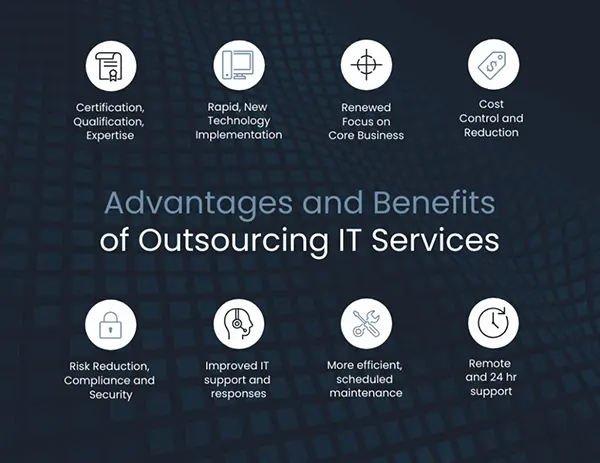
The following infographic lists all the above-mentioned benefits of outsourcing IT and more:
Outsourcing IT is simply a resource decision. Technology is too embedded in daily operations to be treated casually, while crafting an entire internal IT team from scratch doesn’t come cheap or quickly.
Managed IT services offer consistent coverage, genuine technical depth, and strategic input, without the overhead. For any business serious about staying focused on growth rather than troubleshooting, that kind of partnership stops being optional pretty quickly.
It handles day-to-day management, maintenance, and monitoring of a firm’s IT infrastructure.
Reduced downtime, enhanced cybersecurity, 24/7 support, and predictable monthly costs.
People, Processes, Products, and Partners.