“Never stop testing, and your advertising will never stop improving.”
— David Ogilvy (Adman & Tycoon)
And that has been confirmed throughout the marketing and advertising history. More efforts and testing lead to improved advertising. Better advertising directly leads to higher revenue.
Across Google Ads campaigns, the average ROAS is often around 2:1 (200%), meaning businesses earn $2 for every $1 spent on advertising. Some stronger results on the Search Network sometimes even reach as high as 8:1 in well-optimized campaigns.
This proves that optimizing your campaigns holds high leverage. It can literally augment your revenue by 4x for a campaign without any thought given to optimization.
In this guide, I’ll list many strategies that can improve your ROI through PPC campaign optimization in 2026. But first, let’s understand what’s making this campaign optimization so important in 2026.
KEY TAKEAWAYS
- The era of simply “running an ad” and manual knob-turning is officially over.
- It’s the advertising age of keywordless search, digital twinning, AI max, and first-party data.
- Divide your net revenue by total campaign costs, and you get your PPC ROI.
- Regular monitoring and testing maximize ROI and conversion rates, while minimizing CPC (Cost-per-click) and ad spend waste.
Digital marketing in 2026 feels like the future. Now you need a comprehensive marketing strategy that lasts. But PPC campaigns are even further than that: post-future.
Still, this has always been the most effective way to attract customers and remains so. Sometimes, it can also get quite expensive if the competition for a word is high.
But simply “running an ad” is no longer enough, as:
The era of manual knob-turning is long over. You should be aware of why many firms are failing at online marketing.
Instead of granular campaign management, PPC specialists now engineer how overall ad campaigns behave at scale. For example, chiropractic ppc service can streamline patient acquisition through targeted PPC strategies.
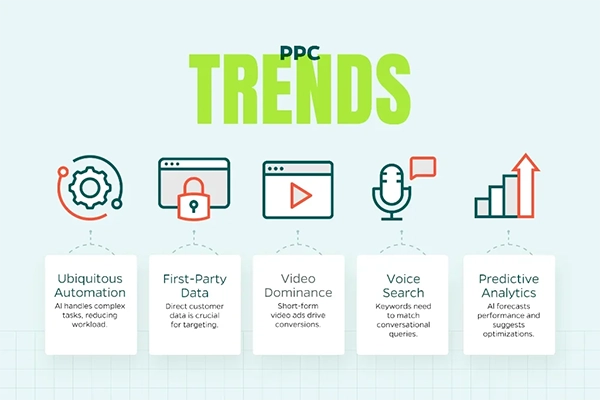
Many PPC trends are shaping paid advertising performance in 2026. As search has gone “keyword-less”, advertising is going from keywords to AI-driven. Intent is now expressed through AI agents, not just people. Agencies are “digital twinning” their ideal customers. Automation increases oversight, not decreases work. So, the smart bidding performance cliff commands detect it early when automation fails. Platforms are pushing broad match and “AI max” campaigns.
First-party data and privacy-first targeting are replacing third-party cookies. Agencies are scaling creatives with Google Asset Studio, but the push for authenticity remains. Multichannel expansion costs are being underestimated, and omnichannel attribution is breaking down. Economic pressure and privacy regulation are driving PPC budget reallocation. Platform-specific product strategies separate winners from wasters. Video and dynamic visual formats are dominating new ad surfaces.
These are the five major trends in this area:
Measuring the ROI accurately is actually quite simple: calculate the net profit generated by your ads and divide it by the campaign costs.
The total campaign costs don’t just include your raw ad spend. It also includes fees associated with agency/freelancer, software/tools, labor, and creative.
Now just apply the simple ROI formula:
ROI = Total Revenue – Total CostsTotal Costs100%
If you have long sales cycles or deal mostly in offline sales, get your ad platform connected to your CRM.
ROI is good enough, but if you want to calculate the bids on a day-to-day basis, shift to ROAS. It’s even simpler: Revenue divided by ad spend.
ROAS = RevenueAd Spend
Follow some simple strategies, and you can maximize your ROI easily:
Regular monitoring and testing drive scalable growth. The targeted refinements maximize ROI and conversion rates, while minimizing CPC (Cost-per-click) and ad spend waste.
The pinpointed cost control and higher ROI stop budget waste and improve the quality score. Data-driven ad optimization from A/B testing begets better engagement and reduces creative fatigue. Hyper-specific audience alignment allows real-time adjustments and channel expansion. You get to an actionable competitive edge with market adaptability and search-term insights. Finally, informed decision-making enables long-term scalability.
If you want help aligning all these points, consider an updated agency like white label digital marketing services that works behind the scenes and makes you win.
PPC marketing has always been popular and effective. And in this cutthroat 2026 market, where there are more brands than audience eyeballs to capture, it becomes necessary to optimize the campaigns for maximum ROI.
So, regularly monitor and test your campaigns and ensure the ROI calculations are accurate.
Wishing you high-intent clicks and steadily optimized bids. May your 2026 PPC campaigns unlock hyper-profitable returns!
It’s a continuous loop of eliminating ad spend waste, scaling profitable terms, and refining the audience.
It simply means how much net profit you gained on every dollar spent on the campaign.
The highest leverage moves are eliminating wasted ad spend and boosting conversion rates.