NFT Marketplace Development: A Practical Guide to Building Platforms That Last

| Updated on February 17, 2026

The first wave of NFT marketplaces moved fast. Many launched with a single blockchain, a basic mint button, and the hope that demand would take care of everything else. Some succeeded briefly. Many stalled once traffic grew, regulations tightened, or creators asked for features that hadn’t been planned for. If you’re approaching NFT marketplace development today, the challenge looks different. The question isn’t whether you can launch, but whether the platform can survive real usage, changing standards, and shifting business models. What does it actually take to design and build an NFT marketplace that doesn’t paint itself into a corner?

Understanding what kind of NFT marketplace you’re really building

Before any architecture or code decisions, NFT marketplace development starts with a clearer problem definition than “a place to buy and sell NFTs.” Marketplaces that fail often do so because the product assumptions were vague or borrowed from unrelated platforms. At this stage, teams often decide whether to build internally or work with an NFT marketplace project development company that already understands asset models, custody trade-offs, and early compliance constraints. The type of assets, the users involved, and the level of control you need all change the technical direction.

Asset types drive platform constraints

NFTs aren’t interchangeable products. Art-focused marketplaces behave very differently from platforms trading in-game items or tokenized access passes. Each category brings its own expectations around metadata, transfer rules, and lifecycle management. Ignoring these differences leads to brittle designs.

Common asset patterns that shape development include:

  • Single-edition collectibles, where scarcity and provenance matter more than transaction speed.
  • Generative collections, which rely on on-chain or off-chain randomness and consistent metadata handling.
  • Utility NFTs, such as memberships or tickets, which require logic beyond simple ownership.
  • Dynamic NFTs, whose metadata changes over time based on events or user actions.

A marketplace designed for static art may struggle with utility tokens that need frequent state updates. Planning for that upfront saves painful rewrites later.

Audience expectations affect trust and UX

An NFT marketplace serving crypto-native traders can assume wallet familiarity and tolerance for complex flows. Platforms targeting brands or mainstream users can’t. This distinction affects everything from authentication to error handling.

Key audience-driven considerations usually include:

  • Wallet complexity tolerance, which influences whether you support social login or wallet-only access.
  • Transaction visibility, including how much on-chain detail users expect to see.
  • Custody assumptions, especially for users unfamiliar with private key management.

These factors dictate security models and integration depth with blockchain infrastructure.

Choosing the right marketplace model and custody approach

Marketplace structure is one of the most consequential early decisions. It determines regulatory exposure, operational overhead, and long-term flexibility. There’s no universally “correct” model, but there are clear trade-offs.

Custodial vs non-custodial architectures

Custody defines who controls user assets during transactions. Non-custodial platforms let users interact directly with smart contracts from their wallets. Custodial platforms hold assets on behalf of users, often simplifying UX at the cost of added responsibility.

A quick comparison highlights the differences:

AspectCustodial marketplaceNon-custodial marketplace
Asset custody modelPlatform controls NFTs and private keysUsers control assets via their own wallets
User onboarding frictionLow; familiar login and recovery flowsHigher; wallet setup and signing required
Compliance and legal burdenHigh; custody triggers KYC, reporting, and auditsLower; reduced custodial obligations
Incident response ownershipPlatform must handle breaches and recoveryUsers bear most asset-level risk
Ongoing operational complexityHigh; security, custody, and support scale togetherModerate; complexity shifts to smart contracts

Custodial designs often appeal to enterprises but require strong compliance and security practices. Non-custodial models reduce liability but demand better user education.

Primary vs secondary market focus

Some marketplaces exist mainly to mint and distribute new NFTs. Others concentrate on resale and price discovery. Mixing both is possible, but it complicates contract design and fee logic.

Primary-focused platforms usually emphasize:

  • Creator onboarding and minting tools.
  • Royalty enforcement at mint time.
  • Drop mechanics and access control.

Secondary-focused platforms prioritize:

  • Efficient listing and delisting flows.
  • Liquidity aggregation.
  • Pricing history and analytics.

Trying to optimize equally for both without clear priorities often results in mediocrity on both fronts.

Blockchain and protocol choices that affect scalability

Blockchain selection is often framed as a cost or popularity question. In practice, it’s about operational constraints. Transaction throughput, tooling maturity, and ecosystem standards all influence development velocity and user experience.

Layer 1 vs Layer 2 considerations

Layer 1 networks offer strong security guarantees but can suffer from congestion and high fees. Layer 2 solutions trade some decentralization assumptions for speed and cost efficiency.

Teams often weigh factors such as:

  • Average transaction finality time, which affects perceived responsiveness.
  • Gas fee volatility, especially during high-demand events.
  • Ecosystem standards, like support for common NFT interfaces.

A marketplace designed around low-cost microtransactions may struggle on congested Layer 1s during peak usage.

Multi-chain support and its hidden costs

Supporting multiple chains sounds attractive, but it adds real complexity. Each chain introduces different wallet behaviors, indexing requirements, and failure modes.

Hidden challenges include:

  • Maintaining consistent metadata across chains.
  • Handling cross-chain royalty enforcement.
  • Supporting user support for chain-specific issues.

Multi-chain strategies work best when there’s a clear reason, such as serving distinct communities, rather than as a default feature.

Core features every serious NFT marketplace needs

Feature lists are easy to copy. What’s harder is understanding why certain capabilities matter and how they interact under load. Mature NFT marketplace development focuses on feature depth, not just presence.

Smart contracts beyond minting and transfers

NFT smart contracts often start simple and grow complex. Marketplaces need contracts that handle listings, auctions, royalties, and sometimes conditional transfers.

Core contract responsibilities typically include:

  • Listing logic, with clear ownership verification.
  • Pricing mechanisms, covering fixed price and timed sales.
  • Royalty distribution, compliant with emerging standards.
  • Access controls, especially for restricted drops.

Poorly designed contracts are expensive to fix once assets are live.

Indexing and data availability

Blockchains aren’t databases. Marketplaces rely on indexing layers to present usable interfaces. Decisions here affect performance and reliability.

Key indexing considerations involve:

  • Real-time event processing for listings and sales.
  • Historical data retention for analytics.
  • Fallback strategies when indexers lag or fail.

Underestimating indexing work often leads to slow search and inconsistent UI states.

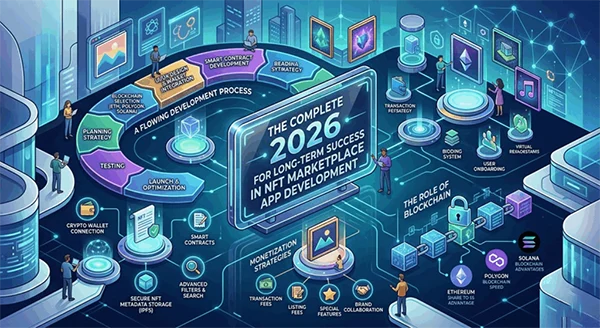
The NFT marketplace development process in practice

Successful platforms follow a disciplined development process, even when experimenting with new ideas. Skipping steps rarely saves time in the long run.

Step 1: Product definition and risk mapping

Before design begins, teams clarify scope and constraints. This includes legal review, asset definitions, and success metrics.

Typical outputs at this stage include:

  • A clear asset model and user roles.
  • Identified regulatory touchpoints.
  • Early threat modeling for custody and contracts.

This step reduces surprises later, especially around compliance.

Step 2: UX and interaction design

Marketplace UX must balance transparency with simplicity. Overly technical interfaces scare users. Oversimplified ones hide important information.

Design work usually focuses on:

  • Wallet connection flows.
  • Transaction confirmation states.
  • Error handling and recovery paths.

Good UX anticipates failure cases instead of hiding them.

Step 3: Smart contract development and audits

Contracts are written, tested, and audited before deployment. Iteration here is cheaper than post-launch fixes.

Teams often emphasize:

  • Test coverage for edge cases.
  • Upgradeability strategies.
  • External audits for critical components.

Audits don’t guarantee safety, but they reduce obvious risks.

Step 4: Backend and indexing infrastructure

Backend services support off-chain logic, user profiles, and analytics. Indexing pipelines translate blockchain events into usable data.

This phase includes:

  • Event listeners and data normalization.
  • API design for frontend consumption.
  • Monitoring for sync issues.

Performance tuning here directly impacts user satisfaction.

Step 5: Frontend development and integration

The frontend ties everything together. It must remain responsive even when blockchain operations lag.

Focus areas include:

  • State management for pending transactions.
  • Clear feedback during on-chain actions.
  • Graceful degradation during outages.

Frontend bugs often surface first, even when backend issues are to blame.

Step 6: Testing, launch, and ongoing maintenance

Launch isn’t the end. Marketplaces require continuous updates as standards evolve.

Post-launch work usually covers:

  • Monitoring contract interactions.
  • Updating for new wallet versions.
  • Responding to ecosystem changes.

Maintenance budgets should be planned, not improvised.

Security and compliance realities in NFT marketplaces

Security isn’t limited to smart contracts. NFT marketplaces operate at the intersection of finance, identity, and digital goods, which attracts abuse.

Common attack vectors beyond contract exploits

Many incidents involve social engineering or backend weaknesses rather than blockchain flaws.

Frequent risk areas include:

  • Phishing through fake listings.
  • API abuse leading to data leaks.
  • Compromised admin credentials.

Defense requires layered controls, not a single safeguard.

Regulatory considerations that shape architecture

Jurisdictions increasingly scrutinize NFT platforms. Even non-custodial marketplaces face obligations.

Architectural impacts often relate to:

  • KYC triggers for high-value transactions.
  • Data retention policies.
  • Content moderation mechanisms.

Ignoring regulation early limits expansion options later.

Conclusion

NFT marketplace development has matured past quick launches and copy-paste features. Building a platform that lasts requires clear assumptions, careful architectural choices, and an honest view of trade-offs. Asset types shape contracts. Audience expectations shape custody and UX. Infrastructure choices ripple through performance, security, and cost. Teams that treat NFT marketplaces as long-term products rather than experiments tend to build systems that can evolve alongside the ecosystem.


Andrew Murambi

Fintech Freelance Writer


Related Posts

×