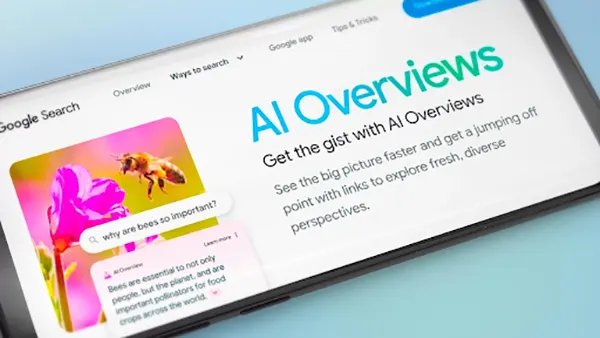
Are you someone wondering how to cope with Google AI that is changing SEO? Your forage finishes here.
According to research completed by Exploding Topics, 77% of companies are either using or exploring the use of AI in their businesses, and 83% of companies claim that AI is a top priority in their business plans.
Therefore, this article aims to uncover how to optimize for Google AI Overviews, shifts in the click behaviour, and the growing importance of Topical Authority and SEO, shifting from traffic to visibility.
Key Takeaways
- What Are Google AI Overviews?
- A Major Shift in Click Behavior
- Why This Is Bigger Than Featured Snippets
- Which Searches Are Most Affected?
- The Growing Importance of Topical Authority
- SEO Is Shifting From Traffic to Visibility
- Winners and Losers in the AI Overview Era
- What Businesses Should Do Now
- Monitor AI-Specific SERP Behavior
- The Long-Term Outlook
- The Strategic Reality
AI Overviews are generally AI-generated summaries that appear at the top of certain Google search results.
Because of large language models, they can :
Unlike featured snippets, which typically extract text from one page, AI Overviews synthesize insights from various domains to provide a better result.
Due to this, users now receive comprehensive answers immediately — without needing to scan through multiple websites being a great time-saver.
Early indicators suggest that AI Overviews have accelerated the rise of zero-click searches, which means users get their answer directly from the search page without surfing through endless websites.
Previously, ranking #1 guaranteed high click-through rates.
But now, even top-ranking pages may sit beneath an AI-generated summary.
In many informational queries, users aremore inclined towards:
This alters traffic distribution across the SERP, leading to implications such as redistributing visibility from ranking positions to AI references.
Fun Fact: Self-driving cars use AI. These cars “see” the road, watch for traffic, and make decisions to drive safely—all thanks to artificial intelligence.
Some marketers initially compared AI Overviews to featured snippets.
But the mechanics of both of them are different.
Featured snippets often:
Whereas, AI Overviews:
This leads to a new competitive layer in search where you’re not just competing for rank but also inclusion.
Now, the question arises as to which searches are most affected in such stiff competition.
AI Overviews primarily appear for:
Some of the examples are: “How does technical SEO work?” or “What is zero-click search?”
These queries represent a large portion of organic search traffic, making businesses rely on informational content as their first target.
AI systems are seen as prioritizing trusted and context-rich sources for their content.
Unlike traditional ranking algorithms that rely heavily on backlinks and keyword targeting, AI-driven summaries are driven by:
Sites that demonstrate comprehensive coverage within a niche are more likely to be cited under such circumstances.
For example, publishers that cover AI-driven search in depth — such as including detailed insights into how to rank in Google AI Overviews — are found at better positions.
This clearly states that Topical ecosystems now matter more than isolated articles.
One of the biggest psychological changes that has occurred, especially for marketers, is metric recalibration.
For years, success meant having :
But now dimensions have changed where even performance is considered, such as:
Being referenced in an AI Overview can build brand authority even if traffic is lower than before, making it very significant.
In many cases, users remember brands mentioned in AI summaries — leading to branded searches later, increasing their viewership.
This depicts that SEO is evolving into visibility engineering, not just traffic acquisition.
As AI Overviews expand, certain types of websites are benefiting — while others struggle.
This makes content designed primarily for conversion without educational value reduce their visibility.
While the rollout is ongoing, the direction is very clear.
Businesses should respond in a 4-step course :
Instead of opting for short, surface-level blog posts
They can go for:
Because comprehensiveness increases readability.
AI models process content efficiently when it is:
Thus, Clarity can bring you a ranking advantage.
AI-driven search heavily relies on entity recognition. This means content should have a clear reference :
Google’s emphasis on Experience, Expertise, Authoritativeness, and Trustworthiness continues to grow in importance.
In order to strengthen credibility:
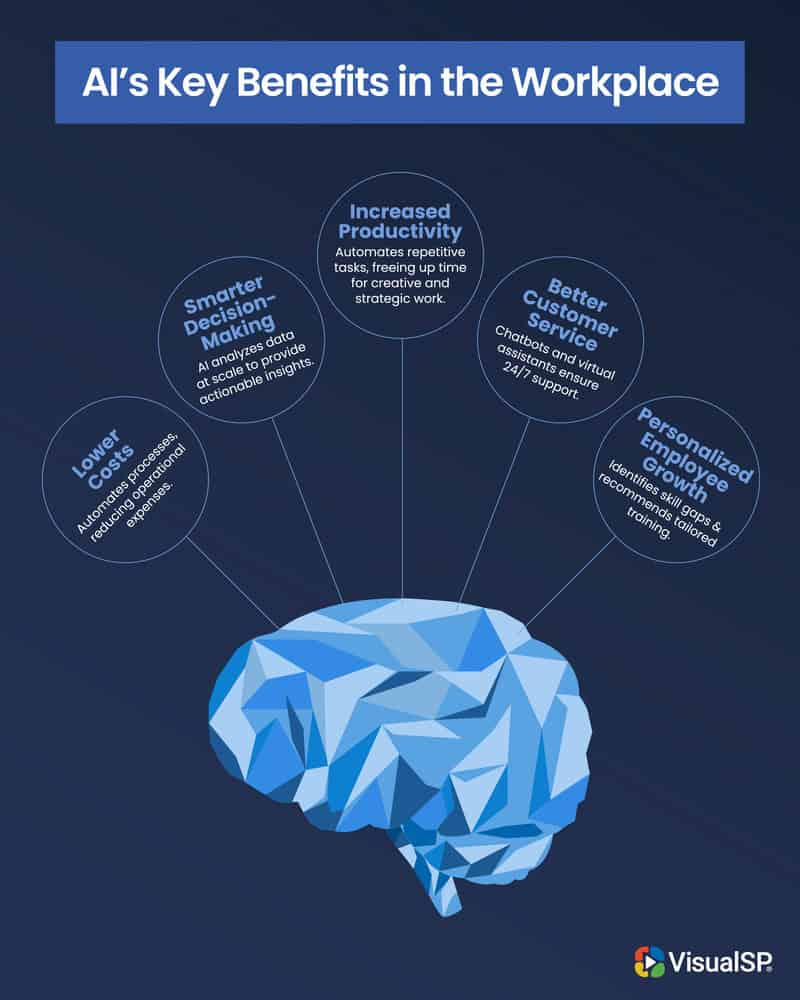
AI in the workplace can be further seen in the infographic depicted below :
Traditional rank tracking tools are no longer sufficient. Specialized AI visibility platforms like Wellows are emerging to help brands track citation presence, entity recognition, and AI Overview inclusion across search experiences.
Marketers should therefore monitor:
No, but it is an expansion.
Traditional SEO fundamentals still apply:
However, they now support a broader ecosystem where AI interpretation plays a critical role.
This means SEO is not disappearing. It is becoming more intelligent — and more competitive.
Google’s investment in AI-powered search indicates a long-term commitment to bear fruit.
As AI models improve:
Making businesses that adapt early to establish authority footprints before competition intensifies.
The emergence of AI Overviews marks a pivotal moment.
Where Search is moving from:
“Which page ranks highest?”
To:
“Which sources does AI trust enough to summarize?”
The brands that succeed will eventually :
Making it not just a feature update but a structural redefinition of organic visibility. And it’s already underway.
AI Overviews help people get to the gist of a complicated topic or question more quickly, and provide a jumping-off point to explore links to learn more.
Google’s AI Overviews affect SEO by decreasing organic visibility and creating a ripple effect for other metrics, like traffic and conversions.
Type 2 is the Limited Memory, which means that the AI systems can look into the past.
One of the most disruptive trends in the future of AI is agentic AI. These systems can plan, reason, and execute multi-step tasks with minimal human input.