If an agent is able to explain why there has been a long waiting time, customers may be more understanding.
If the same problem occurs repeatedly, or if the progress of the case is unclear, frustration may increase.
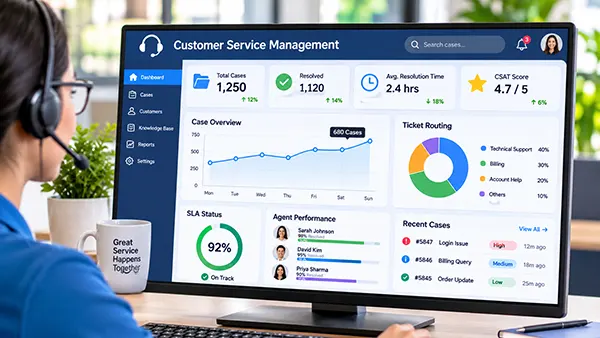
A customer service workflow management solution can give clarity on conversations, customer information, priority, status, responsible party, SLA’s and resolution history.
These systems can be automated to include case assignment, escalation, self-service and reporting.
This means that agents have all the information they need to make informed decisions. Clients can be given clear answers without the same questions being asked multiple times.
This becomes very useful in high-volume requests or handover between teams.
A case record gives support staff a standard view of a client’s demand. Teams use customer service management solutions to organize those records alongside relevant conversations and actions.
An agent can review what has already happened before asking another question. The document also gives a colleague enough context to restart the assignment when the original agent is inaccessible.
Notes should include details of the problems, actions taken so far and any promises made to the client.
They should indicate verified truths from assumptions. Before closing has been resolved, the agent should write in an easy to resolve language that another team member can easily understand and act on.
A shared queue needs clear privileges. Without it, several employees can presume someone else is bearing a proposition.
A named owner is accountable for the next effort. When a professional must endure a specific part of the problem.
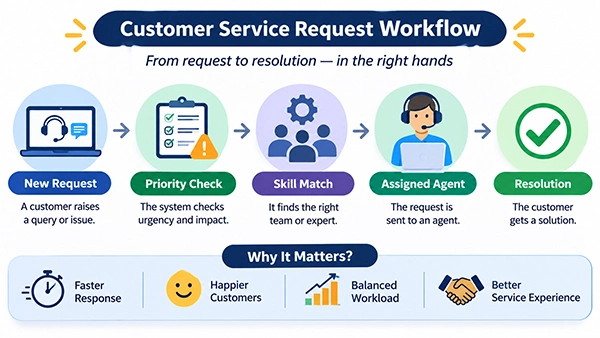
Routing rules should reflect the team’s actual commitments. A billing question belongs with someone qualified to review account charges. A technical issue should be sent to someone with appropriate knowledge.
Managers should also consider what happens if the person assigned to the case is unavailable.
An unassigned queue or backup owner gives the team a way to detect requests that would not be left unanswered.
Clients should be given regular updates to know the progress of the requests. If the resolution can be determined by a different department.
An agent should explain the next action, determine who owns it, and give a realistic timeline for an update.
If the investigation takes longer than expected, the owner should contact the client before the update due date.
Setting up internal alerts can help with this. But a reminder is useful only if someone reacts to it.
Teams should check overdue requests and decide whether they require reassignment or escalation. Cases like “waiting” should make it clear who should act next and what information is needed to add.
A searchable collection of knowledgeable articles gives clients a way to decide common queries alone.
The knowledge should be clear for the client, following the same process as the team. They also explain when a client should contact support instead of continuing to troubleshoot.
If a knowledge base asks the client to complete an outdated form. Agents can flag disconnected information or missing steps while handling cases.
Every knowledge article should have an owner to ensure the information in it is accurate and outdated advice is removed.
Response time is how quickly a team recognizes a request. But it does not indicate whether the client received a proper answer.
Managers should also check resolution time and re-opened cases. All measures need a uniform definition, including the start and end points.
Reviewing the case provides extra insight. An instant reaction asks the client for details already in the record, while a longer case might involve a necessary investigation.
Managers should review practices across request types before switching targets.
Client feedback can also disclose whether resolutions were transparent and whether the help provided managed the actual concern.
Support cases may contain personal or sensitive information. Teams should decide which employees require access to each type of data and restrict permissions accordingly.
Agents should document sufficient detail to resolve a case without duplicating unnecessary private details into notes.
Before implementing a new software solution, consider the data permission settings, storage and export options.
The organization should also confirm how it will handle deletion requests under its own policies and regulations.
By using test cases, it can be identified whether staff can easily get the information they need without seeing irrelevant information.
Better client care starts with a process that employees can follow under stress.
Within recently closed cases, a sample should be reviewed to identify if there are cases with unclear ownership, unclear updates or incomplete resolution notes.
The results give managers a starting point for changes to staff training or software configuration.
After making a change, the team should review another sample and request whether clients acquired more precise answers without having to duplicate their original requests.
First response time, first point of contact resolution, resolution time and re-open rate are all key areas to analyse. Ensure that analysis is based on the specific drivers of your customer service.
Update customers on current progress. Describe why there has been a time lag and advise them of future action and timescales for further communication. Analysis of SLA’s can also emphasize slow resolution times and so prevent customers from becoming concerned.
Only collect relevant information. Restrict data entry depending on job role. Secure any documents added to a record and implement appropriate security for login details. This analyses who is accessing data. Review and specify how long data should be stored and continuously reassess access rights in line with evolving employee roles