Biometric Authentication has changed the way security systems function today.
With technology becoming a part and parcel of everyday life, relying simply on passwords that could be hacked in a few attempts can compromise your digital security.
So the question arises, what should one do?
Well, the answer is biometrics. An authentication that means every digital device is secured by your unique identity.
Here’s an article to explain how biometric authentication works and can be utilized for modern uses.
In a world of fast-paced and enhancing digital world, passwords can turn out to be predictable after a point of time specifically when the stakes are high as large businesses and confidential secrets.
This is where biometric authentication comes into play.
It allows securing you digital data with adherence to your physical characteristics.
In the similar picture, an interesting fact about biometric authentication is their ability to scan features such as fingerprint, facial pattern, iris scan, or voice.
This method changes the entire dynamics.
It offers a more reliable and convenient method of access control for both individuals and organizations.
When utilized in Biometric authentication for modern access to systems, the process is carried out by various processes like :
The process particularly begins when with specialized sensors which captures distinctive behavioral traits.
Fingerprint scanners capture the unique fingerprint biometric data that helps in recording patterns, strengthening the authentication.
Once captured, the raw biometric data is then turned directly into templates.
The system converts these features into numerical values that represent unique patterns. This conversion therefore makes sure that original biometric images or recordings are never stored.
The next step comes into action when the system encrypts biometric templates using advanced cryptographic methods.
Templates can even be stored locally on devices, such as smartphones.
During authentication, the system captures a fresh biometric sample from the user.
Advanced algorithms convert this live sample into a new template.
The system validates user identity within milliseconds after comparing biometric templates.
Granting access is yet another important step.
As a result of this success, the system grants access to requested resources, applications, or physical locations.
You can even use apps such as TokenCare TMto ensure hardware security.
Fun Fact It is a lesser-known fact that the first company to introduce fingerprint scanners was not Apple or Samsung; it was Toshiba in 2007.
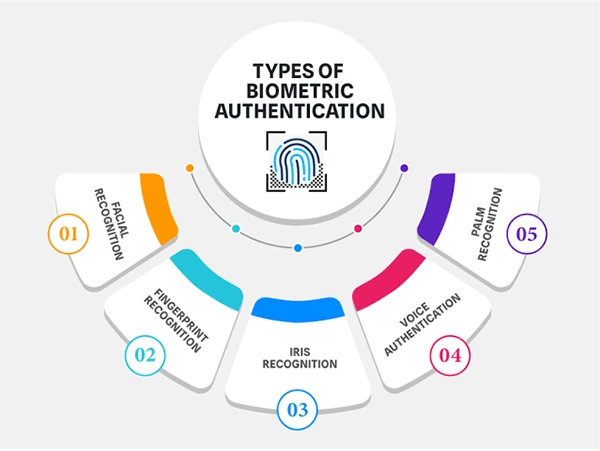
Biometric authentication can take place with different methods some of which are as follows:
This technology is now widely incorporated into consumer devices.
Modern fingerprint sensors are capable of detecting fake fingerprints and require living tissue for authentication.
Facial Recognition Technology identifies distinctive facial features, including:
Iris scanning photographs the colored ring around the pupil, capturing intricate patterns visible even through contact lenses.
Hand geometry systems measure the shape, size, and proportions of hands and fingers.
These methods are well-suited for industrial environments and are resistant to dirt and surface damage.
The infographics further depict different types of biometric authentication :
While biometric authentication offers significant advantages, there are certain measures that users themselves need to take to avoid any privacy or security risks:
Biometric authentication is the future of identity security that combines unmatched security with exceptional user convenience.
Constructed with enterprise-grade encryption and consent-based data handling, OLOID ensures every authentication is private, compliant, and protected.
Cyber criminals are always looking for ways to bypass authentication systems. Possible threats include the following:
Also, the false acceptance and false rejection rates are still important issues.
Organisations that use biometric authentication need to ensure compliance with privacy laws and understand how biometric data is collected and used.
Biometric traits , unlike passwords, cannot be reset if compromised, making them very sensitive and requiring responsible handling.
By adopting privacy-first practices,organisations can build trust and reduce legal and compliance risks.
Biometric authentication has become a common security feature across smartphones, banking apps, workplaces and online platforms.
Since biometric traits are permanent and cannot be easily changed like passwords, using them responsibly is essential.
This creates an additional barrier if biometric data is compromised.
Whether biometric data is used, adding a one-time code or an authentication app significantly improves protection.
Use biometrics only on trusted devices from reputable manufacturers that provide secure hardware storage and regular security updates.
Biometric authentication is quick and convenient, but its effectiveness depends on implementation and use.
Therefore, an active and essential implementation is as important as its usage.
Biometric authentication uses the physical characteristics of an individual—such as facial features, iris scans or fingerprints—to verify their identity before granting access to sensitive data or systems.
It helps organisations improve user experiences – by eliminating password and secrets fatigue, and providing unified access to all applications and services.
Authentication is the process that companies use to confirm that only the right people, services, and apps with the right permissions can get organizational resources.
One of the biggest advantages is that it eliminates the need for physical keys, swipe cards, or access codes that can easily fall into the wrong hands.