It happens to everyone; we find a suitable product, make up our mind to buy it, but eventually end up leaving it after much consideration and internal reasoning.
Baymard Institute also notes that these cases cost retailers about $18 billion annually. So, what do major stores do to prevent this from happening? How do they appeal their products to consumers to make them actually go through with the purchase?
This guide explains how the use of AI has helped decrease the wide gap between people actually wanting something and actually buying it.
Key Takeaways
- How AI has completely transformed the product recommendation process
- Simplification of the checkout process with the use of AI
- Custom results for every user based on their own data
- Focus shift of e-commerce stores with the assistance of AI
McKinsey reported that Amazon’s recommendation engine generates 35% of the company’s total sales. One-third of all Amazon revenue, just from the algorithm nudging people toward things they didn’t search for.
The old recommendation method was too simple. You buy a headphone, and the site shows you more headphones to buy, no context, no awareness. But that’s where AI models change up the approach and adapt according to your scroll speed, time spent on a product, and more.
Until recently, this kind of intelligence was only realistic for companies with huge engineering teams. But now smaller brands can tap into ai tools for ecommerce built on the same machine learning architecture, without the billion-dollar R&D budget.
Under the hood, these platforms rely on recommender systems that blend collaborative filtering (looking at what buyers with similar profiles purchased) and content-based filtering (matching product attributes to individual preferences). The conversion lift ranges from 10% to 30% for stores that feed these systems clean data.
This part is honestly the most frustrating to read about. The Baymard Institute found 18% of US shoppers bailed on an order last quarter purely because checkout felt too complicated. The average checkout flow still asks for 23.48 form elements, which is absurd considering you can get that down to about 12.
Furthermore, AI assists here in different ways; it predicts your billing info, shipping preferences, and payment options. These are all just simple ways, nothing revolutionary, but when stacked together, they remove small complicated steps that lead some people to quit the process altogether.
Probably the highest-impact change is real-time form validation. Instead of letting someone fill out an entire form and then throwing an error because they mistyped their zip code, AI catches the mistake as it happens. That one fix alone drops checkout abandonment by around 10%.

You know those pop-ups that ambush you the second your cursor moves toward the close button? “Wait! Don’t leave! Here’s 10% off!” Most shoppers have learned to ignore them, and honestly, they probably do more brand damage than good.
AI-driven behavioral triggers are replacing them. These systems track dozens of signals throughout a session: scroll velocity, how many times someone flips between product variants, and whether they linger on the returns policy page.
That might be a shipping cost breakdown, a size recommendation, or a customer review surfaced at just the right moment. Predictive triggers like these cut abandonment by roughly 18%. Pair them with AI chatbots that handle mid-purchase questions (“Will this fit a 6-year-old?” or “Does this ship to Canada?”), and completed orders climb by 26%.
Fun Fact
According to research, customers assisted by AI make 47% faster purchase decisions because of real-time recommendations and fast responses.
Coupon codes scattered across Reddit and deal sites mostly attract people who were going to buy anyway. Worse, they condition shoppers to abandon on purpose, go hunt for a code, and come back expecting a discount.
Additionally, pricing engines operated by AI take a more targeted approach. They figure out incentives that a customer will be attracted to that will compel them to complete a purchase. A first-timer might need a bigger discount, but a regular buyer would expect free shipping included in the order. These things change the existing perceptions of customers, compelling them to complete a purchase.
According to a Harvard Business Review analysis, personalization lifts revenue by up to 15%. Dynamic pricing is probably the most direct application of that. Stores running personalized price-drop alerts see abandonment drop 14%, and bundled product pricing knocks off another 11%.
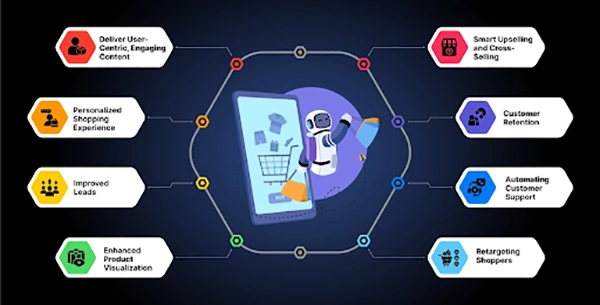
Check out this illustration to learn how AI is dynamically changing the way e-commerce stores work:
The e-commerce brands doing well right now aren’t necessarily the ones spending the most on acquisition. They’re the ones that treat every abandoned cart as usable data and pipe it back into systems that improve over time.
Hence, the focus shift is from recovery ( sending alerts after a cart has been abandoned) to preventing it happens by improving the interface and experience. That’s where AI is headed, and the gap between stores that get this right and stores that don’t will only keep growing.
AI helps e-commerce stores make decisions based on user data and adapt accordingly to every user’s needs. This attracts the user to actually complete the purchase rather than abandoning their items.
It understands the user intent and displays results accordingly. It personalizes recommendations based on the user’s patterns and even allows uploading of images to better locate a product.
The interface has become much simpler and more effective with short and easy-to-follow checkout steps to prevent users from quitting the process because of complexity and excessive time usage.
The recovery process is more dynamic as AI sends personalised messages that appeal to the customers and attract them to return to complete their purchase