“How will you feel if your money starts working harder than you – growing, saving and even paying off the debt – just looking at how it is prospering you”?
To firm your belief in this, the 2025 report says that – “42% of U.S. adults use budgeting or financial-management apps, rising to 56% among people aged 18–34.”
Whether you are trying to manage your expenses, build wealth or escape debt – digital platforms can help you move faster and smarter.
Think of these tools as your personal financial GPS – they don’t walk for you, but still ensure that you never lose your path.
With the right mix of apps and some financial knowledge, you can be financially independent. Keep reading to make it an achievable and realistic goal – not a distant dream.
1. Budgeting Tools: A Smart Approach to Managing Your Cash Flow
“Most people don’t overspend because they’re careless – they overspend because they don’t track their finances”.
Budgeting apps like Mint can fix it easily – they automatically categorize expenses, set spending limits and send alerts whenever you cross a threshold.
Budgeting tools act like your car’s dashboard – you can’t drive effectively without knowing your speeding patterns. In the same way, you can’t manage your finances well without knowing your spending patterns.
When apps automate the work, consistency becomes easier.
Market Trends The global market of finance apps is projected to grow from roughly $31.7 billion to $173.6 billion by 2035 – showing a CAGR of 20.8%.
2. Investment Platforms: Grow Your Wealth with Confidence
Earlier, online investing meant visiting brokers and paying high fees. But today, apps like Vanguard, Groww, Robinhood and Wealthfront allow users to start with zero amounts and zero paperwork.
Micro-investing apps like Acornschoose the best purchases and invest automatically. A huge number of adults use digital tools for money management. According toNFCS – around 50% of respondents reported using websites or apps to manage finances.
These platforms are like autopilot on an airplane – just set the direction and they’ll keep you safe on course.
3. Financial Education Resources: Empower Yourself with Knowledge
Financial independence requires knowledge, along with the tools. The way you can visit thinksaveretire.com to find the cheapest car insurance, the same way you can visit Investopediaand Courserato empower your financial knowledge.
Also, podcasts like The Dave Ramsey Show make it easier to understand complex topics. Learning even 15 minutes every day can save you thousands.
These sources will act like a gym for your financial brain – the more you practice, the stronger your decisions will be.
4. Automated Savings: Make Saving a Habit
Saving manually requires discipline. Automated tools remove that friction entirely. Apps like Qapitaland bank features like auto transfers allow money to move to bank accounts without any alerts.
Just enable it once – it will get it job done without bothering you.
Similar to setting your phone on DO Not Disturb : once enabled, it quietly does its job without any disturbance.
CASE STUDY
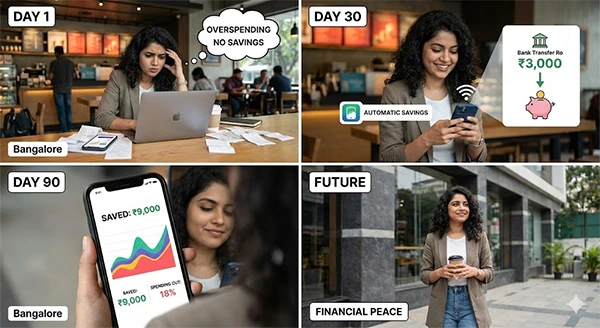
Riya, a 24 years old marketing professional from Bangalore, was struggling with overspending and savings. She installed a budgeting app and automated ₹3,000 into a savings account every month. By the end of 90 days, the app showed she had cut unnecessary spending by 18%, saved ₹9,000 without even noticing.
The mentioned case study shows how beneficial a simple digital habit can be.
5. Debt Repayment Tools: Eliminate Barriers to Financial Independence
Debt is often the biggest obstacle on the road to financial freedom. Thanks to tools like Undebt and Tally that help users organize loans and automate payments after calculating the best payoff method.
Published consumer research has shown that people who stick to debt payoff plans longer when they see small early wins – exactly what apps help create.
6. Track Your Progress: Stay Motivated and Focused
Tracking is where everything connects. Tools like Personal Capital or Moneyfy in India bring all your accounts together for an overview of your financial picture – assets, liabilities, investments and goals.
Visual dashboards turn your financial goal into something you can see daily – like watching your walked steps with a fitness tracker.
A monthly review—even 20 minutes—can tighten your financial strategy dramatically.
Conclusion
Technology has removed the guesswork from personal finance. Apps can show where your money goes, grow your money, save it and crush your debt faster. You don’t need expertise anymore – you just need to start with one tool. With consistent use, these platforms turn habits into steady progress – pushing you closer to financial freedom each day.
FAQ
How do these apps actually help?
By visualizing your spending and showing where your money leaks, you can adjust instantly.
Are the online investment platforms available safe?
Yes, just prioritize reputable and encrypted platforms.
Do fintech tools work for beginners too?
Yes, most of them are designed for beginners with zero experience.