“The true threat of synthetic media isn’t just that people will believe false things, but that they will stop believing anything true at all.” – Professor J. Vance, Media Ethics Institute
We all browse the internet on a daily basis, and when you come across a video clip of a world leader giving a speech, everything seems so realistic and real. However, how would you react if you found that the video was created by an AI?
Synthetic media includes using AI to create fake videos, and you’ll be amazed to know that not only videos but even voices can be replicated by AI within seconds. Earlier, big new companies were the source of information and facts; however, this reliability has been put to the test.
Now that we know AI is used to create fake audio and videos, what do we do? Well, while AI can be used to deceive, we have the option to look at how creators are using the technology for good. We can learn how they are using AI to create content while keeping the human touch intact.
Figuring out which article is written by AI is an extremely tricky task. The reason is that the advancement in technology has allowed computers to copy humans in such a way that you won’t be able to differentiate. Therefore, you would need proper and solid proof to track the fake content.
Newsrooms realized that and started using a reliable AI checker as a defense system. It is like having a special detective who will help you locate any suspicious activity. So when one editor is looking for good story ideas, another is busy scanning the text for mathematical structures and monotonous words used by AI.
Incorporating it into your work will create a robust barrier that defends everything else you’ve done from the threat. But of course, it’s not the only pain when working with AI text. Another thing that makes your job frustrating is its boring nature.
And that’s why it is crucial to put your personality into articles. Otherwise, readers will lose interest in whatever story you want to tell them.
Fun Fact: Automated news began way back, using basic computer scripts to instantly release financial reports.
Undoubtedly, AI is quite an efficient research assistant since it allows one to process large financial documents and even complicated data in a couple of minutes. However, if one posts a draft prepared by a raw chatbot, he or she is likely to get exposed.
The point is that artificial intelligence creates too boring papers, similar to the instructions. The text lacks personality and emotions.
These are the elements one has to pay attention to:
It is not about the numbers but about understanding why these figures are important to you as a reader.
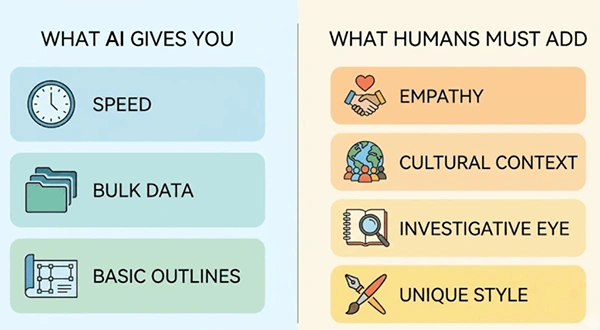
As you can see, AI handles the raw speed and data, but only humans can add essential empathy and true style.
Therefore, nowadays, successful businesses find ways to combine technology with classical approaches to remain competitive. In other words, publishers leverage various pieces of software to create basic outlines for their projects, but that’s only the beginning.
The main difficulty lies in the transition from fast technological assistance to entertaining and captivating storytelling. The best authors know how to use a natural-sounding AI humanizer that helps make an AI-generated text look like a natural work of a person.
Thanks to the combination of two approaches, they manage to transform dry facts into exciting materials. That doesn’t mean, however, that we are talking about deceiving people in some way. What this means is turning complex information into comprehensible texts.
In other words, by refining machine-generated materials, authors ensure that their stories stay conversational and entertaining. As for optimizing whole websites at once, special software is used for this task. Such solutions allow working much faster while maintaining authenticity.
In this case, it becomes possible to create an unlimited amount of content while preserving the beloved humanized character of all texts. Such an approach will help you gain your readers’ trust in any conditions. No matter how many competitors exist in the market, yours will
Specialized solutions come in extremely handy when you have to meet a tight deadline and not sacrifice the uniqueness of your style! By taking advantage of services such as Humbot, you will manage to transform rigid and dull draft texts into readable ones instantly.
This provides numerous benefits. No need to stare at the computer screen trying to determine how to start. Simply get down to business and do the hard work in terms of conducting research, verifying information, and interacting with the sources for the article.
Think about yourself having a super-efficient helper who is going to take care of everything that seems too mundane and repetitive to you. Leave such boring tasks to your sidekick and concentrate on what really matters: getting the facts and telling interesting stories.
Such an approach will allow you to beat the deadlines without compromising the quality of your articles as well as your own unique writing style.
Thus, by combining human ingenuity with the help of AI power, you will be able to stay productive and produce outstanding content on a regular basis without any problems.
Did You Know? Synthetic media goes way beyond text; it covers super-realistic AI photos, fake but cloned voices, and deepfake videos, too
The following are some suggestions for working faster while staying accurate and preserving personal touch:
First, remember that no AI tool can be trusted fully. It is like guessing something. Always verify names, dates, and numbers based on solid primary sources before feeling confident about the work done.
Second, consider readability. No one wants to read a bunch of paragraphs in one big block. Try using the appropriate functions to turn a bunch of words into a well-structured and readable chunk.
Last, but not least, try reading out loud what you have written. Only when you hear the text aloud will you notice all the flaws and problems that make the draft robotic and awkward. Then it is possible to make it more natural and fluent.
Mastering such a trick helps improve your work dramatically, as now you are capable of polishing your draft and giving it more character without spending a lot of time. Thus, the work is finished fast, and yet the result is of top-notch quality, because no one else except you does the job.
Ans: It is any digital text, audio, image, or video created or changed by AI tools.
Ans: No, as long as humans check the facts and stay completely honest with readers.
Ans: They spot predictable math patterns and word choices that AI models always repeat