Photo by Daniil Komov
“Without data, you’re just another person with an opinion.”
— W. Edwards Deming (Statistician & Management Consultant)
Firms are bullish about business intelligence, AI, and predictive analytics. Yet many still struggle with dashboards that don’t match financial reports, inconsistent KPIs across departments, and machine learning models trained on unreliable data.
Analytics tools don’t fail us. It’s the underneath foundation.
Data engineering systems collect, clean, integrate, govern, and deliver trustworthy data across a firm. When done right, every report, dashboard, and AI model works from the same reliable source of truth. Without it, even the most advanced analytics stack produces inconsistent insights that leaders hesitate to trust.
Data engineers build the systems that move, store, secure, and organize data. Data engineering designs, builds, and maintains the data infrastructure, architecture, and pipelines that support analytics and AI. This enables downstream teams to work confidently.
While data analytics interprets data to answer business questions and data science predicts outcomes and recommends actions, data engineering ensures reliable data pipelines for both, forming the essential foundation.
Many firms evaluating software development and data engineering services find that these disciplines must be tightly coupled from day one. “We see data engineering as the control system behind every reliable analytics initiative,” notes one of SoftDoes’s senior solution architects.
Every reliable dashboard needs a reliable pipeline, moving raw data from operational systems into analytics-ready datasets. Preserving quality at every step, data pipelines convert raw data into insightful datasets. They automate data movement and transformation from sources to destinations and can be batch, near real-time, or streaming.
The process follows a clear sequence: data ingestion pulls records from sources; data integration maps fields and resolves duplicates; data transformation applies business logic, cleaning, and aggregations; data storage holds the data in cloud warehouses or lakehouses; finally, a semantic layer standardizes metrics for BI and AI use.
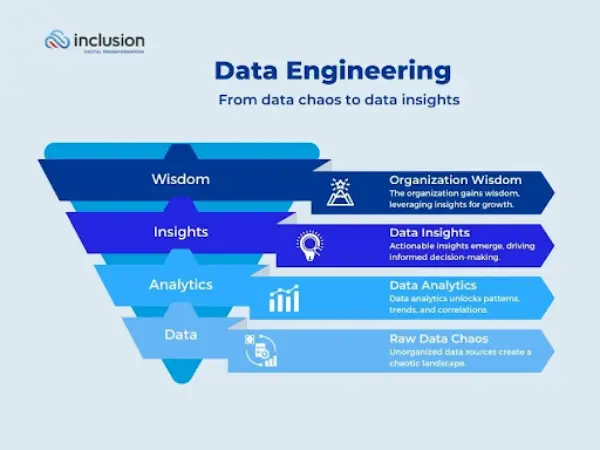
Data quality helps with accurate decision-making and insights. Data engineering ensures quality through rigorous validation across key dimensions:
Modern data observability enables monitoring of freshness, volume, and distribution shifts, akin to DevOps monitoring uptime. One e-commerce firm deploying real-time data quality frameworks cut dashboard incidents by 85 percent, boosting user trust.
Data governance is also crucial: policies for master and reference data, and clear ownership across departments. Without it, shadow data marts with conflicting definitions arise, creating silos. Treating governance as a priority, data engineering supports reliable data pipelines for analysis.
The design of data infrastructure and architecture in the initial year of an analytics program greatly impacts reliability and costs over the next five years. Data architectures are scalable and efficient and handle growth without failure.
Compare an ad hoc approach where analysts run direct queries, upload CSVs manually, and create transforms in BI tools with a deliberate setup using cloud data warehouses, standardized pipelines, and role-based access controls. The former leads to data chaos; the latter enables scalable, usable data.
Reliability is ensured through redundancy across availability zones, idempotent pipelines preventing data corruption on retries, robust retry strategies, and automated lineage tracking to identify report dependencies. Database management, data protection, and retention policies support smooth operations.

Successful AI analytics models and executive dashboards have one thing in common: dependable data. They all rely on well-built data pipelines and disciplined data management. Data architectures enable organizations to make data-driven decisions by providing reliable data to every consumer.
Good data engineering reduces friction for experimentation. New data points, metrics, or features can be added quickly because ingestion, integration, and storage patterns are standardized. Without dedicated data architectures, organizations end up with siloed shadow data marts maintained by individual teams, undermining data integrity and compliance. SoftDoes pairs data engineers with data scientists and analytics engineers from day one on transformation and modeling projects.
Choosing a data engineering partner involves far more than comparing technology stacks. Guide your evaluation by reviewing concrete artifacts from potential vendors: architecture diagrams, pipeline designs, and incident postmortems from past data analytics projects. Focus on how they handle complex data environments rather than polished presentations.
A mature partner offers a phased roadmap:
Ensure the vendor’s engineers have experience with both legacy integrations and cloud data infrastructure. Look for skills in orchestration, observability, schema management, and storage best practices.
As VentureBeat has reported, misaligned tech stacks and rushed data lake projects frequently create “data swamps,” which underscores the value of deliberate architectural choices and managing data with discipline.
Reliable analytics is an ongoing collaboration between internal teams and external data engineering partners. Treat your data architecture solutions as living systems requiring continuous attention.
Transparent cost models are vital. A good partner proactively shares cloud consumption, licensing, and support fees, identifying optimization opportunities instead of simply adding workloads. This transparency helps avoid cost surprises that can derail analytics programs.
A robust post-launch maintenance plan should include SLAs for data freshness, error budgets for pipeline failures, regular schema reviews, and quarterly platform health checks. As ZDNET has reported, outages and data breaches frequently stem from neglected maintenance and unclear ownership, reinforcing why these agreements matter.
SoftDoes ensures long-term support for data platforms by combining automated monitoring with a dedicated data engineer familiar with the client’s business. This approach guarantees accurate data flow despite evolving source systems, providing business users with reliable data for reporting and analysis.
Reliable analytics isn’t created by better dashboards alone. It emerges from intentional data engineering across data collection, integration, transformation, storage, governance, and ongoing operations. Every step in the data lifecycle matters.
Here is a practical roadmap for organizations starting soon:
Success requires experienced data engineers, disciplined governance, and strong partnerships. Organizations investing in solid data architectures today will be ready for the next wave of AI and automation. The question is not if you need reliable data pipelines, but if you can afford to wait.
It’s the process of designing and maintaining systems that collect, clean, transform, store, and deliver reliable data for analytics, reporting, and AI applications.
It ensures information is accurate, consistent, and readily available, allowing organizations to make confident business decisions.
It builds the infrastructure that prepares and manages data, while data analytics examines that data to uncover trends, answer business questions, and support decision-making.