“Design is not just what it looks like and feels like. Design is how it works.” – Steve Jobs (American businessman, investor, and inventor)
You may have a disruptive idea and caffeine to execute, but flawless code alone won’t save you in 2026. In a hyper-saturated market, users now demand intuition and not just function. If your UX feels like a chore, you are done!
Finding the right design partner is not just a task; it’s a survival strategy that you need to pay attention to.
Key Takeaways
- The best agencies challenge your assumptions to build a better product.
- In 2026, UX is a core retention strategy, not decoration.
- Make sure that your agency builds a design system, not just screens.
- Select an agency that understands your specific startup stage, as context is the king (Seed vs Scale-up)
The era of ‘good enough’ is long gone; 2026 is the era of the AI-driven and hyper-personalized interfaces. If users hesitate, you’ve lost them. A strong UX strategy eliminates churn and cuts development by fixing logic errors before coding actually begins. In 2026, high-tier design is your main competitive differentiator.
Many founders have the tendency to consider design agencies for vending machines and laying emphases on ‘Dribble-appeal’ over problem-solving. You can avoid this by ensuring seamless communication through Slack or Jira and defining clear success metrics. Even a beautiful project becomes useless if the users are unable to navigate it.
So, how do you go through the noise? You need a partner who speaks ‘startup,’ not just ‘art.’
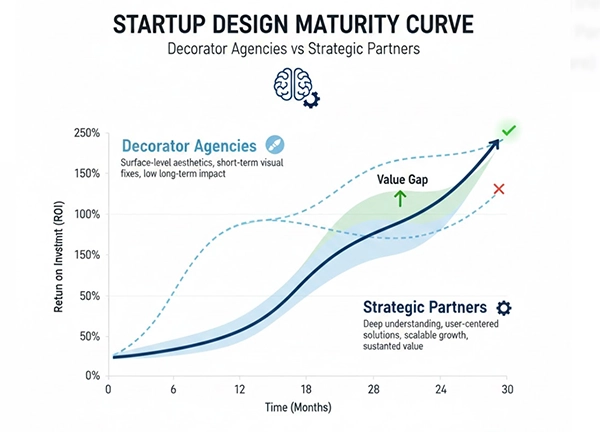
Do not run after pixel pushers; you need a product strategist. You need to select agencies that challenge your assumptions and align every pixel with your business goals.
Agencies such as Gaspy Studio stand out because they treat design as a business tool, ensuring that every interface decision drives conversion and retention instead of just looking sleek.
Did You Know?
Every $1 invested in UX, the Return on Investment (ROI) can go upto $100. Fixing an issue in design is 10x cheaper than fixing a problem in development.
If an agency skips research to save time, it is your cue to run. In 2026, assumptions are expensive. A top-tier design (UI/UX) agency for early-stage startups will insist on talking to your potential users. They must use heatmaps, interviews, and A/B testing to validate the hypothesis before they exhaust their runway.
Scalability is the key! If your agency provides you with a set of static screens without a component library, they have set you up for technical debt. You need a design system that allows your developers to build faster and ensures consistency as you scale from MVP to Series A.
Pair up your agency with your growth stage: Pre-Seed needs speed, while Series B requires optimization. Make sure that they thrive in your specific environment requirements, whether chaotic or structured. Your design partner should function as a strategic co-founder, not just a standard vendor.
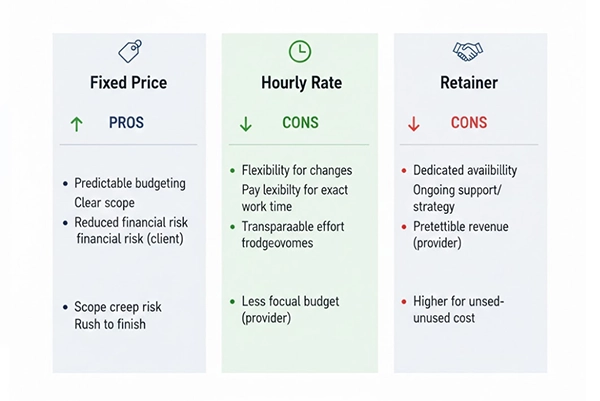
The pricing models consist of:
Fun Fact: In 2026, the average user decides whether they wish to stay on a new app or not in just 0.05 seconds; therefore, your first impression is literally a blink of an eye!
Do not just look at the hourly rate; you should look at the value. A cheap agency that takes twice as long is actually more expensive.
Selecting a design partner is a very crucial decision; it can either be a ‘make-or-break’ decision. Therefore, it is suggested that you look for a team that not only challenges you but also worries about your ROI as much as you do and goes into the data deeply.
In 2026, the best agency is not the one that says ‘yes’ to everything; it is the one that helps you build the right thing.
There’s no doubt that freelancers are cheaper, but it can also not be denied that agencies do offer a variety of skills, such as motion, UI, research, and reliability.
10 to 20% of your initial development budget should be allocated to design and research to avoid any further expensive code rewrites, as a general rule.
A dedicated MVP design sprint usually takes 4-8 weeks, based on the complexity.